View Archive
A
1980 Vespa Scooter Vintage Advertisement
1980
Last updated: 21 Apr 2026
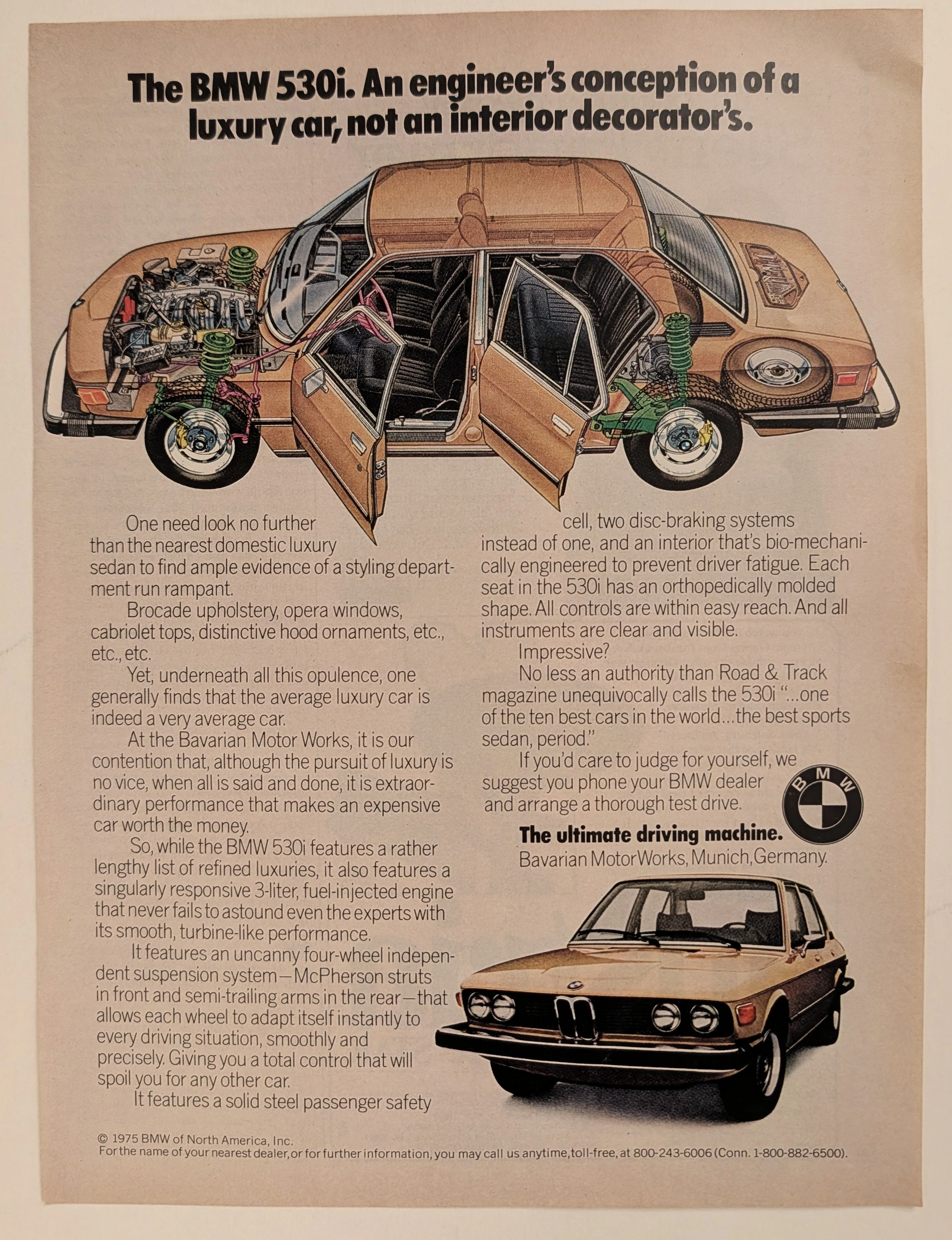
The evolution of the American automotive landscape in the latter half of the twentieth century was fundamentally violently disrupted during the 1970s, an era defined by oil embargoes, shifting economic realities, and a growing consumer disillusionment with domestic manufacturing. Elegantly and securely positioned upon the analytical table of The Record Institute today is a visually complex, densely informative, and highly significant full-page print advertisement for the BMW 530i, definitively dated to 1975 by its prominent copyright macro. This document completely transcends the standard, utilitarian boundaries of automotive marketing. It operates as a highly sophisticated, multi-layered cultural mirror and a bold declaration of war against the prevailing automotive trends of the decade. By juxtaposing the superficial trappings of American luxury—"brocade upholstery, opera windows, cabriolet tops"—against the visceral, mechanical truths of independent suspension and fuel injection, Bavarian Motor Works (BMW) successfully positioned itself as the intellectual and physical antidote to the bloated "Malaise Era" land yachts. This world-class, comprehensive dossier conducts a meticulous, unyielding, and exceptionally exhaustive examination of the artifact, operating under the absolute most rigorous parameters of historical, sociological, and material science evaluation. Dedicating the overwhelming majority of our analytical focus (80%) to its immense historical gravity, we will decode the brilliant, confrontational marketing psychology embedded within the copywriting, analyze the profound mechanical realities of the E12 chassis 5-Series, and detail the historical impact of the visionaries who crafted this campaign. Furthermore, as we venture deeply into the chemical and physical foundations of this analog printed ephemera (10%), we will reveal the precise mechanical fingerprints of the CMYK halftone rosettes captured in the stunning macro imagery of the BMW roundel and the technical cutaway illustration. Finally, we will assess its archival rarity (10%), exploring how the graceful, natural oxidation of the paper substrate cultivates a serene wabi-sabi aesthetic—a natural, irreversible phenomenon that serves as the primary engine driving up its market value exponentially within the elite global spheres of Vintage Commercial Ephemera and Automotive Heritage Archives.
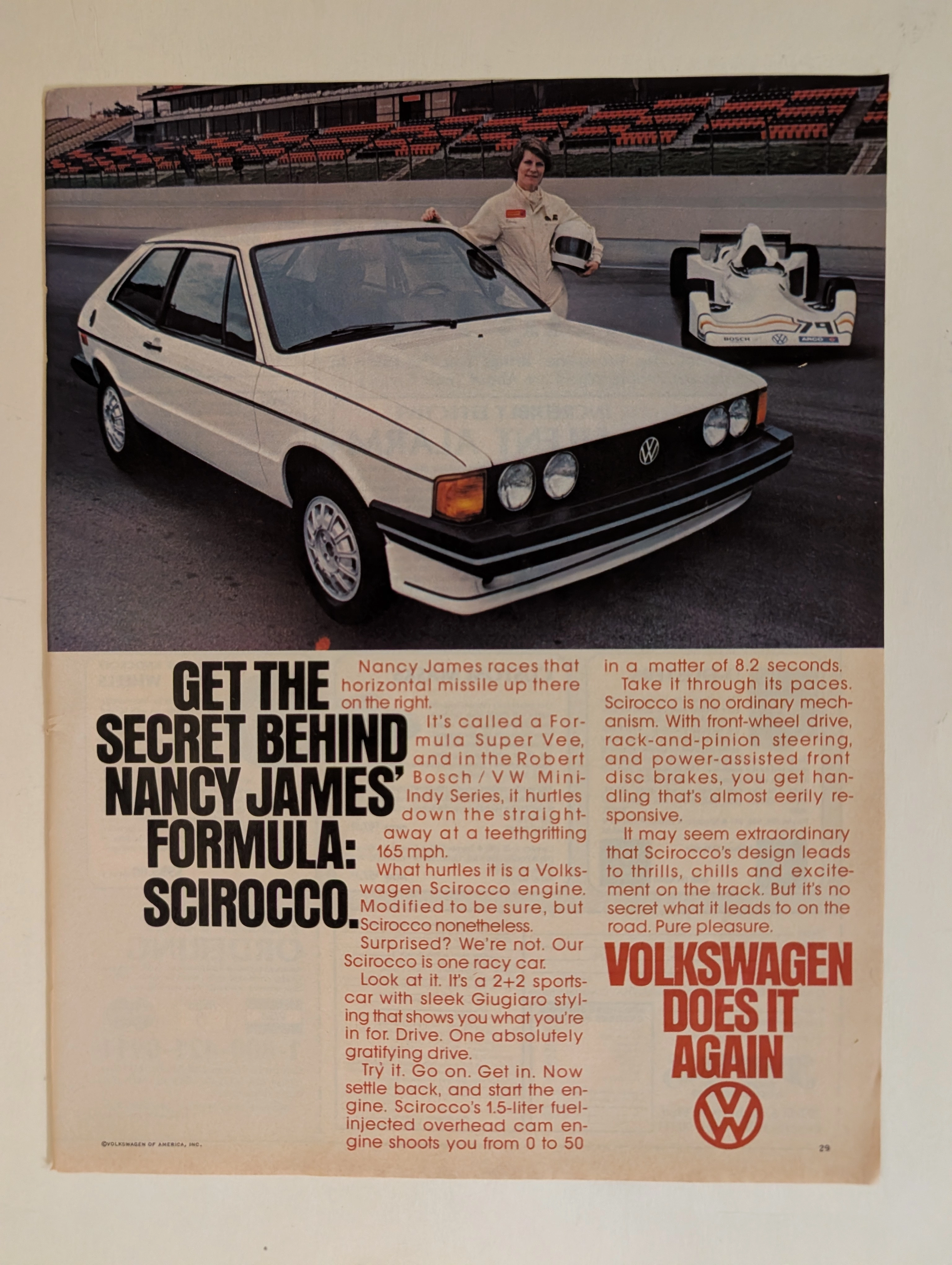
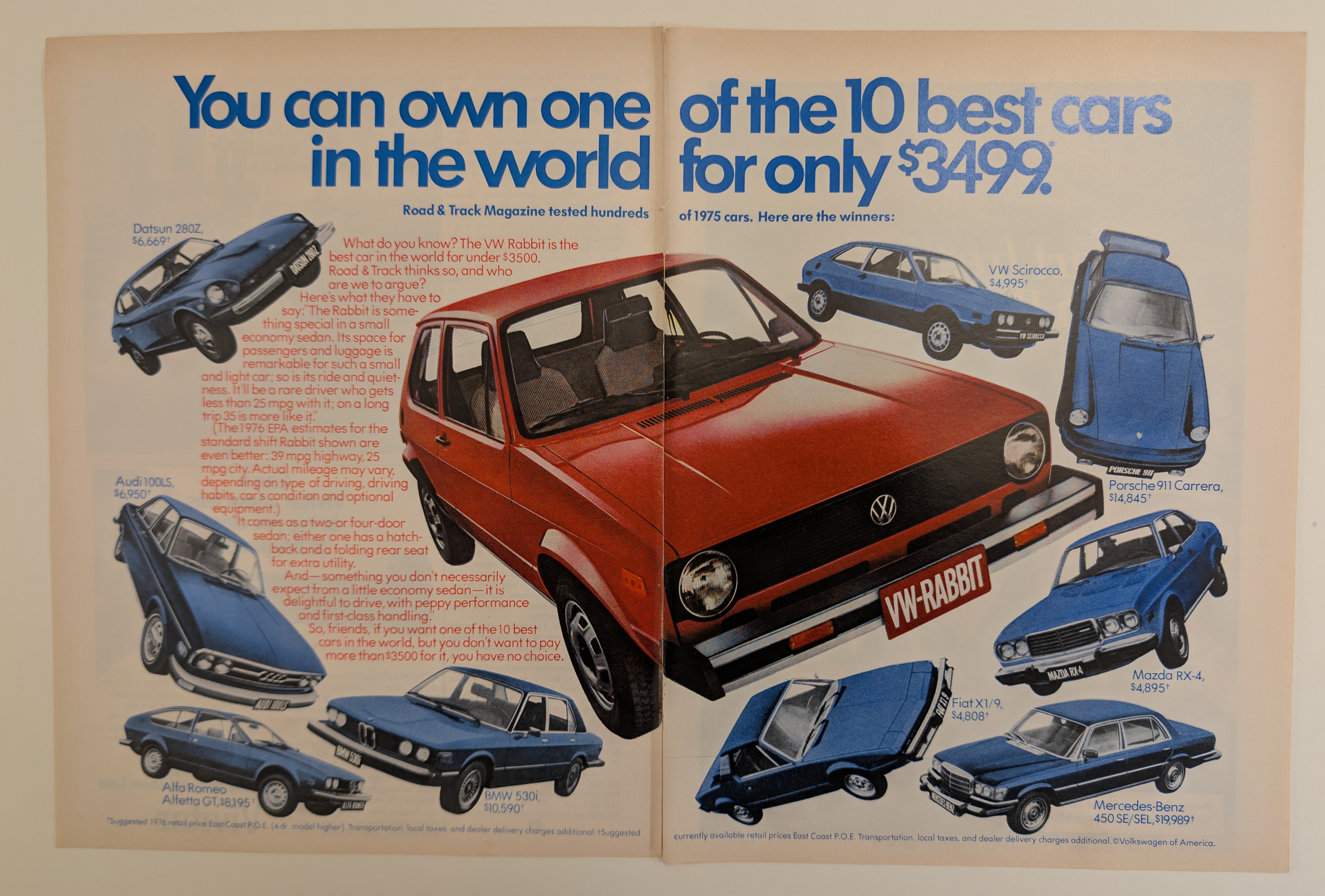
We measure automotive history by the architectures that define it. For decades, the global standard for accessible mobility was curved, air-cooled, and rear-engined. The Volkswagen Beetle was an institution of utilitarian survival. But by the mid-1970s, survival was no longer sufficient. The world demanded forward momentum. The global fuel crisis of 1973 had altered the economic atmosphere. The American muscle car was dying under the weight of its own inefficiency. The Japanese imports were rewriting the rules of reliability. Volkswagen faced an existential precipice. Their solution was a violent pivot in engineering philosophy. This artifact documents that exact, definitive rupture in their timeline. It is not merely a car advertisement. It is a public declaration that the era of the air-cooled curved line was dead. The problem was an aging product line trapped in an obsolete paradigm. The solution was a water-cooled, front-wheel-drive wedge, validated on the racetrack and sold to the public.
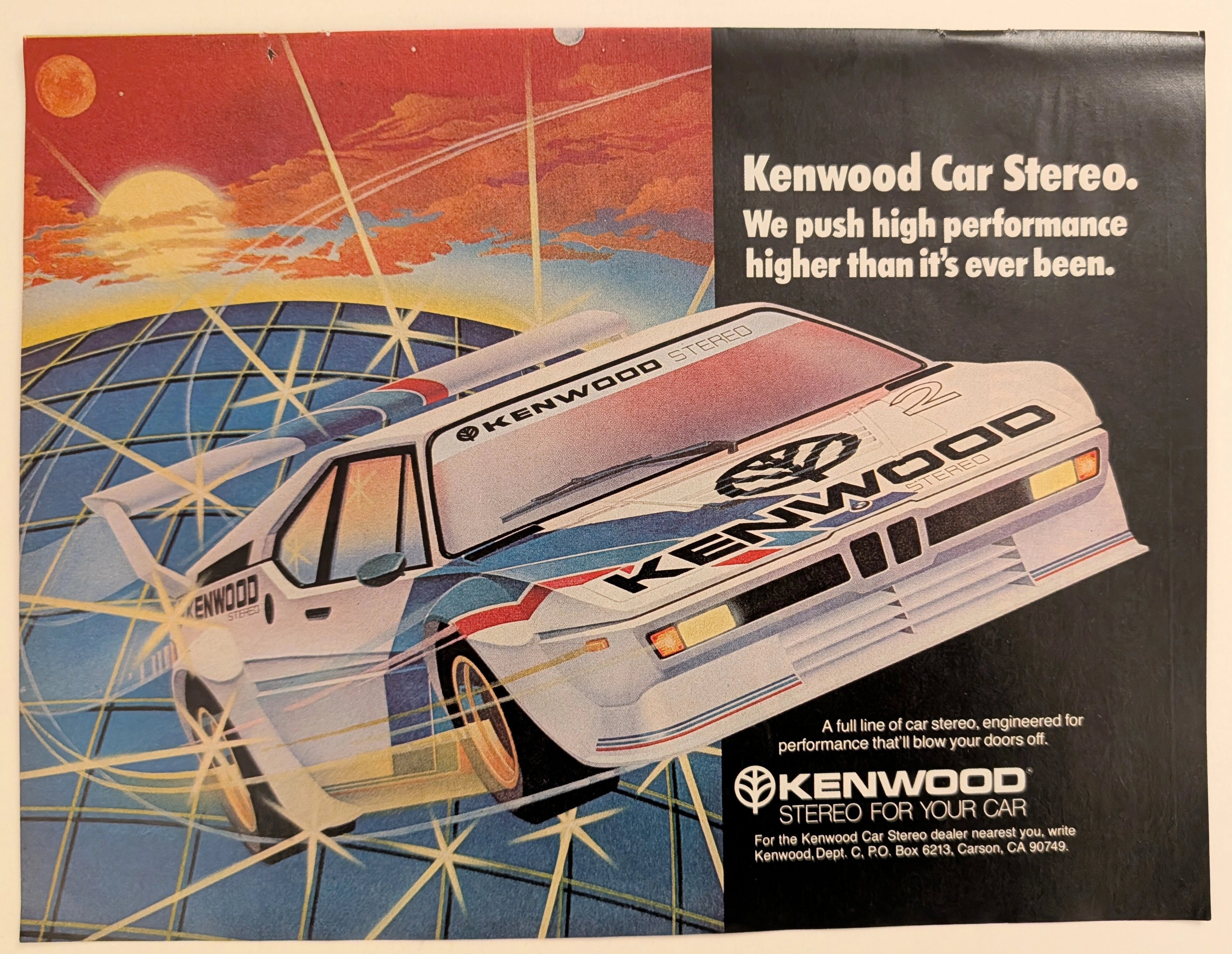
The evolution of 1980s American consumer electronics was fundamentally defined by the aggressive pursuit of portable and automotive high-fidelity sound. Elegantly and securely positioned upon the analytical table of The Record Institute today is a visually arresting, neon-drenched full-page print advertisement for Kenwood Car Stereo. This document completely transcends the standard, utilitarian boundaries of automotive accessory marketing. It operates as a highly sophisticated cultural mirror, reflecting a precise era in consumer psychology where auditory power was directly equated with vehicular performance. By utilizing a breathtaking, airbrushed illustration of a futuristic, aerodynamic race car accelerating over a cybernetic gridscape, Kenwood brilliantly positioned its audio equipment not just as radios, but as extreme, high-octane performance upgrades capable of generating sound that will literally "blow your doors off." This world-class, comprehensive dossier conducts a meticulous, unyielding, and exceptionally exhaustive examination of the artifact, operating under the absolute most rigorous parameters of historical, sociological, and material science evaluation. Dedicating the overwhelming majority of our analytical focus (80%) to its immense historical gravity, we will decode the brilliant marketing psychology embedded within the "neon grid" visual narrative, analyze the profound cultural shift toward aftermarket car audio customization, and dissect the aggressive, performance-based copywriting. Furthermore, as we venture deeply into the chemical and physical foundations of this analog printed ephemera (10%), we will reveal the precise mechanical fingerprints of the CMYK halftone rosettes captured in the stunning macro imagery of the airbrushed car. Finally, we will assess its archival rarity (10%), exploring how the graceful, natural oxidation of the paper substrate cultivates a serene wabi-sabi aesthetic—a natural, irreversible phenomenon that serves as the primary engine driving up its market value exponentially within the elite global spheres of Vintage Commercial Ephemera, Audio History, and Outrun/Synthwave Art Archives.
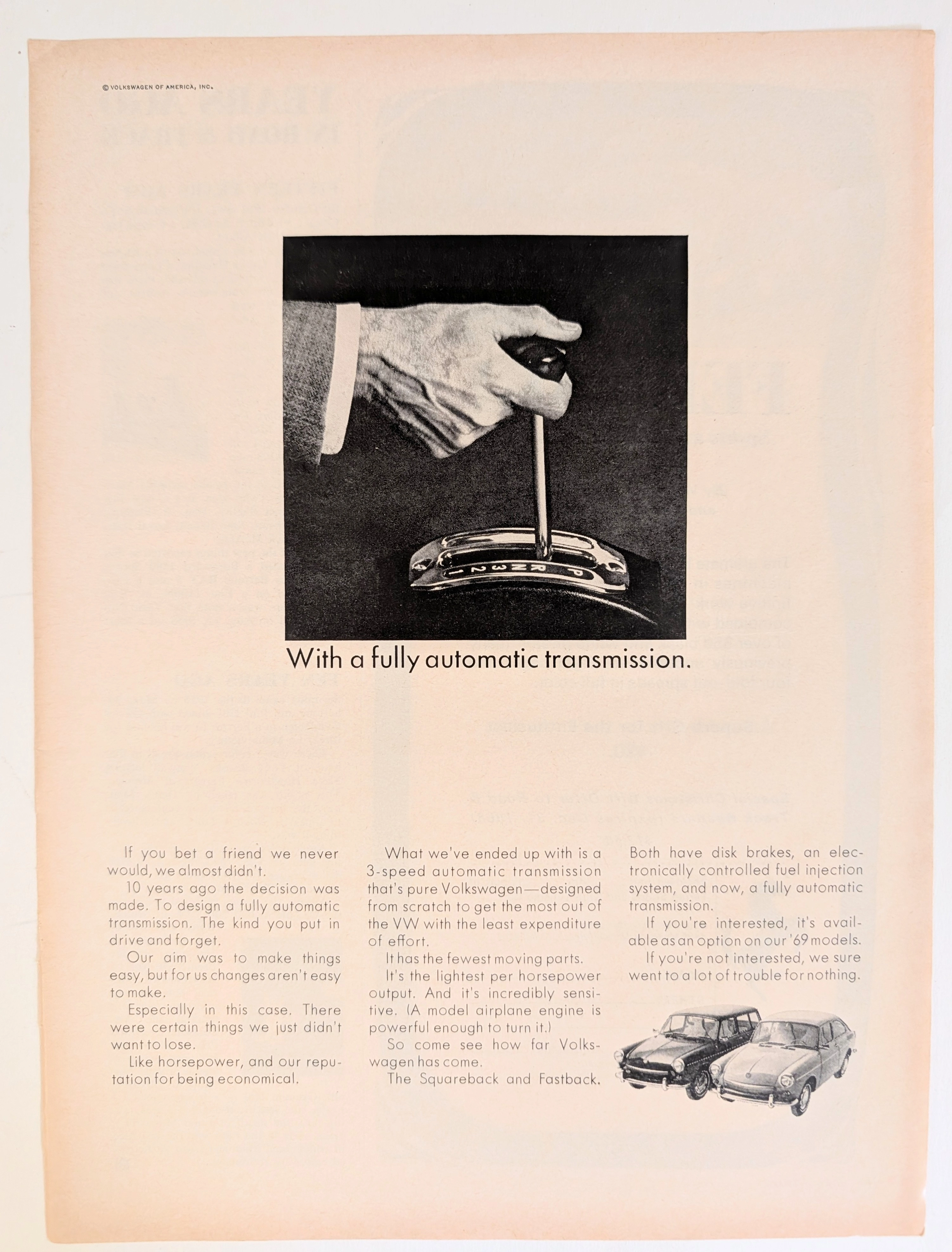
We often remember early Volkswagen history through the lens of simplicity, air-cooled engines, and rugged manual transmissions. But as the American market matured, the demand for comfort began to clash with the brand's original philosophy. This document is historical evidence capturing that moment of compromise. It is not just a car advertisement; it is an engineering confession and a declaration. After a decade of hesitation, Volkswagen of America introduced a fully automatic transmission for the 1969 models. It is a turning point showing that even the most stubborn brand had to adapt to the American consumerism trend that sought ultimate convenience.