THE TIME TRAVELER'S DOSSIER: OLD CROW - THE MYTHOLOGY OF AMERICAN BOURBON
The History
PART I: THE ARCHITECTURE OF MYTH-MAKING AND THE TITANS OF AMERICANA ]
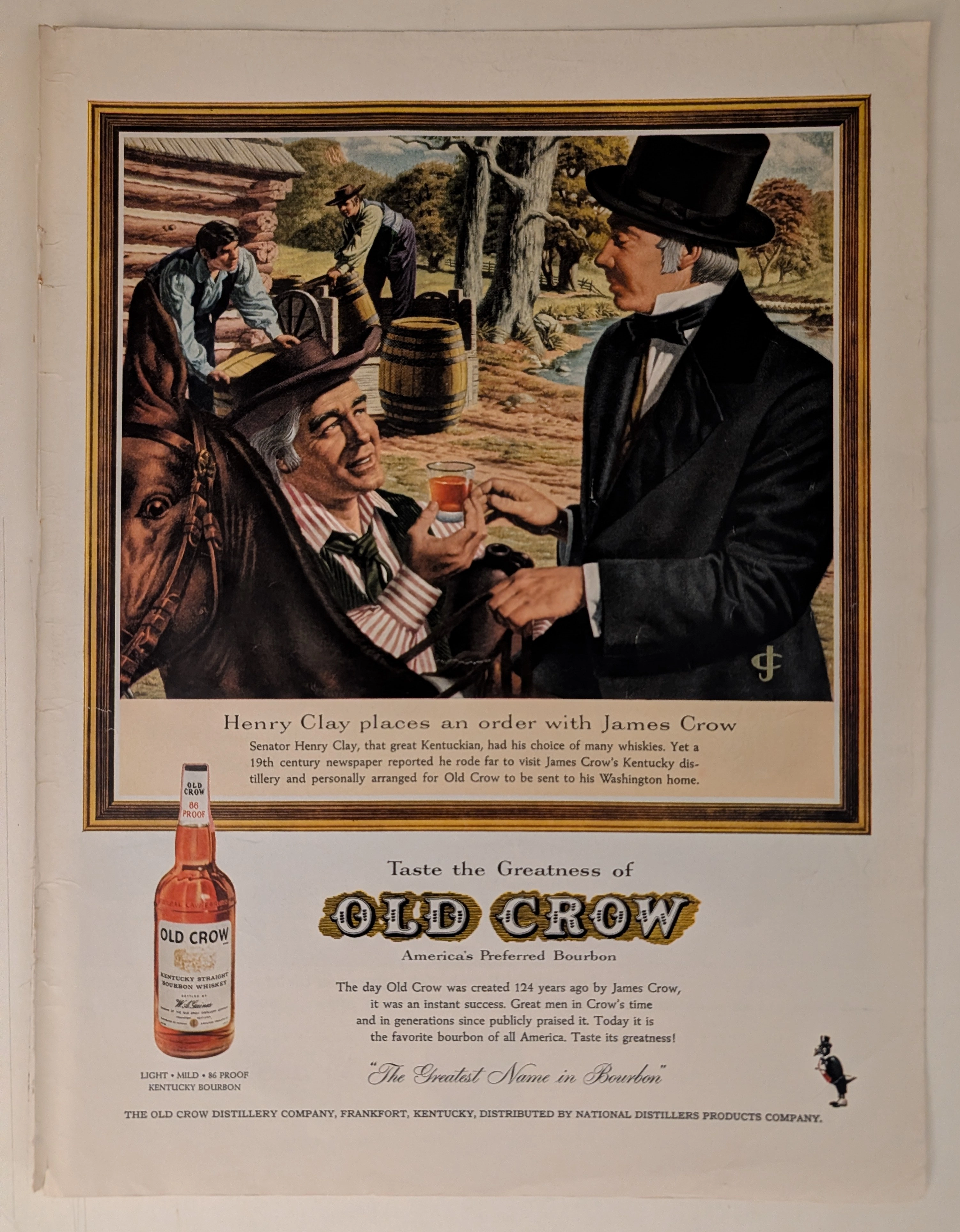
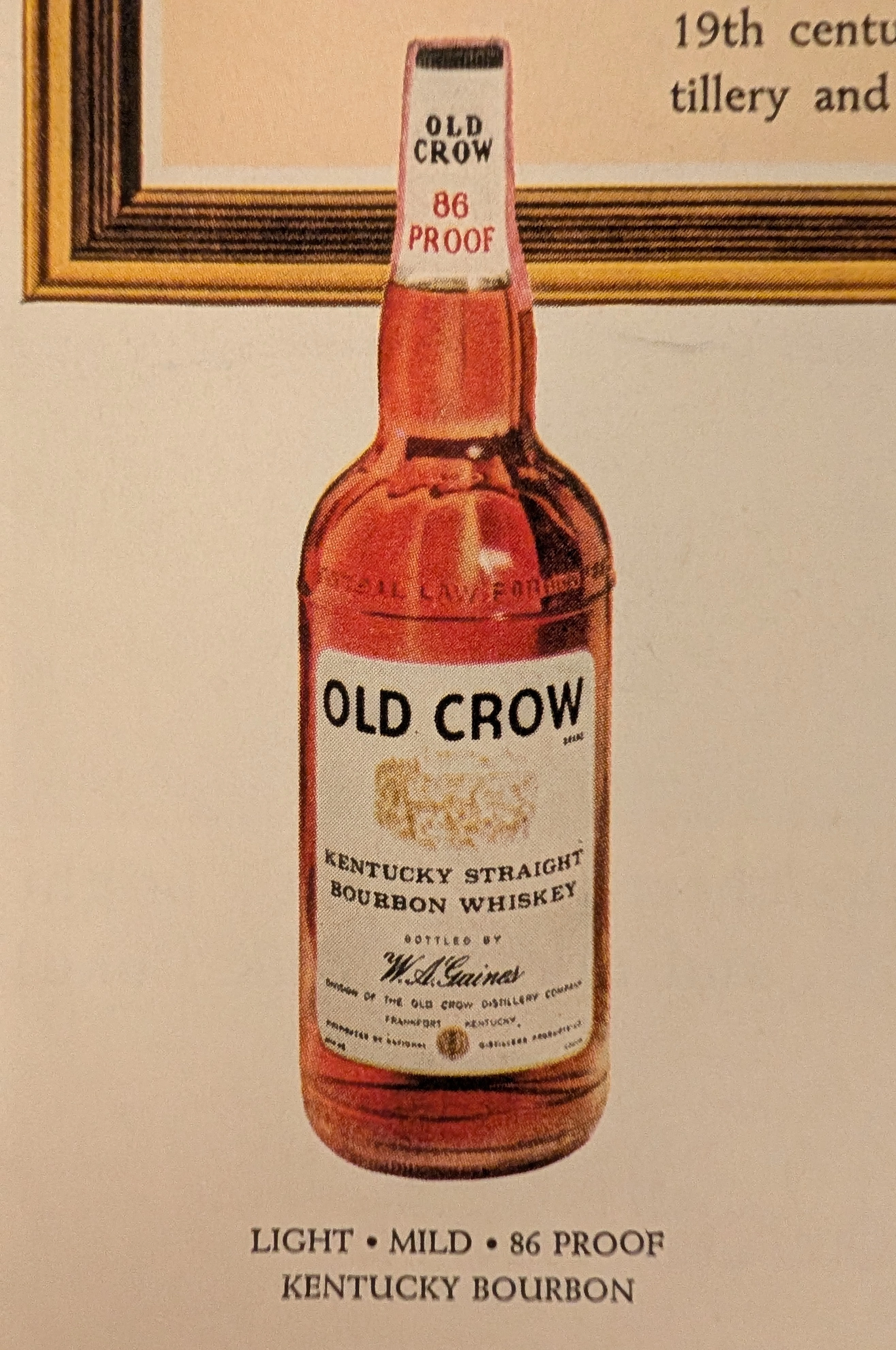
To merely glance at this document is a severe dereliction of curatorial duty; we must forensically interrogate its deep psychological intent. In the post-WWII era, America was booming, and the new middle and upper-middle classes were hungry for products that offered not just utility, but legacy. This advertisement is not merely selling alcohol; it is actively selling "history, class, and American royalty."
The copywriting, "Henry Clay places an order with James Crow," is a brilliant piece of social engineering that relies entirely on the historical weight of the figures depicted. We must understand who these men were to grasp the magnitude of the manipulation.
Senator Henry Clay (Left, on horseback): Known to history as "The Great Compromiser," Henry Clay was a political titan of the 19th century. He was a powerhouse statesman who represented Kentucky in both the U.S. Senate and the House of Representatives, serving as Secretary of State and running for President multiple times. He was the embodiment of American political elite and Southern aristocracy.
James Crow (Right, standing): He was a Scottish immigrant and a brilliant chemist who arrived in Kentucky in the 1820s. He is historically credited with revolutionizing the bourbon industry by introducing the "sour mash" process, bringing strict scientific rigor and consistency to what was previously a chaotic, unregulated distilling environment.
The imagery of a man of Clay's immense stature—a national leader—riding out personally to the frontier wilderness to order this specific liquor sends a deafening psychological broadcast to the mid-century reader: This is not a common drink. This bottle is the chosen spirit of the highest political elite, the architects of the nation, and those with impeccable, uncompromising taste. It is the ultimate act of borrowing heritage to cloak a modern mass-produced product in the undeniable, bulletproof armor of high social status.
[ PART II: FORENSIC MACRO DETAILS & THE PROHIBITION STAMP ]
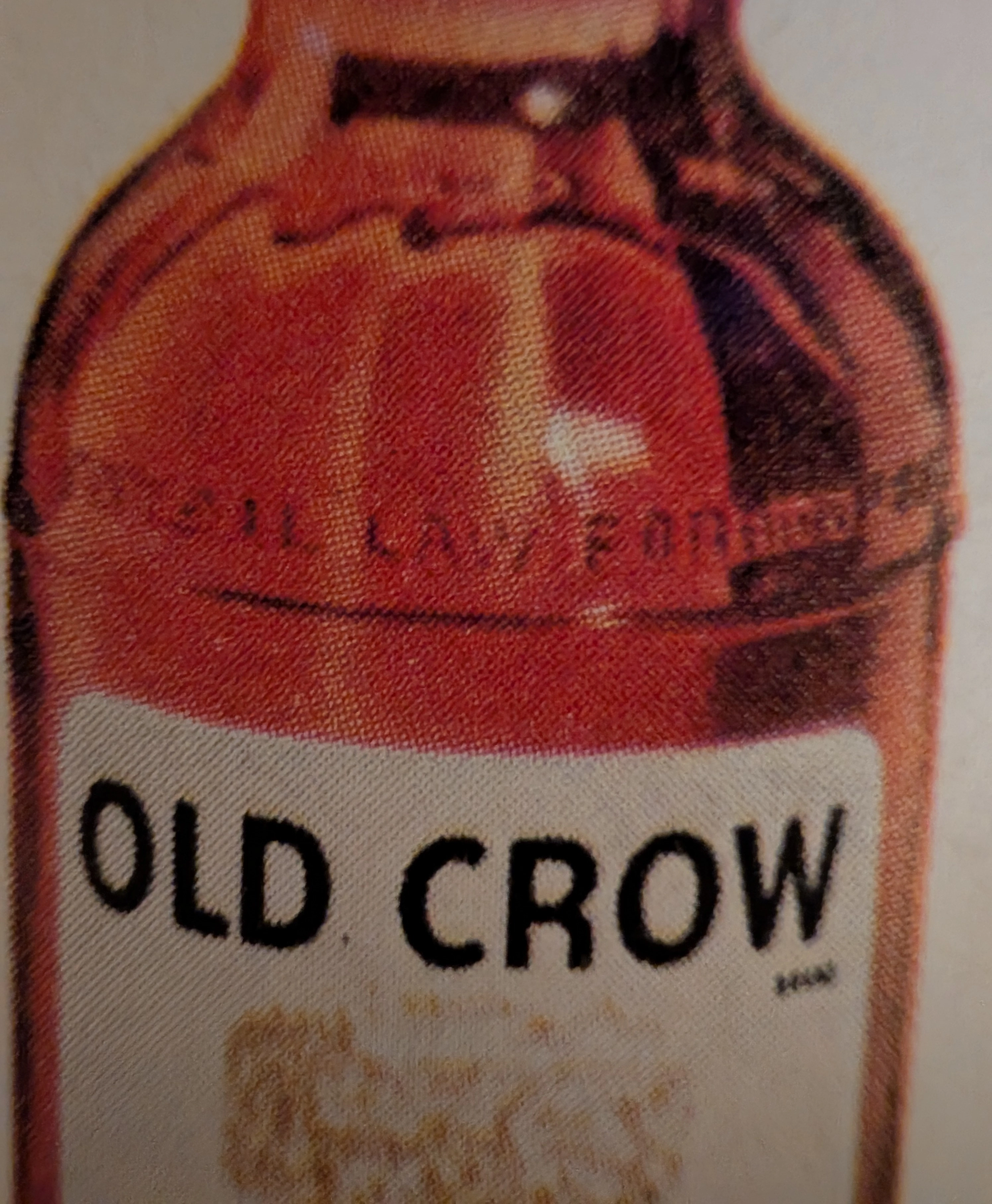
At The Record, our curatorial gaze does not stop at the surface; it penetrates down to the microscopic ridges of the glass and the woven threads of the canvas. Direct your attention to the extreme macro crop of the bottle's shoulder.
Here, the greatest historical secret of this artifact is laid bare. You can clearly see the text physically molded into the amber glass: "FEDERAL LAW FORBIDS SALE OR RE-USE OF THIS BOTTLE". This is not a mere design element; it is an absolute, undeniable forensic "Timestamp." This specific legal mandate was strictly enforced by the United States federal government following the repeal of Prohibition (the 21st Amendment) in 1935. The law was enacted to prevent bootleggers and illicit distillers from collecting empty bottles of premium brands, refilling them with cheap, dangerous moonshine, and reselling them to the public. This federal mandate remained in effect until it was officially lifted in 1964. The presence of this hidden, embossed text unequivocally dates the production of this advertisement's source imagery to the mid-20th century (circa late 1950s to very early 1960s). It is a physical scar of American legal history permanently stamped onto the product.
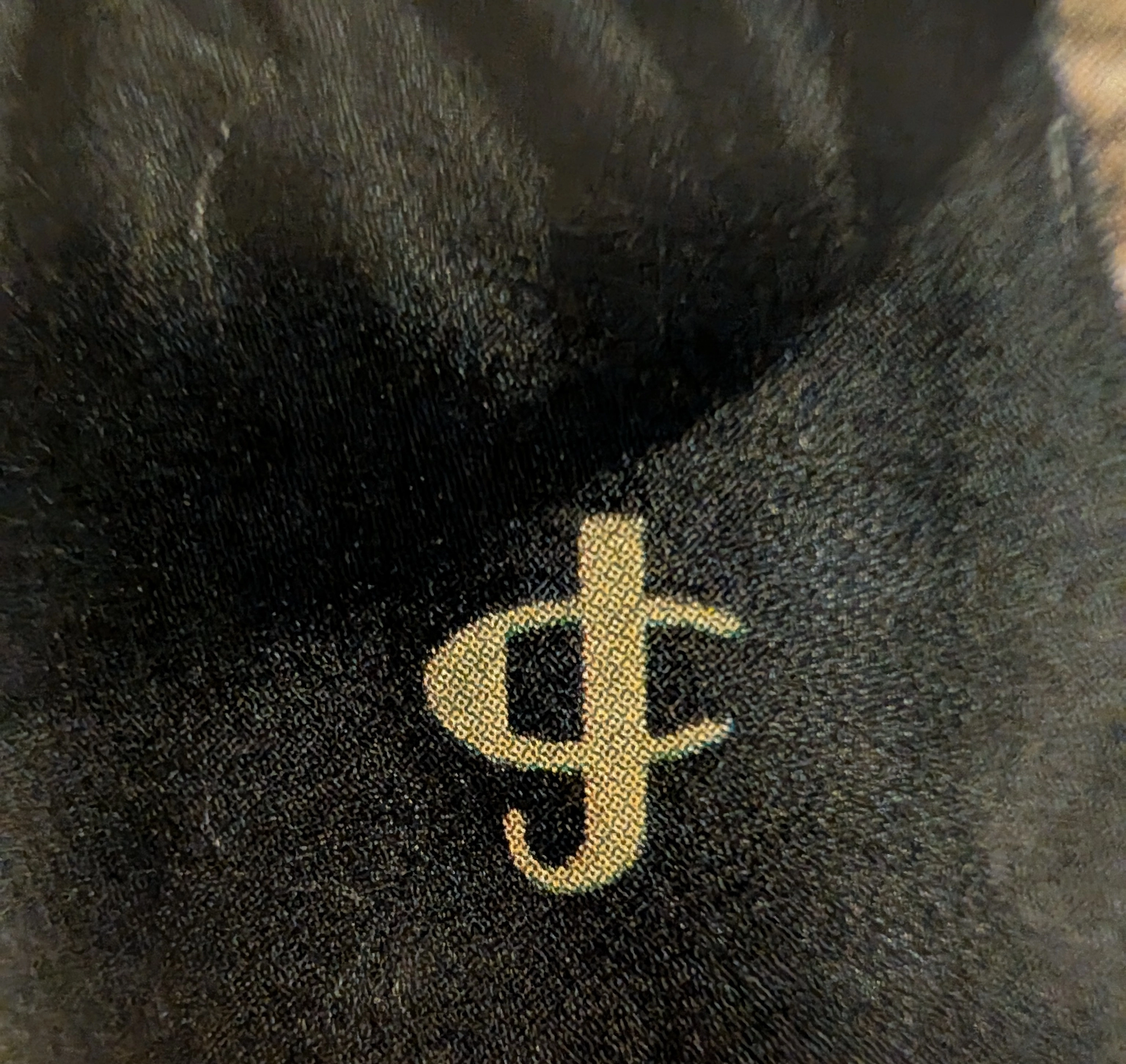
Furthermore, examine the breathtaking macro detail of James Crow's black coat. The artist has hidden a meticulously embroidered, glowing golden "JC" monogram on the fabric. This is a microscopic level of dedication to craftsmanship and brand identity in an era entirely devoid of digital graphics or zoom functions. The artist knew that 99% of readers would miss this detail, yet they painted it anyway, demonstrating a terrifying commitment to the perfection of the illusion.
The Paper
PART III: ARCHIVAL AND MARKET SIGNIFICANCE OF EPHEMERAL DECAY ]
The physical medium of this artifact is just as historically profound, if not more so, than the art it carries. We must maintain an absolute, uncompromising reverence for the inevitable, tragic, and spectacular beauty of analog destruction.
This artifact is not a modern poster reprint. It is an original, magazine-sized cut sheet. This specific format is critical. This high-quality page was designed for disposable, immediate consumption. Examine the extreme left edge of the canvas. You will notice a jagged, uneven, and violently torn perimeter running vertically from top to bottom. Amateurs and sterile perfectionists might view this as damage. At The Record, we view this as the "Scar of Liberation." It is the undeniable physical proof that this page was forcefully and purposefully ripped from the heavy metal staples of a thick, original publication decades ago. It was manually separated, cut out, and rescued from the incinerator of history by someone who recognized its artistic and cultural value.
More importantly, observe the surface of the paper itself. Over the course of nearly seven decades, ambient oxygen and ultraviolet light have waged a relentless, invisible chemical war against the paper's inherent wood-pulp lignin. This irreversible oxidation process has gracefully degraded the once-sterile, bright white background into a deep, warm, toasted Antique Ivory.
This slow, majestically tragic molecular death is precisely what drives the extreme market value of this artifact. This delicate, highly flammable, and chemically self-destructing sheet of analog paper is quietly burning itself alive. This is the profound Japanese aesthetic of Wabi-Sabi—the spiritual realization of finding absolute perfection in impermanence, flaw, and decay. No modern digital screen, no pristine reprint, can ever replicate the tactile fragility, the distinct olfactory signature of decaying pulp, or the authentic soul of this mid-century paper. In the global market of high-end ephemera, it is this very impermanence that elevates it from a piece of vintage commercial trash to a highly coveted, irreplaceable Primary Art Document. Its value increases exponentially precisely because it is slowly disappearing.
The Rarity
PART III: ARCHIVAL AND MARKET SIGNIFICANCE OF EPHEMERAL DECAY ]
The physical medium of this artifact is just as historically profound, if not more so, than the art it carries. We must maintain an absolute, uncompromising reverence for the inevitable, tragic, and spectacular beauty of analog destruction.
This artifact is not a modern poster reprint. It is an original, magazine-sized cut sheet. This specific format is critical. This high-quality page was designed for disposable, immediate consumption. Examine the extreme left edge of the canvas. You will notice a jagged, uneven, and violently torn perimeter running vertically from top to bottom. Amateurs and sterile perfectionists might view this as damage. At The Record, we view this as the "Scar of Liberation." It is the undeniable physical proof that this page was forcefully and purposefully ripped from the heavy metal staples of a thick, original publication decades ago. It was manually separated, cut out, and rescued from the incinerator of history by someone who recognized its artistic and cultural value.
More importantly, observe the surface of the paper itself. Over the course of nearly seven decades, ambient oxygen and ultraviolet light have waged a relentless, invisible chemical war against the paper's inherent wood-pulp lignin. This irreversible oxidation process has gracefully degraded the once-sterile, bright white background into a deep, warm, toasted Antique Ivory.
This slow, majestically tragic molecular death is precisely what drives the extreme market value of this artifact. This delicate, highly flammable, and chemically self-destructing sheet of analog paper is quietly burning itself alive. This is the profound Japanese aesthetic of Wabi-Sabi—the spiritual realization of finding absolute perfection in impermanence, flaw, and decay. No modern digital screen, no pristine reprint, can ever replicate the tactile fragility, the distinct olfactory signature of decaying pulp, or the authentic soul of this mid-century paper. In the global market of high-end ephemera, it is this very impermanence that elevates it from a piece of vintage commercial trash to a highly coveted, irreplaceable Primary Art Document. Its value increases exponentially precisely because it is slowly disappearing.
Visual Impact
The Visual Impact of this vertical canvas is a masterclass in establishing brand pedigree, historical weight, and unshakeable authority. The architectural layout of the page is brilliantly divided into two distinct, yet psychologically intertwined, realms.
In the upper framed painting, we are thrust into a dynamic, historically staged scene. We witness a direct interaction between two titans of American history set against the rustic, unforgiving backdrop of a 19th-century frontier distillery. The golden hour lighting cascading across the figures imbues the scene with a heroic, almost mythological warmth. The composition intentionally draws the viewer's eye to the center: the passing of the amber liquid, the physical transaction of quality.
Below this framed mythos sits the "modern" world (at the time of publication), featuring the Old Crow Bourbon bottle presented in stark, undeniable, and razor-sharp focus. The vast expanse of negative space surrounding the bottle and the elegant typography serves a deliberate psychological purpose: it isolates the product, elevating it from a mere consumer good to a priceless, untouchable artifact on display in a national museum. The contrast between the rugged painted past and the crisp, photographic reality of the bottle creates a bridge of unbroken lineage.
Exhibition Halls
The Archive Continues
Continue the Exploration
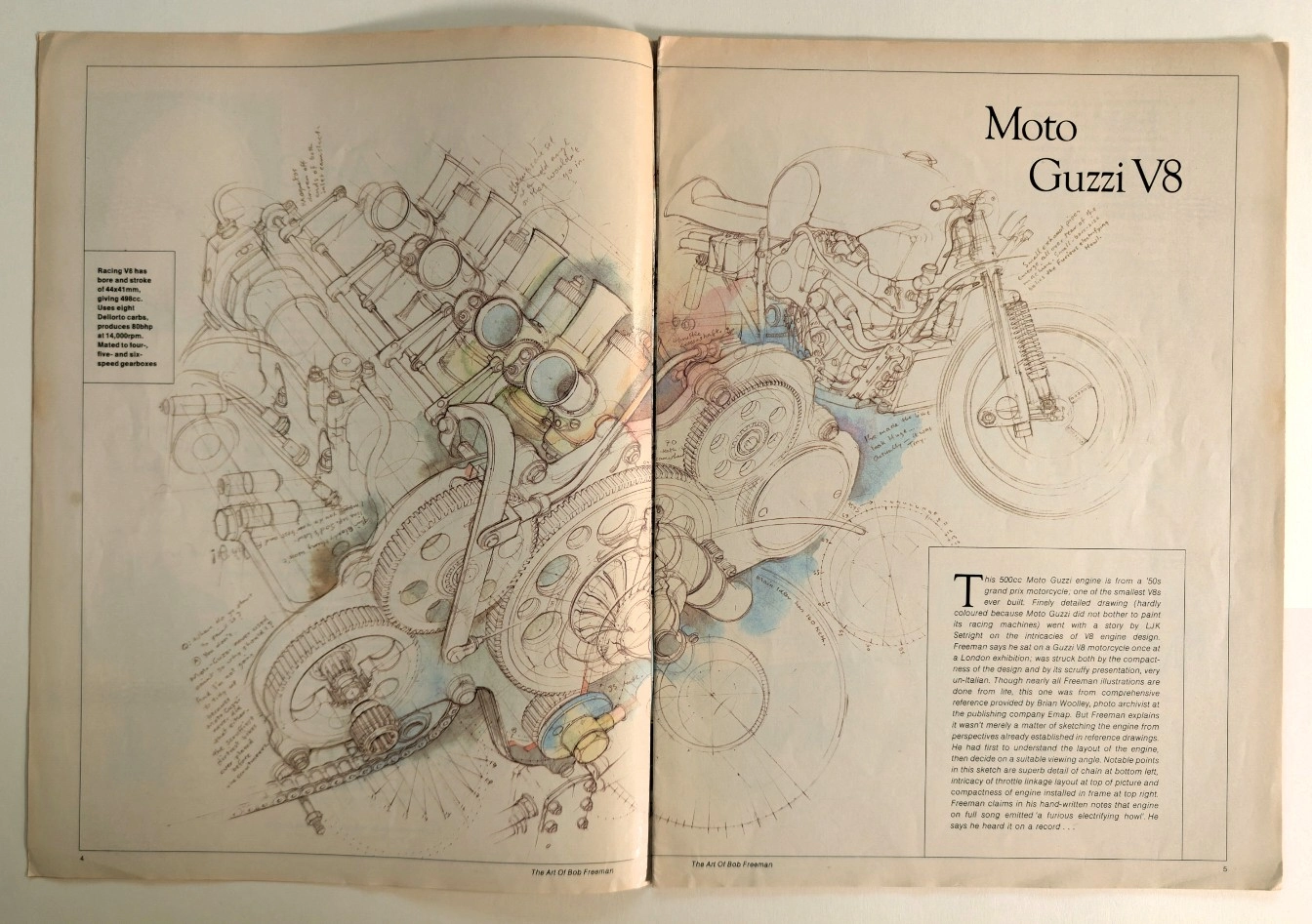
Anatomy of a Monster: The Moto Guzzi V8 Technical Masterpiece
Unearthing a rare technical illustration of the legendary Moto Guzzi V8 engine by Bob Freeman, preserved on naturally aged, pre-2000 analog print media.

Vargas Girl · Other
The Time Traveller’s Dossier: 1970s The Vargas Girl Vintage Illustration — The Ethereal Elegance of the American Pin-Up
Discover the captivating allure of the 1970s The Vargas Girl vintage illustration, a quintessential masterpiece of mid-to-late 20th-century editorial and commercial art. This exquisite piece transcends typical vintage ads by encapsulating the playful, sophisticated, and idealized sexuality that defined the era's publishing landscape. Featuring Alberto Vargas' legendary watercolor and airbrush technique, the illustration portrays an elegant, nude woman adorned with a delicate sun hat and a suggestive smile, perfectly punctuated by the flirtatious caption: "... And a pinch to grow on." It brilliantly illustrates how classic print ads and editorial features constructed a powerful narrative of liberated yet deeply romanticized femininity. For archivists, cultural historians, and collectors of old advertisements and pop-culture ephemera, this Vargas Girl stands as a definitive artifact. It not only highlights the artistic zenith of the American pin-up but also visually immortalizes a transitional era in publishing, making it a highly prized document in the history of commercial illustration.
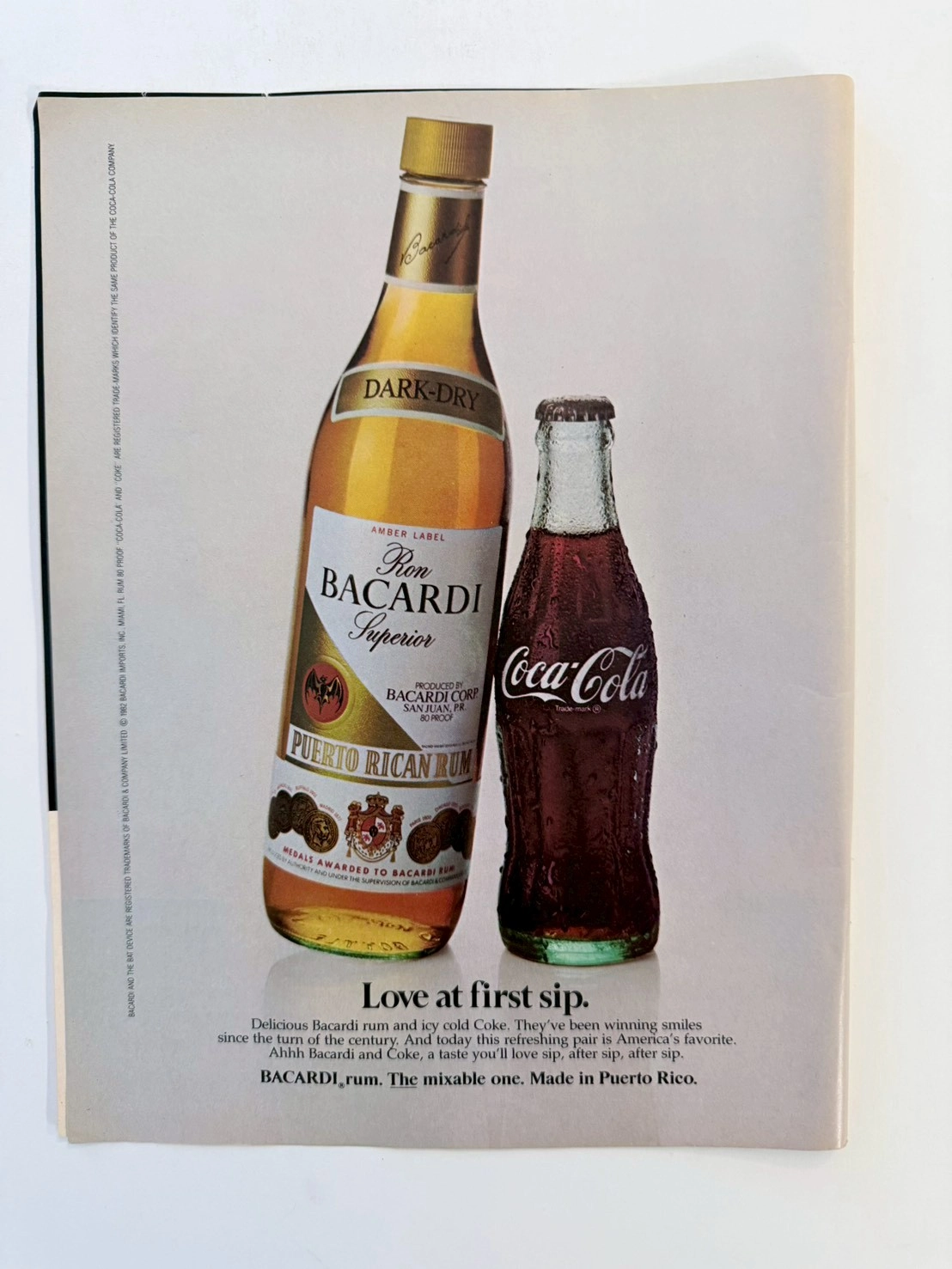
The Treaty of Two Empires: Deconstructing the 1982 Bacardi & Coca-Cola Vintage Ad (Class S)
Dive into the history of American consumerism with this museum-grade analysis of the iconic 1982 Bacardi and Coca-Cola co-branding advertisement. This Class S archival piece captures the definitive shift from the Golden Age of Illustration to 1980s commercial studio photography. Explore the geopolitical legacy of the "Cuba Libre" and the analog practical effects behind the immortal condensation on the Coca-Cola contour bottle.