THE TIME TRAVELER'S DOSSIER :THE BIRTH OF THE WIDE-TRACK — The Record Institute JournalTHE TIME TRAVELER'S DOSSIER :THE BIRTH OF THE WIDE-TRACK — The Record Institute JournalTHE TIME TRAVELER'S DOSSIER :THE BIRTH OF THE WIDE-TRACK — The Record Institute JournalTHE TIME TRAVELER'S DOSSIER :THE BIRTH OF THE WIDE-TRACK — The Record Institute JournalTHE TIME TRAVELER'S DOSSIER :THE BIRTH OF THE WIDE-TRACK — The Record Institute JournalTHE TIME TRAVELER'S DOSSIER :THE BIRTH OF THE WIDE-TRACK — The Record Institute Journal
1 / 6

✦ 6 Photos — Click any image to view in high resolution

March 12, 2026

THE TIME TRAVELER'S DOSSIER :THE BIRTH OF THE WIDE-TRACK

AutomotiveBrand: PontiacIllustration: Arthur "Art" Fitzpatrick and Van Kaufman (The legendary "Fitz and Van" duo)
Archive Views: 19
Heritage AdvertisementsTravel & Tourism

The History

[ PART I: THE BIRTH OF THE WIDE-TRACK ]
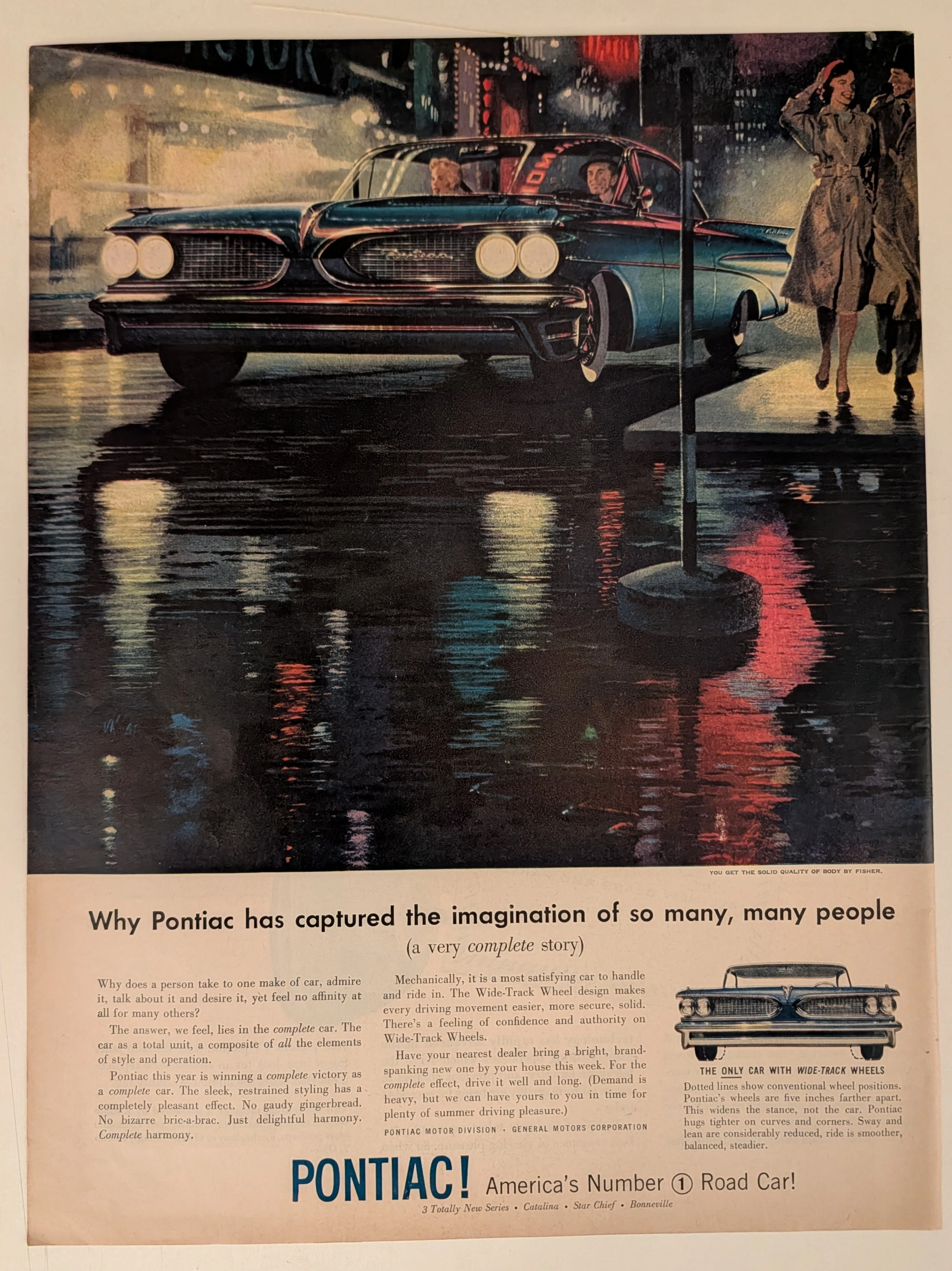
Welcome to the hushed, heavily guarded vaults of American industrial history. To merely glance at this document is a severe dereliction of curatorial duty; we must forensically interrogate its engineering and psychological intent. The year 1959 was "Year Zero" for Pontiac. Facing declining sales, General Motors executive Semon "Bunkie" Knudsen famously demanded that the brand shed its "grandma" image.

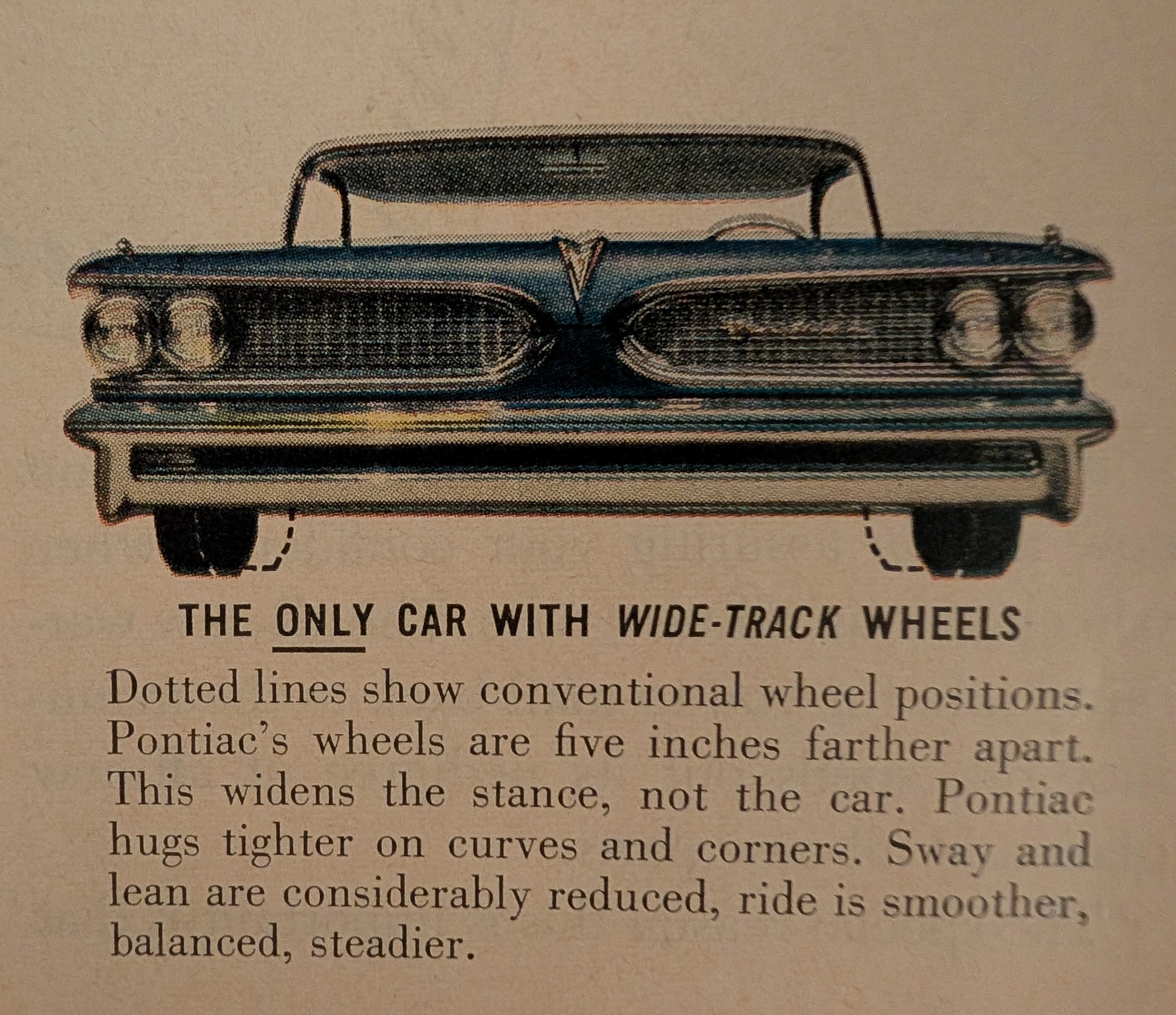
Direct your analytical focus to the lower right quadrant of the page. Here, the ad drops all poetic pretense and delivers a brutal, diagrammatic engineering flex: "THE ONLY CAR WITH WIDE-TRACK WHEELS." Pontiac literally pushed the wheels five inches further apart than conventional cars of the era. The text arrogantly explains the physics: "This widens the stance, not the car. Pontiac hugs tighter on curves and corners." This wasn't just a marketing slogan; it was a fundamental shift in chassis design that allowed Pontiac to dominate NASCAR and street performance for the next decade. The visual diagram, showing the conventional dotted lines inside the massive new track, is a piece of corporate propaganda designed to make every competitor's vehicle look instantly obsolete and dangerously unstable.

[ PART II: THE ILLUSION OF FITZPATRICK AND KAUFMAN ]
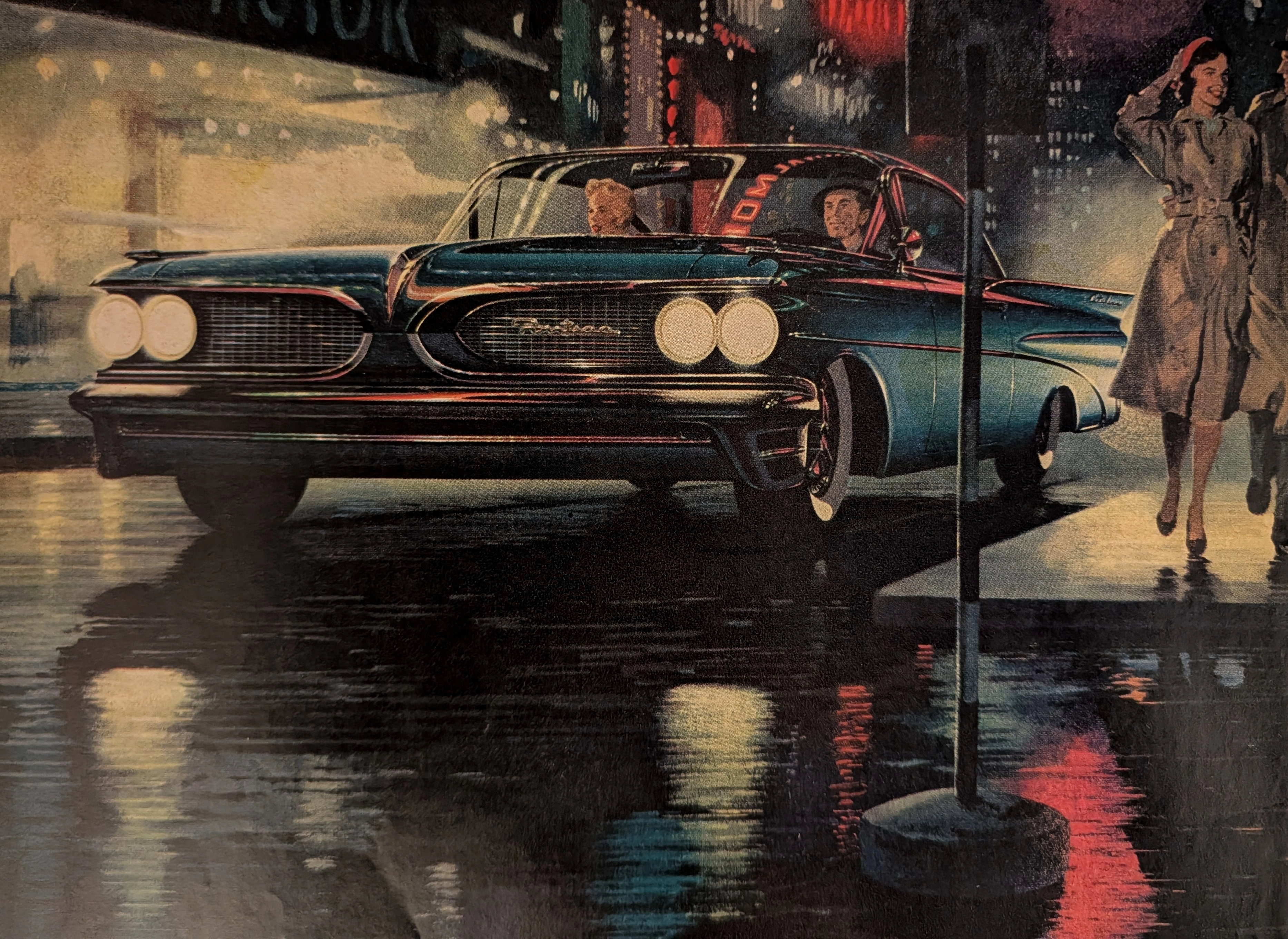
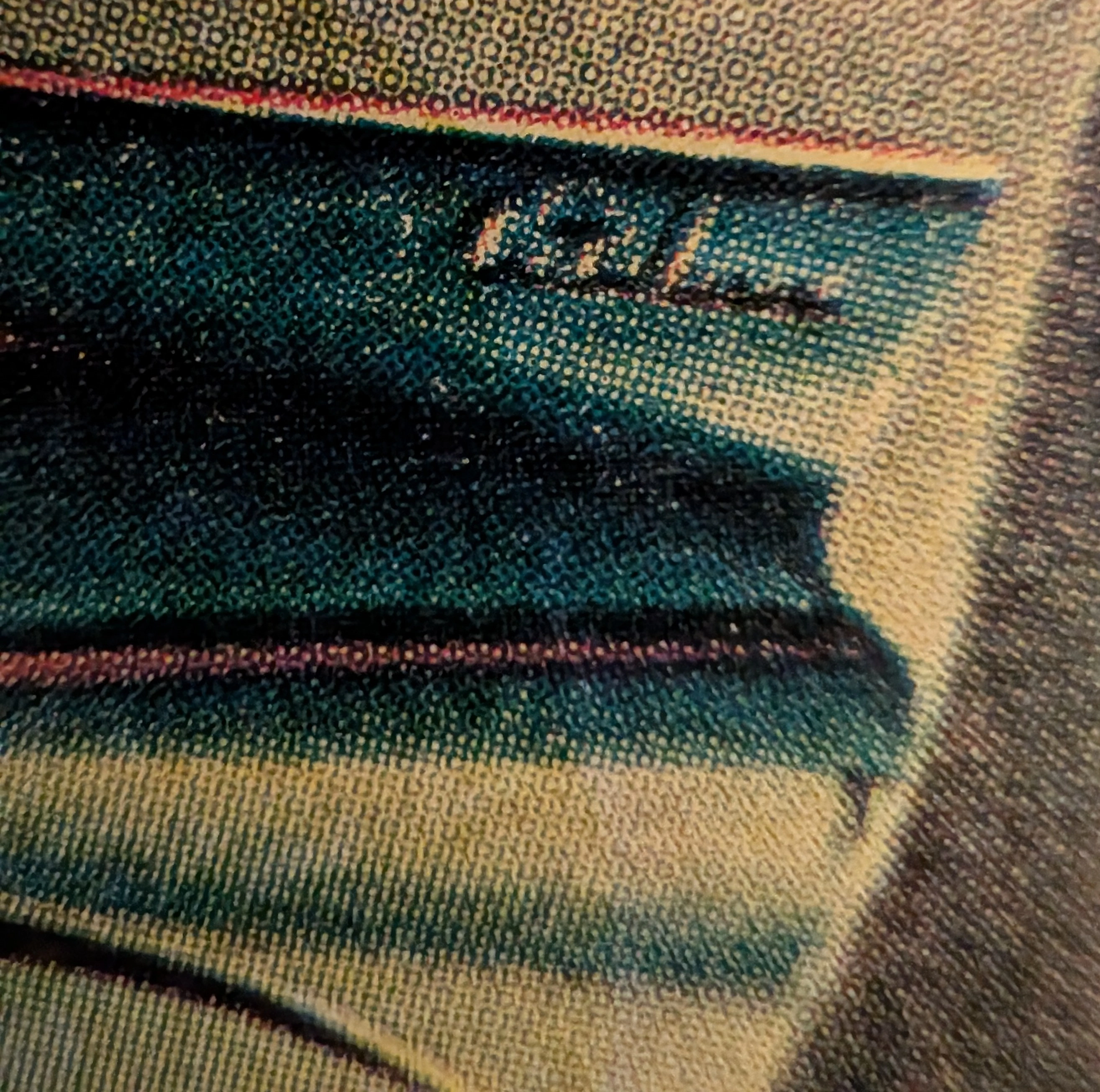
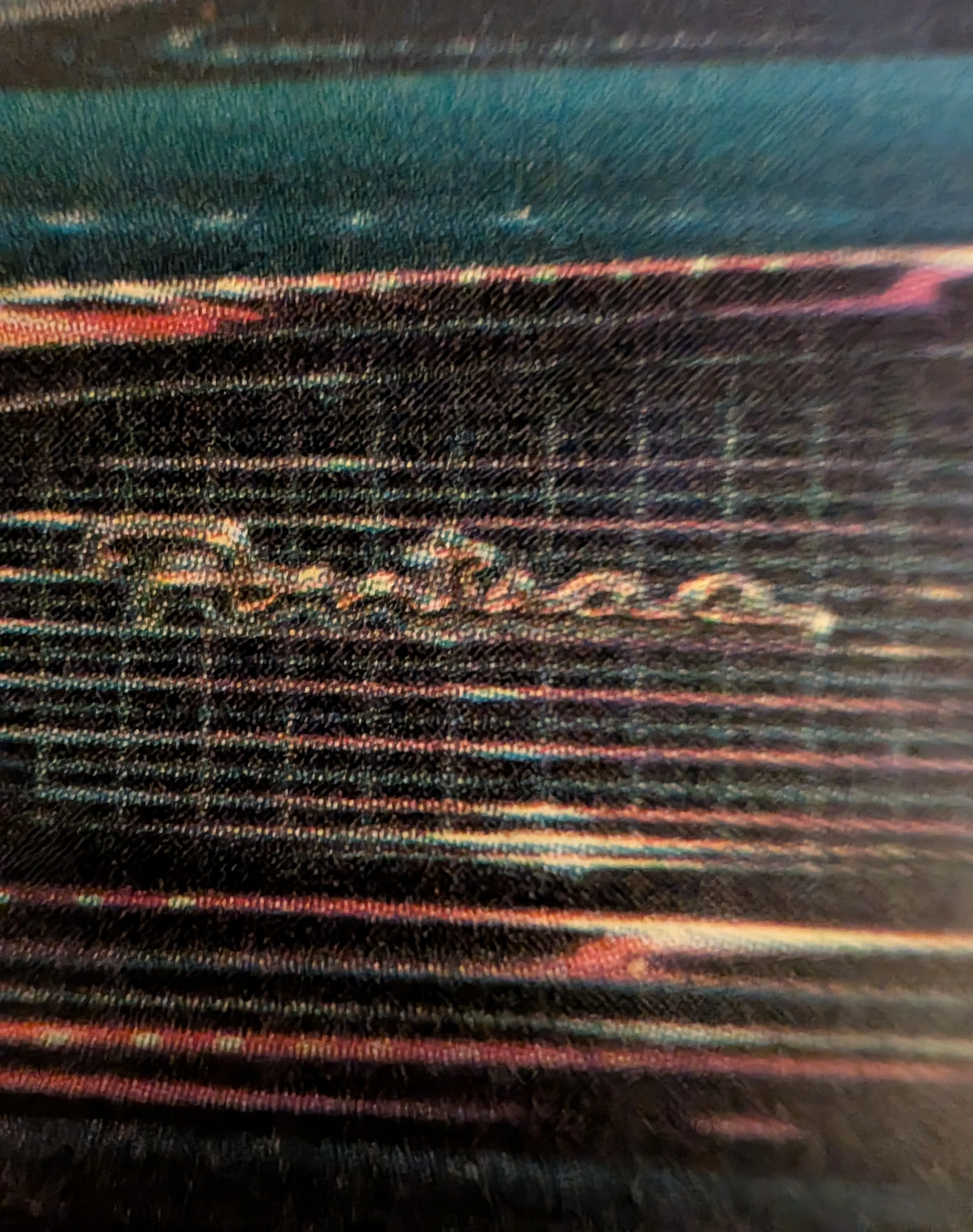
At The Record, our curatorial gaze penetrates down to the molecular level of the ink and the hidden hands that applied it. Examine the extreme macro crop of the car's teal flank.

Buried within the halftone dot matrix of the rainy reflections, you will find the clandestine, highly stylized signature of the artists (likely an intertwined "VK" for Van Kaufman or a variant of Fitz's mark). This signature represents the apex of commercial illustration. Art Fitzpatrick famously stated that he did not draw cars as they were; he drew them as people wanted them to be. He would cut apart photographs of the vehicles, stretch them, widen them, and lower the rooflines by inches to create an impossibly sleek, predatory silhouette. When you look at the split-grille and the delicate "Pontiac" script hovering in the steel mesh, you are not looking at a photograph of a car; you are looking at a masterfully engineered psychological weapon designed to trigger pure consumer lust.

[ PART III: THE CORPORATE HALLMARK — BODY BY FISHER ]
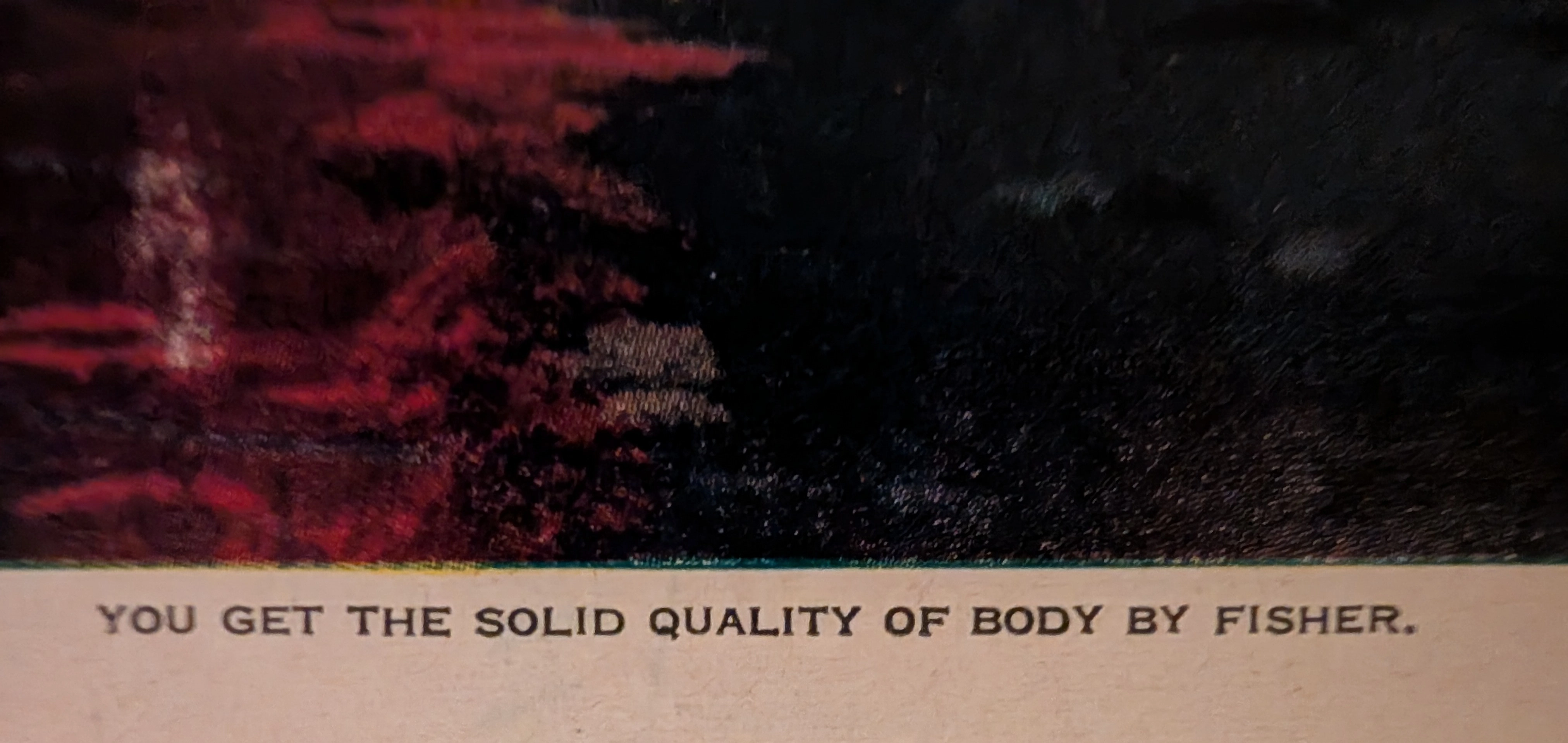
Direct your attention to the unassuming, microscopic text floating above the headline: "YOU GET THE SOLID QUALITY OF BODY BY FISHER".

This single line of text is a massive historical anchor. Fisher Body was the coachbuilding division of General Motors, an operation so powerful and prestigious that GM mandated its branding be explicitly featured on all their vehicles. In the 1950s, the "Body by Fisher" emblem was synonymous with heavy-gauge Detroit steel, rattling-free construction, and impenetrable safety. By placing this text underneath a scene of a dark, rain-swept city, Pontiac is sending a subconscious message of survival and protection. It tells the buyer: No matter how harsh the world outside gets, you are safe inside our steel

The Paper

The physical medium of this artifact is just as historically profound as the artwork it carries. At The Record, we maintain absolute, uncompromising reverence for the inevitable, tragic beauty of analog destruction.

This is a mass-market magazine print, explicitly designed by its publishers for immediate, disposable consumption. The highly acidic wood-pulp paper utilized in 1959 harbored a fatal chemical death sentence within its very fibers from the millisecond it rolled off the roaring offset printing presses.

Observe the surface of the paper itself. Over nearly seven decades, ambient oxygen and ultraviolet light have waged a relentless chemical war against the paper's inherent lignin. This irreversible oxidation process has birthed a magnificent, undeniable "patina." The once-sterile white borders have gracefully degraded into a warm, toasted Antique Ivory, while the typography softens into the porous fibers.

This is the profound aesthetic of wabi-sabi—the spiritual realization of finding absolute perfection in impermanence, flaw, and decay. This paper is quietly, literally burning itself alive at a molecular level. Its slow, majestic, and irreversible death is precisely what transfigures it from a disposable piece of 1950s corporate marketing into an immortal piece of Primary Art. As these original analog pages chemically disintegrate and vanish from existence year after year, their extreme physical scarcity skyrockets, driving their archival and historical market significance exponentially upward. No ultra-high-resolution digital scan can ever replicate the tactile fragility, the tragic history, or the distinct olfactory signature of this decaying 1959 pulp.

The Rarity

To understand the immense valuation of this artifact, one must comprehend the brutal reality of ephemera survival. The post-war era was defined by rapid consumption; magazines were read, left in waiting rooms, and immediately thrown into incinerators or landfills.

The statistical probability of a full-page, highly detailed 1959 Pontiac advertisement surviving nearly 70 years with its deeply saturated nighttime halftone colors perfectly intact, its delicate typography legible, and its "Wide-Track" historical data preserved is staggeringly low.

When you fuse this pristine physical preservation with the monumental historical shift of Pontiac's rebranding, the mythical artistic execution of Fitz and Van, the forensic evidence of mid-century lithography, and the breathtaking wabi-sabi degradation of its paper stock, this artifact unequivocally commands the prestigious Rarity Class A designation. It has evolved far beyond a disposable piece of vintage commercial advertising. It is a highly coveted Historical Relic, a museum-grade testament to Detroit's golden age of design, demanding to be framed and fiercely protected by an alpha curator who understands the heavy, irreplaceable weight of analog automotive history.

Visual Impact

he Visual Impact of this vertical canvas is a masterclass in atmospheric manipulation and geometric dominance. The architectural layout abandons the bright, sterile showrooms of typical 1950s advertising, plunging the viewer into a highly cinematic, neon-drenched, rain-slicked urban nightscape.

The background is a dark, impressionistic blur of city lights, rendering the environment chaotic and cold. However, the foreground is entirely conquered by the 1959 Pontiac. The vehicle is rendered as an impenetrable sanctuary of warmth, power, and high society. The headlights pierce the gloom, while the rain-slicked asphalt acts as a hyper-reflective mirror, doubling the visual weight of the car and anchoring it massively to the earth. To the right, a glamorous couple hurries through the rain, their physical vulnerability sharply contrasting with the serene, untouchable comfort of the couple inside the Pontiac. The car is not merely a mode of transport; it is a heavily armored luxury fortress moving through the night.

■ EXECUTIVE SUMMARY

Share This Archive

The Archive Continues

Continue the Exploration
The Time Traveller's Dossier: The Tailfin of Rebellion – "Blue Cadillac" by Peter Lloyd

Cadillac · Automotive

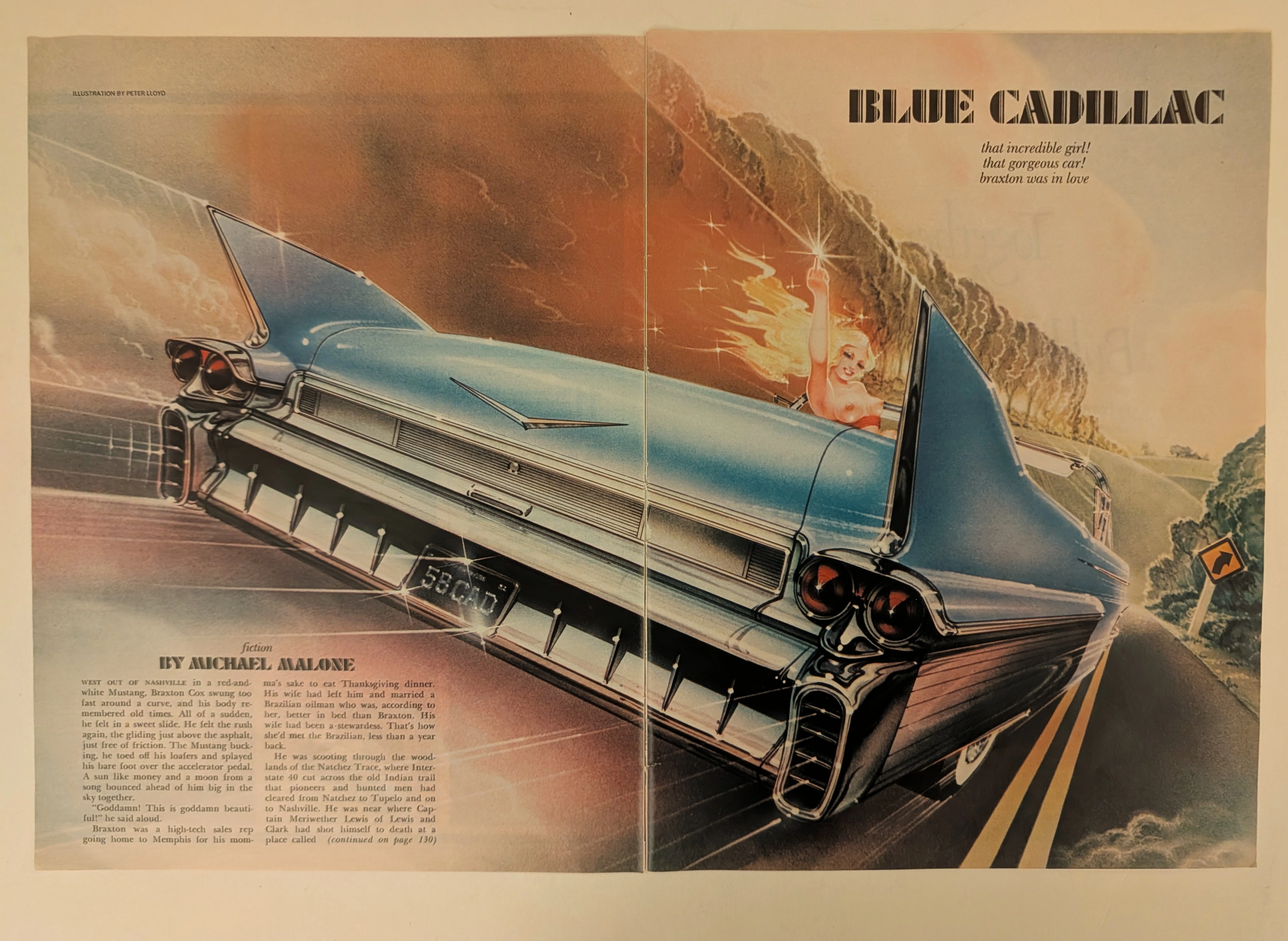
The Time Traveller's Dossier: The Tailfin of Rebellion – "Blue Cadillac" by Peter Lloyd

History is not written; it is printed. Before digital algorithms dictated human behavior, societal engineering was executed through the calculated geometry of the four-color offset press. The historical artifact before us is a magnificent two-page magazine spread—an original, magazine-sized print carefully extracted from its source publication. It serves as a weaponized blueprint of counter-culture defiance and a testament to the absolute zenith of the golden age of airbrush illustration. This museum-grade archival dossier presents an academic deconstruction of Peter Lloyd’s breathtaking illustration for Michael Malone’s fiction piece, "Blue Cadillac." Operating on a profound binary structure, it documents a calculated paradigm shift where the wholesome, conservative American Dream of the 1950s is violently hijacked by the liberated, rebellious spirit of the late 20th century. Through the lens of late-analog commercial artistry and precise visual forensics, this document serves as a masterclass in psychological semiotics, establishing the visual tropes of the American open road that relentlessly dominate modern retro-futuristic pop culture.
Magnavox Star System 1981 Leonard Nimoy TV Advertisement | 'The Picture of Reliability' | Deep Analysis Rarity Class A-SS

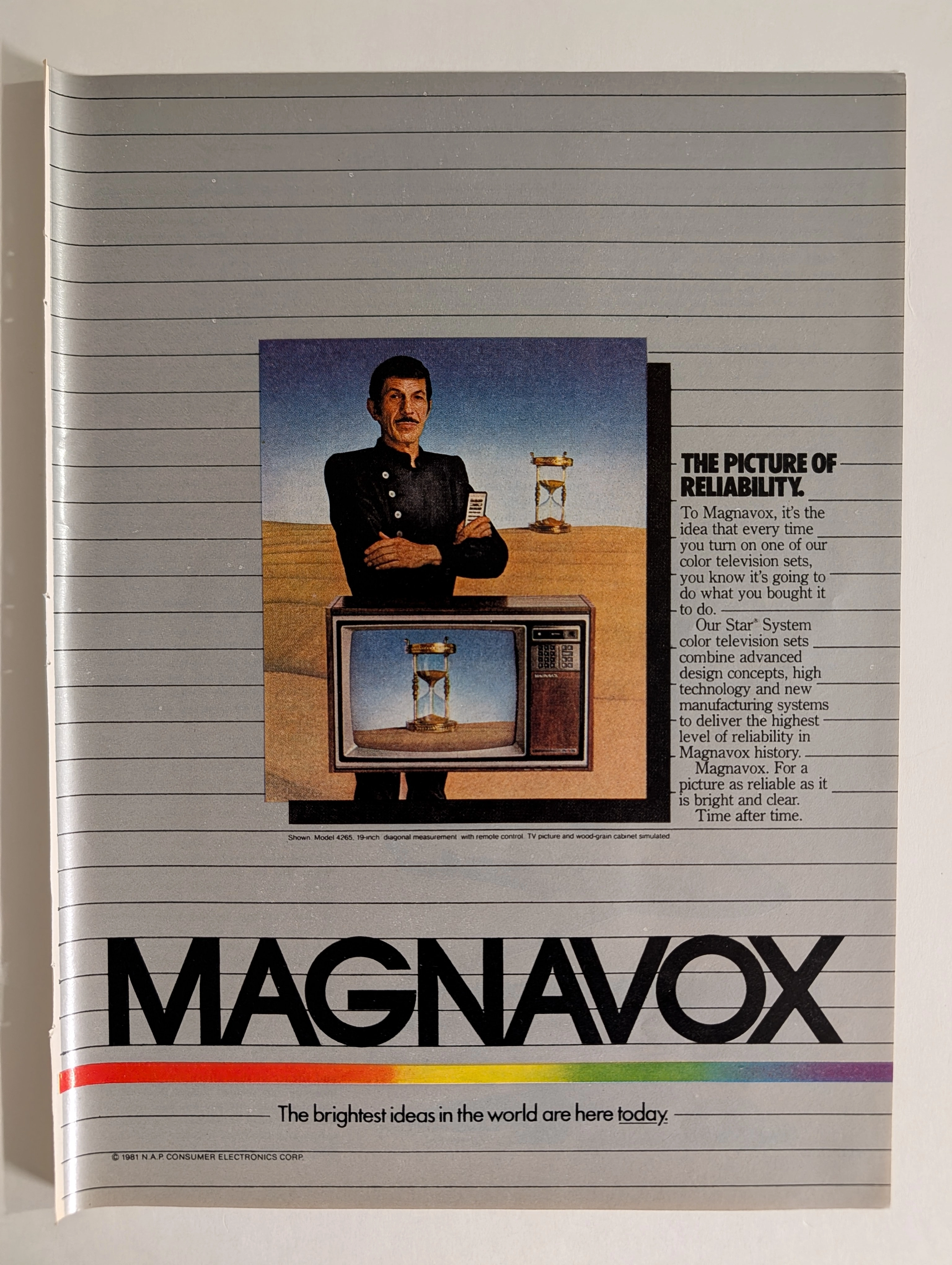
Magnavox Star System 1981 Leonard Nimoy TV Advertisement | 'The Picture of Reliability' | Deep Analysis Rarity Class A-SS

The advertisement analyzed here is a full-page full-color magazine promotion for Magnavox's Star® System color television sets, copyright © 1981 N.A.P. Consumer Electronics Corp. The ad features what is almost certainly Leonard Nimoy — iconic for his role as Mr. Spock in Star Trek — dressed in a black nehru-collar uniform against a surrealist desert landscape, standing above a Magnavox color TV set (Model 4265, 19-inch diagonal) that displays an hourglass on screen. A second hourglass appears behind him. The visual concept communicates timeless reliability. The headline 'The Picture of Reliability' and tagline 'The brightest ideas in the world are here today' frame Magnavox's Star System as the pinnacle of 1981 television technology. The rainbow spectrum stripe at the bottom is a distinctive brand element that ran across Magnavox advertising throughout the early 1980s. N.A.P. (North American Philips) Consumer Electronics Corp. was the American subsidiary of Philips that owned the Magnavox brand at this time, having acquired it in 1974.
The Time Traveller's Dossier: The Illumination of Memory – The Kodak Instamatic 104 and the Flashcube Revolution

Kodak · Technology

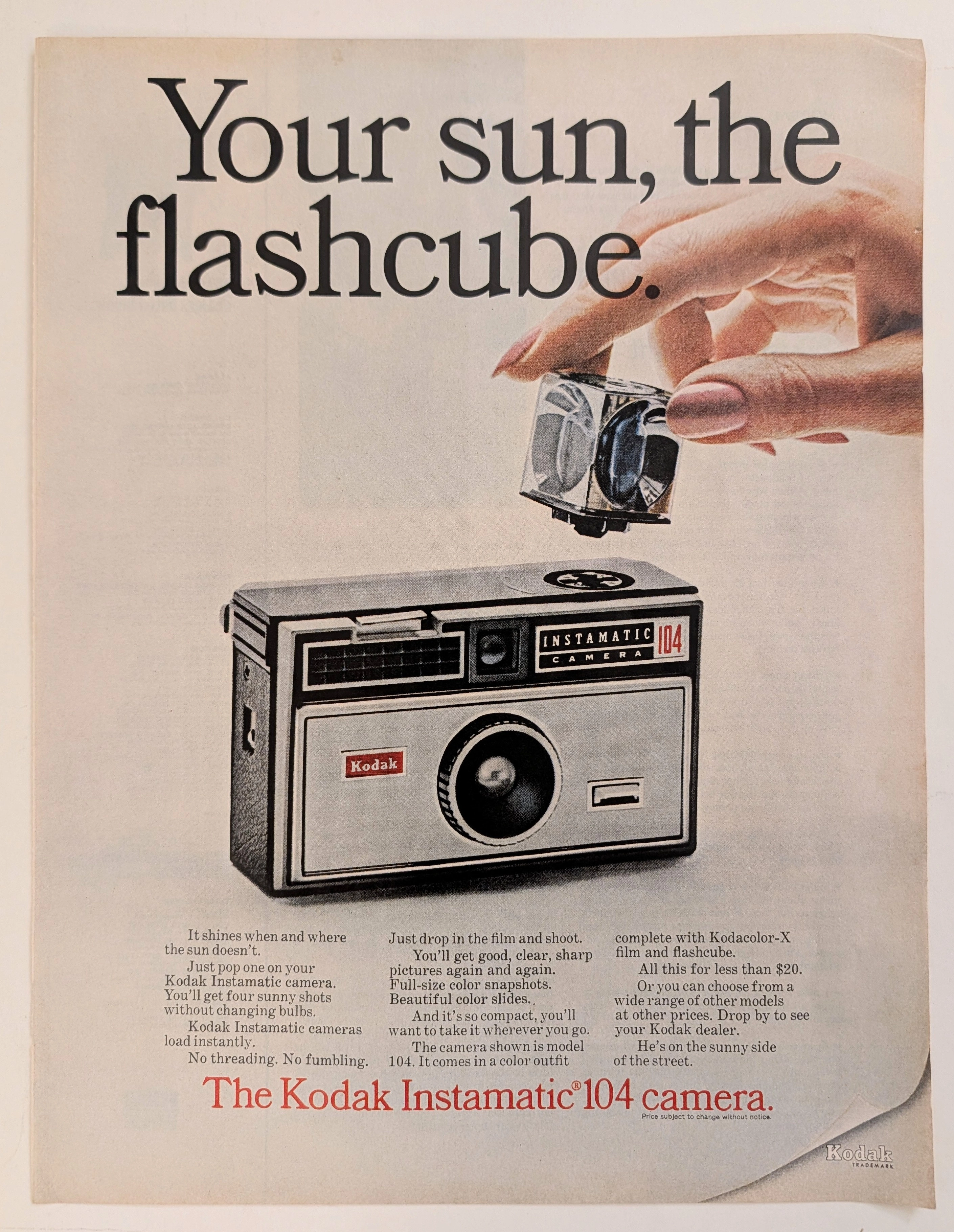
The Time Traveller's Dossier: The Illumination of Memory – The Kodak Instamatic 104 and the Flashcube Revolution

The evolution of the American domestic experience during the mid-twentieth century was inextricably linked to the ability of the average citizen to document it. The historical artifact elegantly and securely positioned upon the analytical table of The Record Institute today is a striking, full-page print advertisement for the Kodak Instamatic 104 camera, dating to the mid-1960s. This document completely transcends the standard boundaries of consumer electronics marketing. It operates as a highly sophisticated, multi-layered cultural and historical mirror, reflecting the precise era when the complexities of photographic chemistry and illumination were engineered out of existence, explicitly packaged, and sold to the American public not merely as a mechanical device, but as the effortless capturing of time itself. This world-class, comprehensive dossier conducts a meticulous, unyielding, and exceptionally deep examination of the artifact, operating under the absolute most rigorous parameters of historical, sociological, and material science evaluation. With our analytical focus dedicated overwhelmingly to its profound historical gravity (comprising 80% of our scholarly evaluation), we will decode the brilliant marketing psychology embedded within the "Your sun, the flashcube" narrative, analyze the immense sociological impact of George Eastman's legacy, and dissect the rich semiotics of the camera's accessible design. Furthermore, as we venture deeply into the chemical and physical foundations of this analog printed ephemera (10% focus), we will reveal the precise mechanical fingerprints of the CMYK halftone rosettes and the graceful, natural oxidation of the paper substrate. Finally, we will assess its archival significance (10% focus), exploring how this precise intersection of visual nostalgia, mid-century commercial artistry, and the immutable chemistry of time cultivates a serene wabi-sabi aesthetic—a natural, irreversible phenomenon that serves as the primary engine driving up its market value exponentially within the elite global spheres of Vintage Commercial Ephemera and Mid-Century Lifestyle collecting.
Published by

The Record Institute

Taxonomy Match

Related Articles

The Time Traveller's Dossier: The Architecture of Eternity – De Beers "Glory of Bells" Advertisement (Circa early 1940s) — related article
Read Article

The Time Traveller's Dossier: The Architecture of Eternity – De Beers "Glory of Bells" Advertisement (Circa early 1940s)

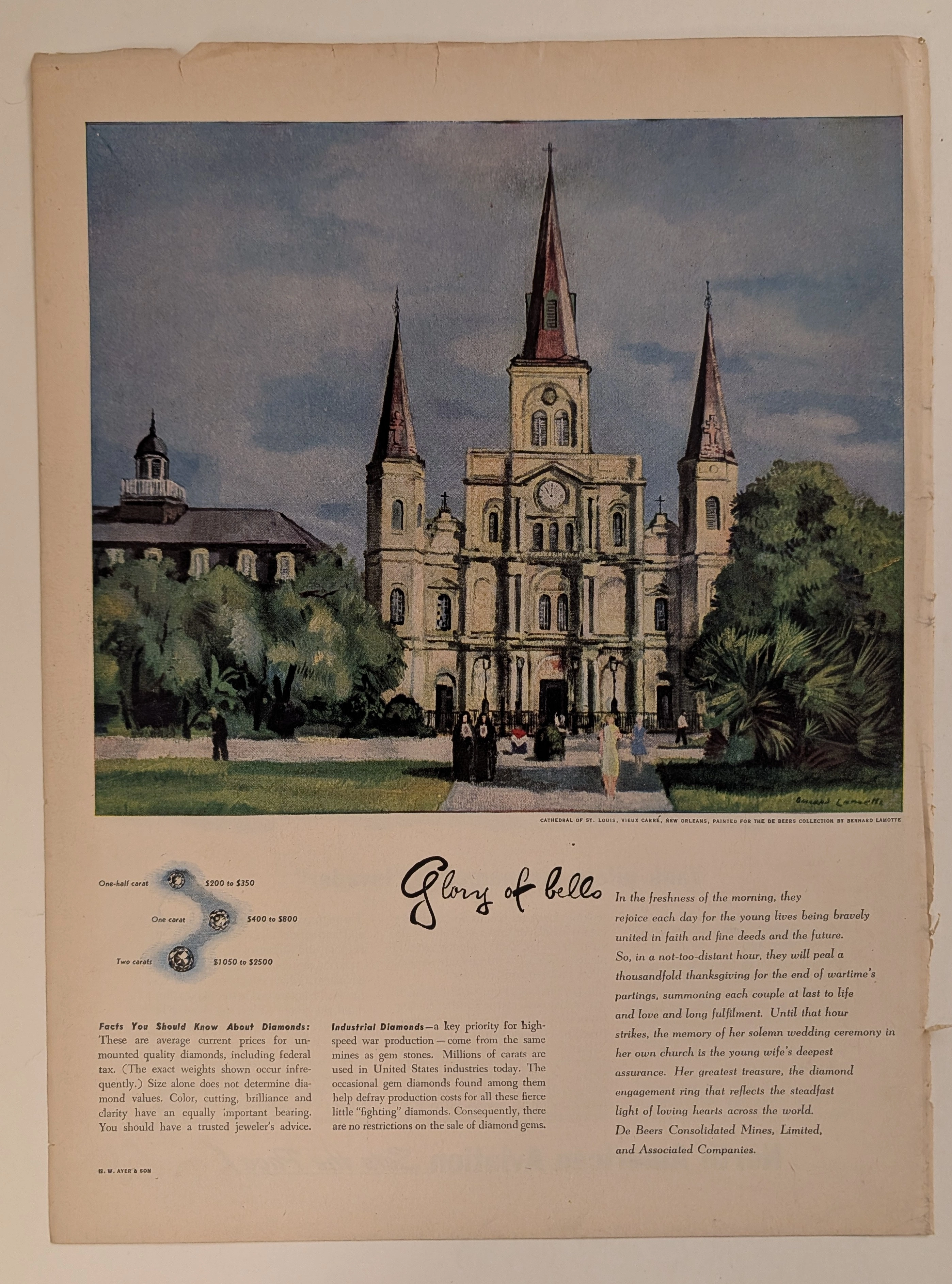
History is not shaped by chance; it is engineered by those who control the narrative and own the resources. Long before the digital age fragmented human attention, the ultimate manifestations of social engineering and psychological manipulation were executed through the calculated precision of the four-color offset printing press and the masterful strokes of commercial fine art. The historical artifact presented before us is not merely a page from a vintage magazine. It is a perfectly weaponized blueprint of corporate capitalism, a masterpiece of emotional extortion, and a foundational document in the creation of one of the most successful, universally accepted illusions in the history of human commerce: the diamond engagement ring. This museum-grade, academic archival dossier presents an exhaustive, microscopic deconstruction of a World War II-era print advertisement for De Beers Consolidated Mines, Limited, executed by the legendary advertising agency N.W. Ayer & Son. Operating on a profound and ruthless binary structure, this document records a calculated paradigm shift within the global luxury and gemstone industry. It captures the precise historical fracture where a monopolized carbon allotrope was conceptually transmuted from a rare gemstone into an absolute, non-negotiable sacrament of love, faith, and matrimony. Through the highly specialized lens of late-analog commercial artistry and stringent visual forensics, this document serves as a masterclass in psychological marketing. It established the foundational archetype for linking extreme financial expenditure with spiritual and emotional devotion—an archetype that unconditionally dictates the visual and strategic totems of the modern diamond industry today.

The Time Traveller's Dossier: The Architect of the Great Society – Lyndon B. Johnson — related article
Read Article

The Time Traveller's Dossier: The Architect of the Great Society – Lyndon B. Johnson

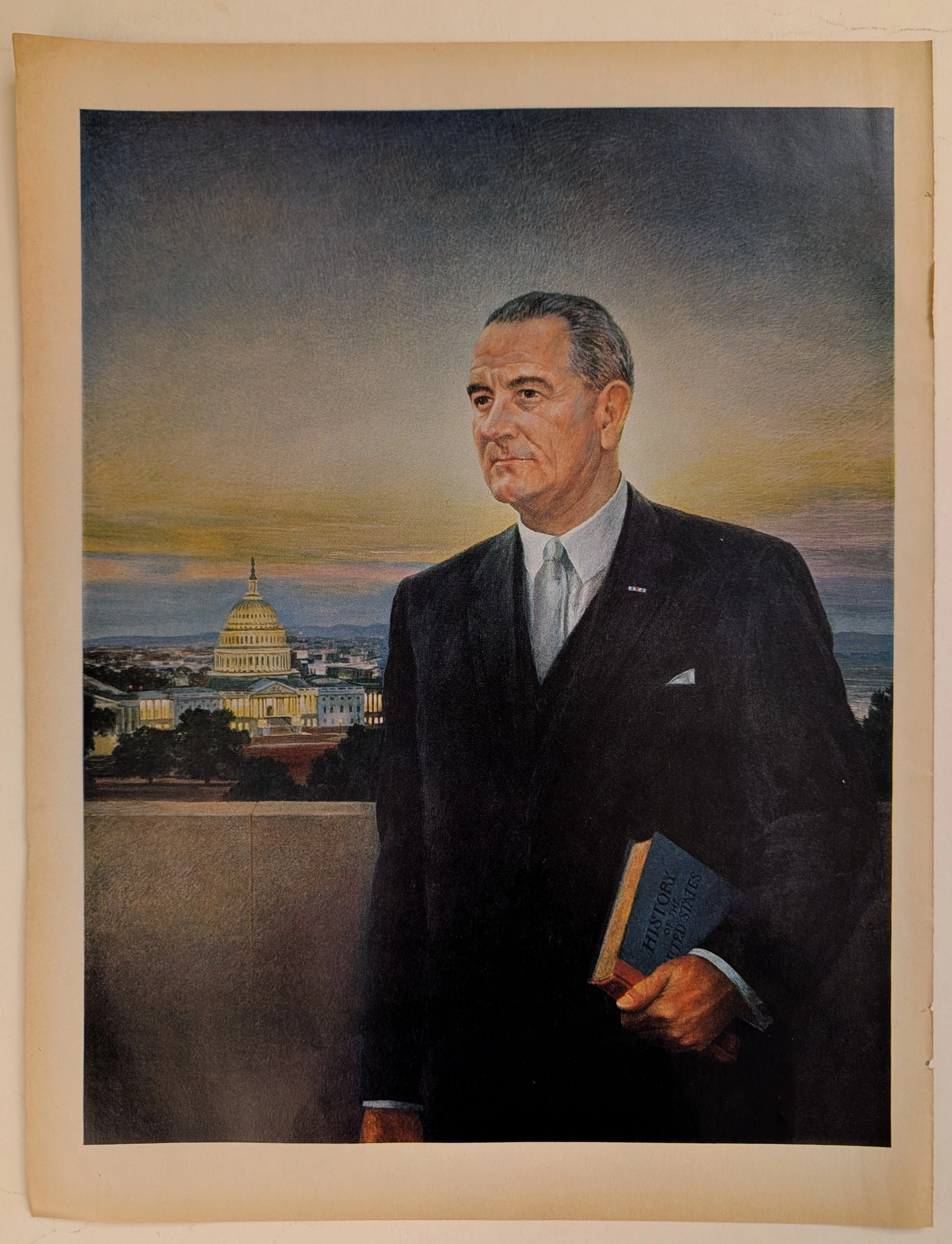
The presidency of the United States during the mid-twentieth century was an office defined by epochal challenges, sweeping domestic transformations, and the profound weight of global leadership. The historical artifact elegantly and securely positioned upon the analytical table of The Record Institute today is a majestic, large-format political lithograph portraying Lyndon Baines Johnson, the 36th President of the United States. Originating from the transformative core of the 1960s, this document completely transcends the traditional boundaries of political memorabilia. It operates as a highly sophisticated, multi-layered cultural and historical mirror, reflecting the exact moment when unparalleled legislative ambition intersected with the intricate realities of the geopolitical landscape on a single printed page. This world-class, comprehensive dossier conducts a meticulous, profound, and historically objective examination of the artifact, operating under the absolute most rigorous parameters of sociological and material science evaluation. We will decode the brilliant iconographic strategy embedded within this portrait, analyze the legendary political machinery of a statesman who mastered the United States Senate, and dissect the rich, aspirational semiotics surrounding the Great Society initiatives alongside the challenging context of the Cold War era. Furthermore, as we venture deeply into the chemical and physical foundations of this analog printed ephemera, we will reveal the precise mechanical fingerprints of the CMYK halftone rosettes and the graceful, natural oxidation of the paper substrate. This precise intersection of visual nostalgia, mid-century commercial artistry, and the immutable chemistry of time cultivates a serene wabi-sabi aesthetic—a natural, irreversible phenomenon that serves as the primary engine driving up its market value exponentially within the elite global spheres of Vintage Political Ephemera and Presidential Archives collecting.

THE TIME TRAVELER'S DOSSIER: THE ARCHITECTURE OF POWER AND THE BIRTH OF THE DIGITAL WORLD IN THE 50S — related article
Read Article

THE TIME TRAVELER'S DOSSIER: THE ARCHITECTURE OF POWER AND THE BIRTH OF THE DIGITAL WORLD IN THE 50S

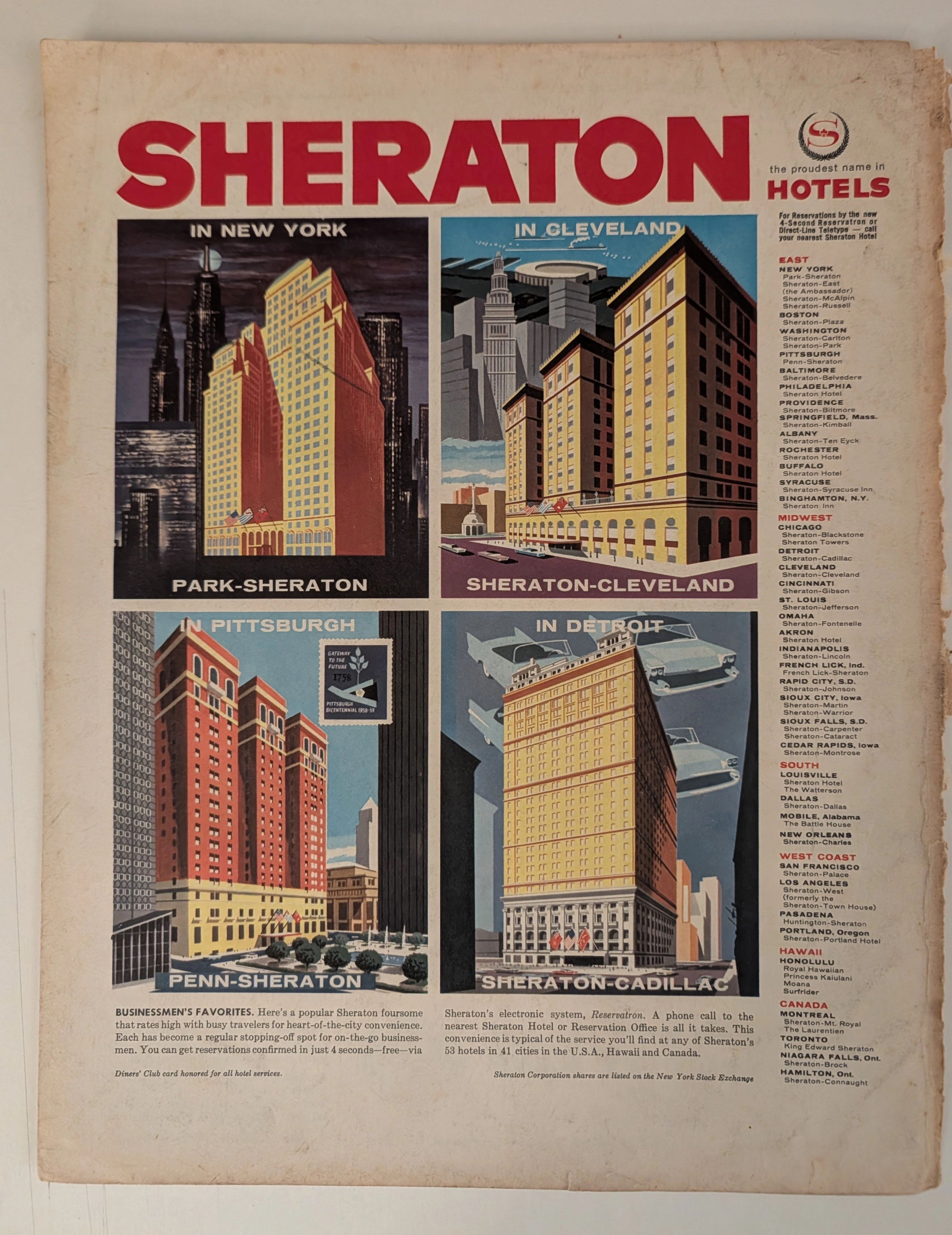
The artifact under exhaustive, uncompromising museum-grade analysis is a remarkably preserved Historical Relic originating from the absolute zenith of the post-war American economic boom. This Primary Art Document is a sweeping, monumental full-page advertisement for the Sheraton Hotels empire, forensically dated to circa 1958–1959 via the explicitly illustrated Pittsburgh Bicentennial (1758-1958) stamp embedded within the artwork. This document is not merely a travel advertisement; it is a profound "Sociological Blueprint of the American Corporate Ascendancy." Visually anchored by four hyper-stylized, architectural illustrations of Sheraton's flagship properties—New York, Cleveland, Pittsburgh, and Detroit—the piece captures the era's unbridled optimism. Each panel is a masterpiece of mid-century commercial illustration, particularly the Detroit panel featuring ethereal, floating tail-fin automobiles symbolizing the Motor City's dominance. Furthermore, this artifact documents critical milestones in global business history. It proudly advertises the acceptance of the Diners' Club card, marking the revolutionary dawn of the modern credit card era. It also boasts of Sheraton's "Reservatron" electronic system—one of the earliest commercial applications of computing in the hospitality industry—and proudly declares its listing on the New York Stock Exchange. Rescued from the binding of a forgotten, heavy-stock periodical, this pre-2000s analog artifact is an unforgeable testament to the Japanese aesthetic of wabi-sabi. Printed on inherently acidic wood-pulp paper, it exhibits a beautifully violent, jagged right margin and a deep, warm amber oxidation across its surface. This majestic, unstoppable chemical degradation transforms a mass-produced corporate propaganda piece into an irreplaceable, ready-to-frame Primary Art Document of mid-century architectural and economic history.

THE TIME TRAVELER'S DOSSIER: BLOOD CAPITALISM AND THE WEAPONIZATION OF WHISKEY — related article
Read Article

THE TIME TRAVELER'S DOSSIER: BLOOD CAPITALISM AND THE WEAPONIZATION OF WHISKEY

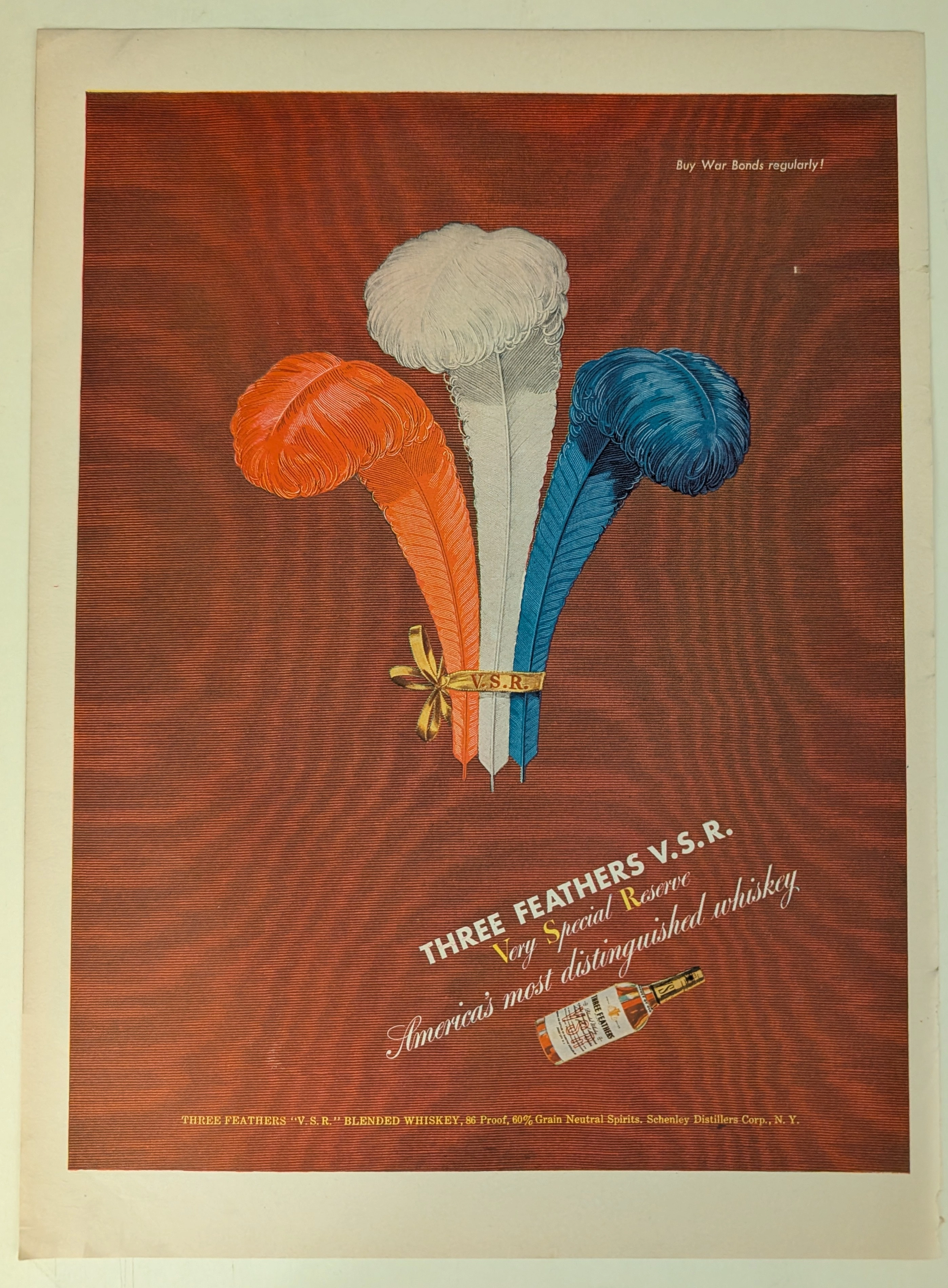
This impeccably preserved Historical Relic is a Primary Art Document from the brutal crucible of World War II, featuring a sweeping advertisement for THREE FEATHERS V.S.R. Blended Whiskey. It chronicles the ultimate mid-century psychological strategy of "Patriotic Capitalism." The artifact is forensically and definitively dated to the WWII era by the explicit, government-aligned directive in the upper right corner: "Buy War Bonds regularly!". Visually, the brand masterfully hijacked American nationalism by rendering its iconic three feathers in a vibrant Red, White, and Blue patriotic color scheme. Surviving the aggressive scrap paper drives of the 1940s, the acidic analog paper exhibits a profound integration of the deep crimson ink into its degrading fibers, perfectly encapsulating the analog aesthetic of wabi-sabi. This slow chemical death elevates this rescued wartime artifact to an irreplaceable Primary Art Document of Rarity Class A.

THE TIME TRAVELER'S DOSSIER: HOLLYWOOD PROPAGANDA AND THE DAWN OF MULTIMEDIA SYNERGY — related article
Read Article

THE TIME TRAVELER'S DOSSIER: HOLLYWOOD PROPAGANDA AND THE DAWN OF MULTIMEDIA SYNERGY

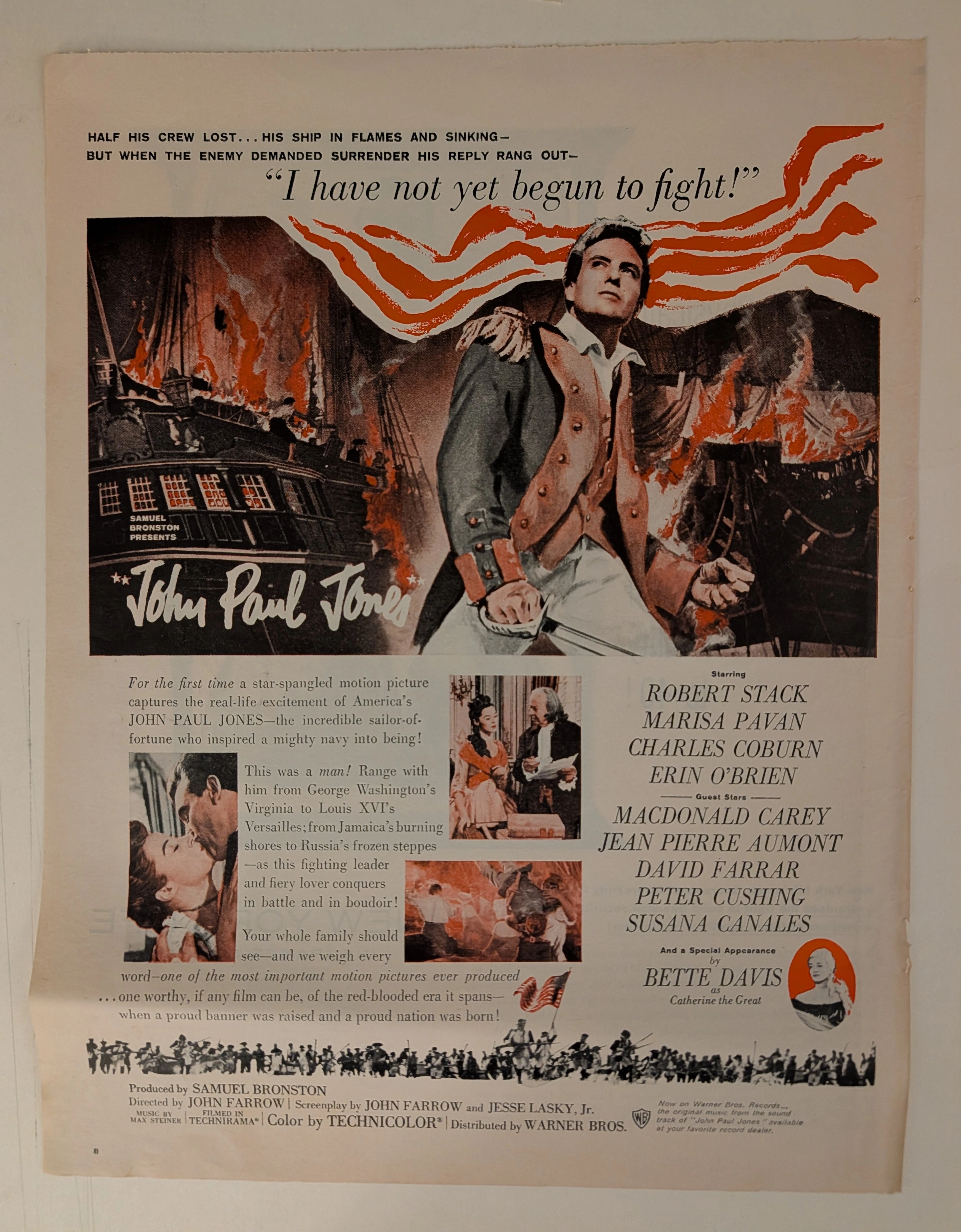
The artifact under exhaustive, uncompromising, and unprecedented museum-grade analysis is a remarkably preserved Historical Relic originating from the zenith of Hollywood's post-war epic era. This Primary Art Document is a monumental, full-page theatrical advertisement for the 1959 biographical epic "John Paul Jones", produced by the legendary independent film mogul Samuel Bronston and distributed by Warner Bros.. ​This is not merely a movie poster; it is a "Forensic Blueprint of Cold War American Nationalism and Multimedia Synergy." Released in 1959, at the height of the Cold War, the advertisement aggressively weaponizes the foundational mythos of the United States Navy. The commanding, blood-red headline, "I have not yet begun to fight!", serves as a psychological anchor, projecting unyielding American defiance to both domestic audiences and global adversaries. Visually dominated by the rugged, heroic portrait of Robert Stack, the ad expertly balances masculine wartime aggression with romantic subplots and diplomatic intrigue featuring Charles Coburn as Benjamin Franklin. Furthermore, it showcases elite Hollywood casting power by explicitly highlighting a "Special Appearance by Bette Davis as Catherine the Great" in a striking red cameo vignette. ​Crucially, this artifact documents an early, masterful execution of cross-platform corporate synergy. The bottom corner explicitly markets the original Max Steiner soundtrack on Warner Bros. Records, proving that the commercialization of the "Original Motion Picture Soundtrack" was already highly codified. ​Rescued from the inevitable oblivion of disposable entertainment media, this pre-2000s analog artifact is a breathtaking embodiment of the Japanese aesthetic of wabi-sabi. Printed on inherently acidic mid-century wood-pulp paper, it exhibits beautifully authentic edge wear and a profound, warm amber oxidation across its surface. This unstoppable molecular death transforms a mass-produced piece of Hollywood propaganda into an irreplaceable, ready-to-frame Primary Art Document of cinematic and sociological history.

THE TIME TRAVELER'S DOSSIER:THE ENGINEERING OF ELEGANCE, THE GUCCI TRUNK, AND THE ARCHITECTURE OF REASON — related article
Read Article

THE TIME TRAVELER'S DOSSIER:THE ENGINEERING OF ELEGANCE, THE GUCCI TRUNK, AND THE ARCHITECTURE OF REASON

The artifact under exhaustive, uncompromising, and unprecedented museum-grade analysis is a remarkably preserved Historical Relic originating from the absolute zenith of West German automotive engineering. This Primary Art Document is a densely informative, multi-column magazine advertisement for the Mercedes-Benz 280SE Sedan (W116 chassis). ​This document is a "Forensic Blueprint of Engineered Elegance and Status Commodification." It aggressively markets the 280SE as the "Heir to a Classic," positioning it as a vehicle that inherits the legendary proportions of the 450 Series but is powered by a highly advanced, fuel-injected 6-cylinder engine. The copywriting reads like an arrogant technical dossier, boasting of the "Continuous Injection System" (CIS) and a fully independent "Suspense-free suspension" derived from the legendary C-111 high-speed research vehicle. ​However, the absolute psychological masterstroke lies in the lower-left illustration. To visually prove the cavernous "18.2 cubic feet of usable space," the artist meticulously illustrated the trunk effortlessly swallowing a bicycle, golf clubs, and a set of Gucci luggage. The unmistakable beige geometric monogram and the iconic red-and-green Web stripe on the suitcases serve as a deliberate, powerful socio-economic signal. It explicitly communicates that the Mercedes-Benz trunk is designed exclusively for the "Jet-Set" elite who travel with Italian haute couture. ​Rescued from a mass-market periodical, this pre-2000s analog artifact exhibits a beautifully authentic warm ivory oxidation across its surface. This majestic chemical aging transforms a mass-produced piece of technical propaganda into an irreplaceable Primary Art Document of automotive and sociological history.