
THE TIME TRAVELER'S DOSSIER: BLOOD CAPITALISM AND THE WEAPONIZATION OF WHISKEY
The History
(THE HISTORY: World War II, The Bonds of Death, and the Architecture of Patriotism )
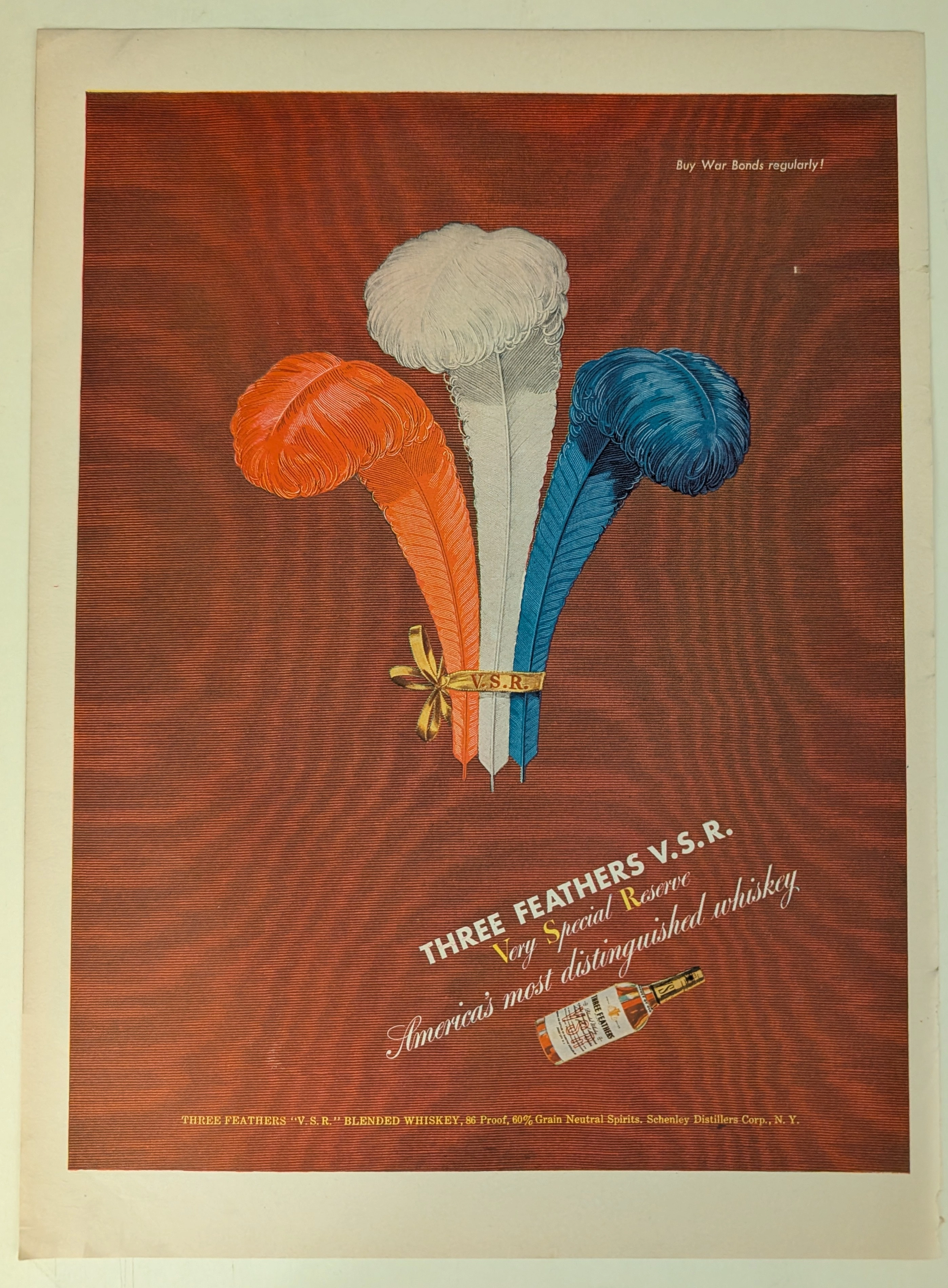
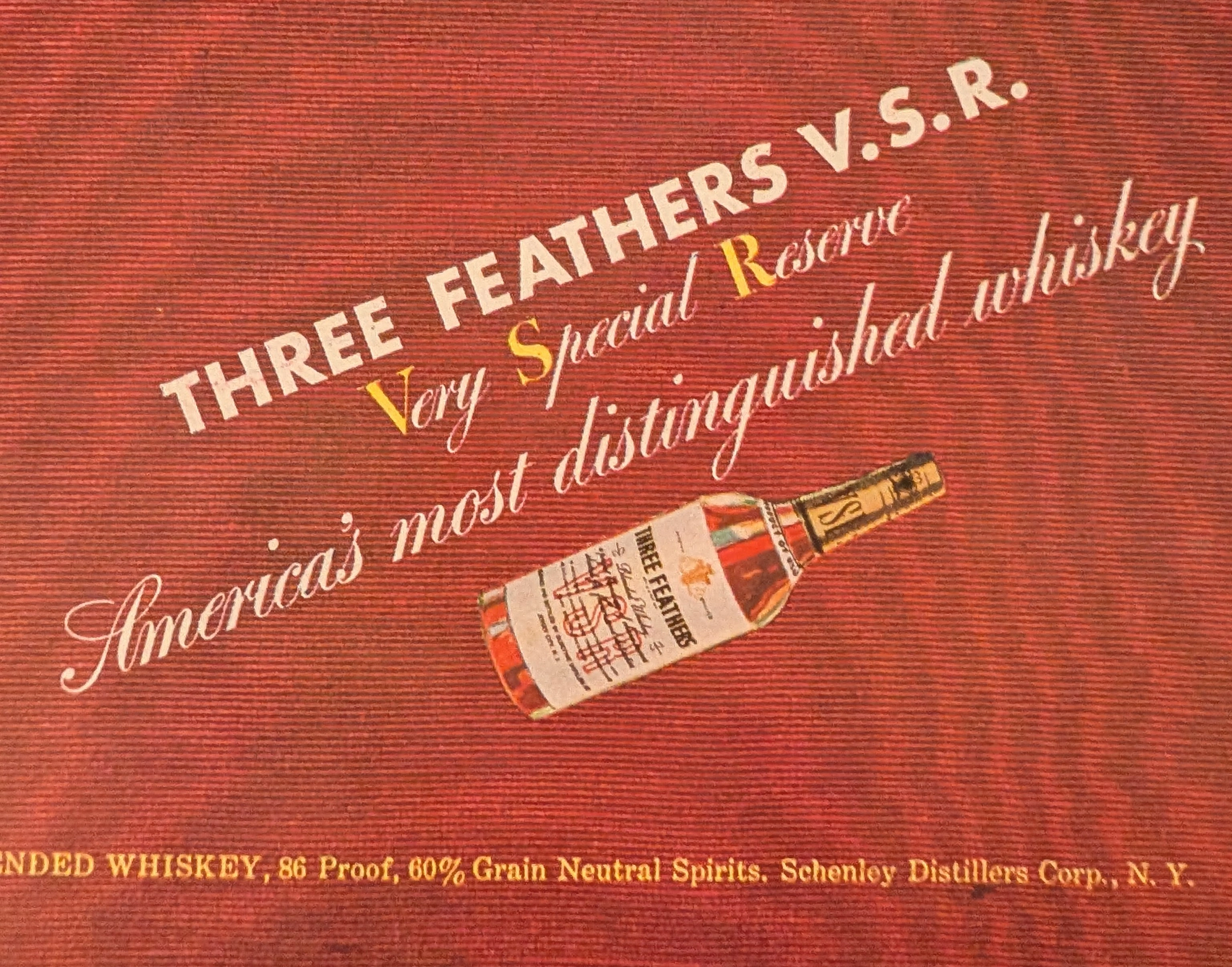
As the Chief Curator of The Record, the uncompromising guardian of analog history, I welcome you to an era where the entire globe was engulfed in absolute fire. The impeccably preserved Historical Relic that lies before you is not a mere, soulless vintage liquor advertisement. It is a forensic "Blueprint of Military Propaganda" expertly disguised as commercial art. This Primary Art Document is the formidable work of Schenley Distillers Corp., N.Y., showcasing their flagship brand: THREE FEATHERS V.S.R. (Very Special Reserve).
The staggering, immeasurable historical valuation of this artifact is hidden within a single, brief sentence anchored in the upper right corner of the page: "Buy War Bonds regularly!". This sentence is the forensic, undeniable evidence that definitively locks the age of this document squarely within the World War II era (1941-1945). During the height of the global conflict, the United States government required astronomical capital to manufacture tanks, aircraft, and munitions. Massive American corporations were "requested" (or heavily pressured) to sacrifice their premium advertising real estate to help the government sell war bonds. This advertisement is a definitive historical record of the exact moment when the line between "private corporate marketing" and "state-sponsored propaganda" was completely obliterated.
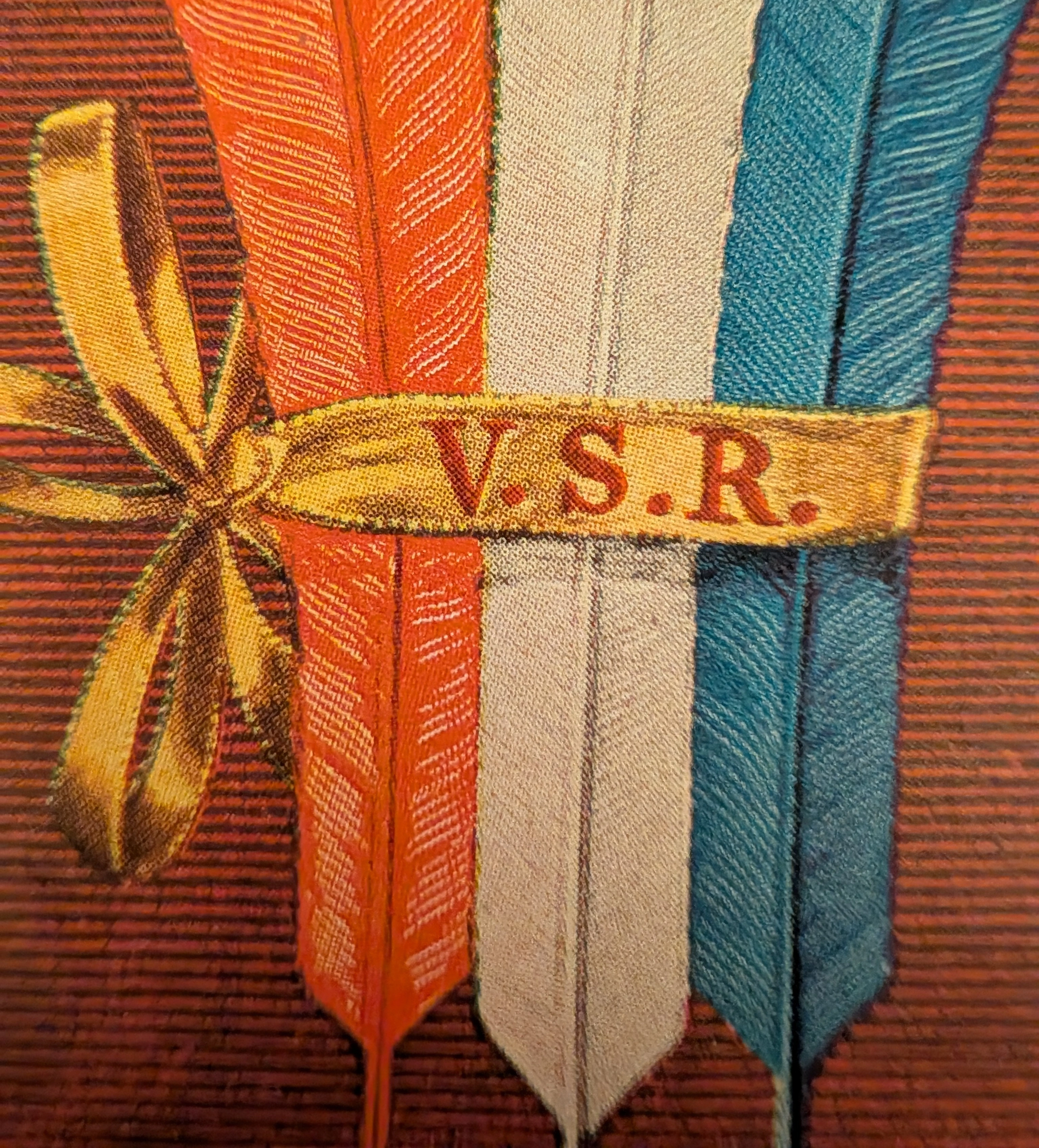
Furthermore, the Visual Architecture of this piece is a masterclass in covert Psychological Warfare. The brand's traditional symbol—three abstract feathers—has been radically redesigned and weaponized into the patriotic colors of Red, White, and Blue, mirroring the American flag ("Old Glory"). Bound together by a golden ribbon stamped "V.S.R.", these colors stand imposingly in the center of the page above the whiskey bottle. This establishes a deeply psychological framework: drinking Three Feathers was implicitly framed as the act of a loyal, patriotic American.
Another critically vital industrial detail is the microscopic text at the very bottom: "86 Proof, 60% Grain Neutral Spirits". During WWII, the U.S. government ordered distilleries nationwide to halt the production of straight bourbon, redirecting alcohol production towards gunpowder, synthetic rubber, and military medical supplies. The fact that this premium whiskey is a "Blended Whiskey" containing 60% neutral spirits is a permanent historical scar of Wartime Rationing, explicitly printed on the page.
(THE PAPER: The Aesthetics of Decay (Wabi-Sabi) — Crimson Ink on Burning Wood-Pulp )
At The Record, our ultimate, uncompromising reverence is reserved for the inevitable, tragic, and spectacular beauty of analog destruction. This standalone Primary Art Document was surgically rescued, liberated, and meticulously preserved. Magazines during World War II were printed on exceptionally cheap, highly acidic wood-pulp paper due to severe wartime resource shortages.
Direct your curatorial gaze to the physical surface of this artifact. Its physical miracle lies in the "Deep Crimson Wood-grain Texture". The analog ink from the 1940s has bled deep into every single microscopic fiber of the paper. Over the course of more than 80 years, ambient oxygen has waged a relentless chemical war against the paper's inherent lignin. This irreversible oxidation process has gracefully degraded the once-white edges into a warm, toasted Amber Patina. This is the profound Japanese aesthetic of wabi-sabi—the spiritual realization of finding absolute perfection in impermanence and decay. This paper is quietly, literally burning itself alive at a molecular level. No modern digital reprint can ever replicate the sheer depth of pigment, the tactile soul, nor the intoxicating olfactory signature of aging 1940s pulp. Its slow, majestic death is precisely what transfigures it into an immortal piece of Primary Art.
(THE RARITY: Class A — A Miraculous Survivor of the Wartime Incinerators )
To fully comprehend the immense valuation of this artifact, you must understand the brutal reality of its era. Finding 1940s ephemera that retains such vibrant, bleeding color fidelity while articulating such a heavy historical narrative is an archival miracle. During WWII, the American government launched massive, aggressive "Paper Drives." Millions of old magazines were swept out of civilian homes, legally mandated to be pulped down and recycled into artillery packaging and ammunition boxes.
The fact that this Three Feathers advertisement, bearing the stark command "Buy War Bonds regularly!", managed to escape the wartime incinerators for over eight decades is an archival triumph. When you fuse this extreme physical scarcity with the monumental history of Patriotic Marketing and the breathtaking physical trauma of its analog decay, this artifact unequivocally commands the highly prestigious Rarity Class A designation. It has evolved far, far beyond a disposable piece of vintage liquor advertising. It is a highly coveted Historical Relic, demanding to be framed and fiercely protected by an alpha curator who truly understands the heavy, beautiful, and irreplaceable weight of World War II history.
Exhibition Halls
The Archive Continues
Continue the Exploration
VISA · Travel
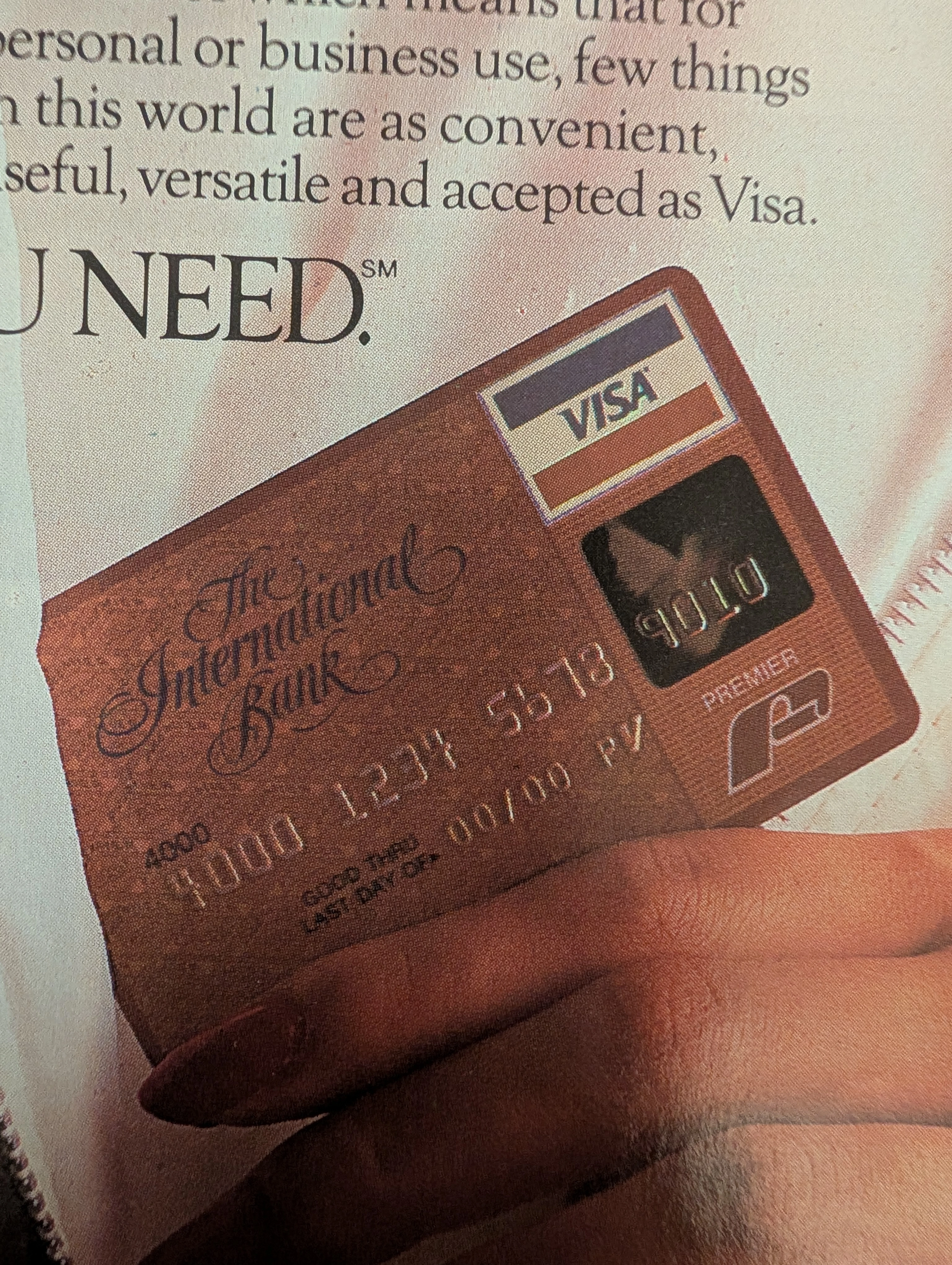
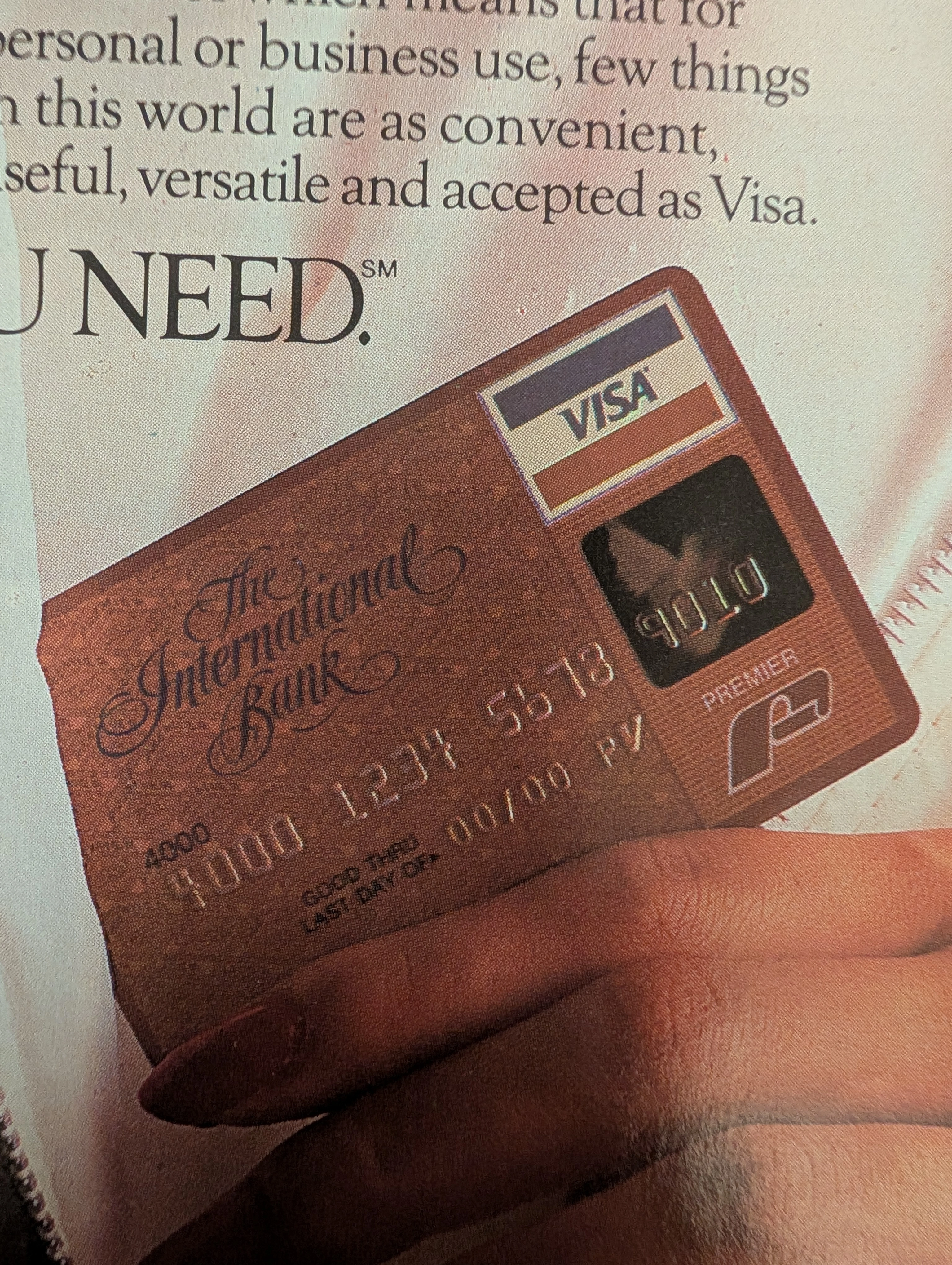
The Time Traveller’s Dossier: 1985 Visa Premier Vintage Advertisement — The Passport to Borderless Wealth
Delve into the archives to explore this definitive 1985 Visa Premier vintage advertisement, a piece that serves as far more than mere financial promotion. It is a historical milestone capturing the evolution of global consumerism and the financial services industry. Published during the mid-1980s, an era when international travel became the ultimate status symbol, this artifact stands as a powerful representation of the premium credit card wars for collectors of vintage ads and old advertisements. The "All You Need" campaign fundamentally transformed Visa's image from an everyday convenience into a "financial passport," universally accepted from the exclusive ski slopes of California to the majestic peaks of Switzerland. Unlike classic print ads of previous decades that focused on tangible consumer goods, this piece sells the intangible allure of freedom, security, and elite access. This document remains a profound testament to the dawn of financial globalization and a masterpiece of fintech archival history.
THE TIME TRAVELER'S DOSSIER: THE STRATOSPHERIC MANSION AND THE AESTHETICS OF DECAY
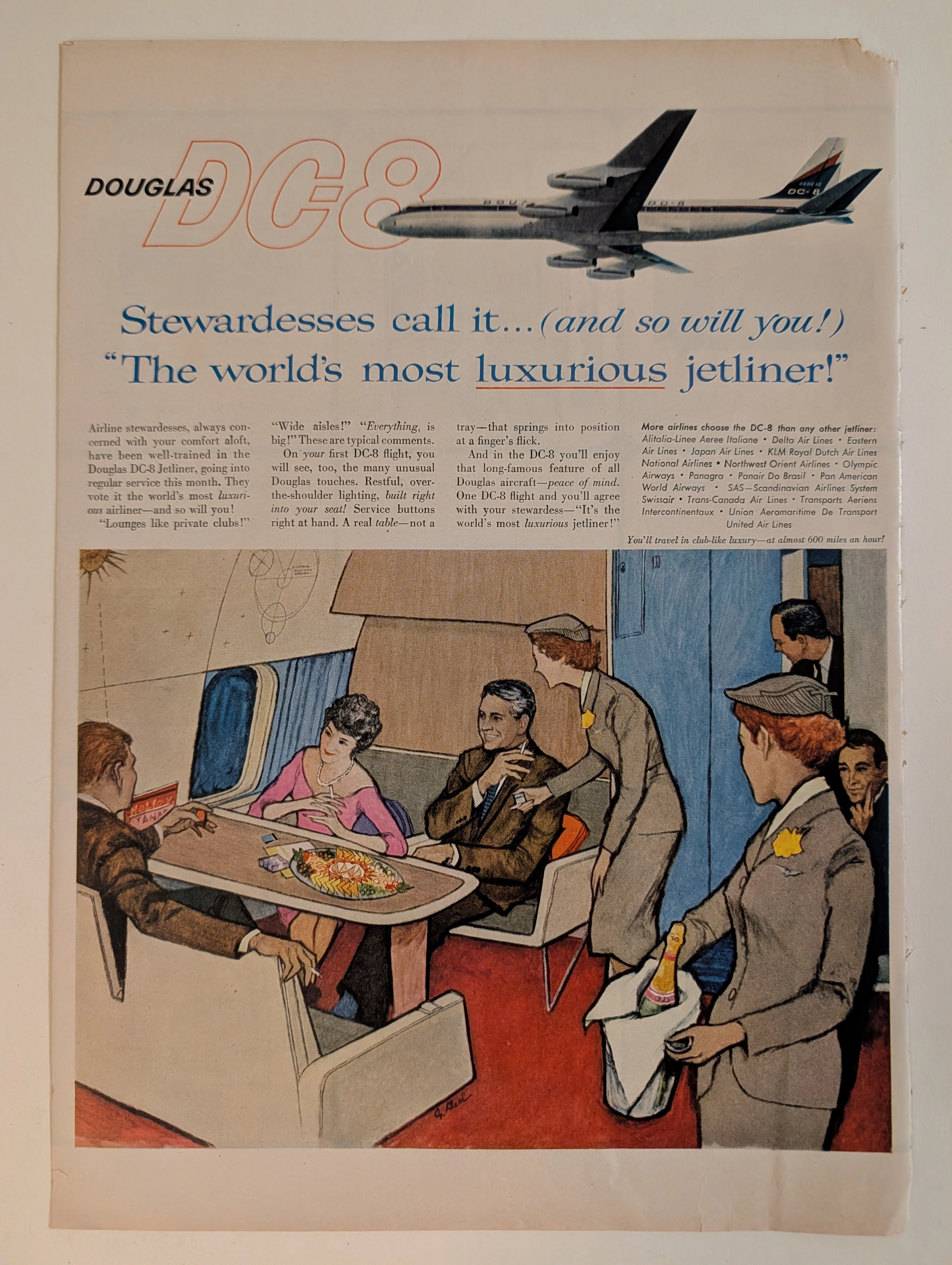
The artifact under exhaustive, museum-grade analysis is a flawlessly preserved Historical Relic originating from the absolute dawn of the commercial Jet Age (circa late 1950s to early 1960s). This Primary Art Document is a magnificent full-page advertisement for the Douglas DC-8, the aerospace leviathan engineered to rival the Boeing 707 and conquer the global skies. Visually anchored by an elegant, sweeping illustration of the aircraft's exterior and a highly detailed, evocative rendering of its opulent passenger lounge, the piece represents the zenith of mid-century aspirational marketing. Signed by an elusive mid-century commercial artist, the illustration captures the "Palomar Lounge"—a private club in the stratosphere where the elite played cards, smoked, and drank champagne beneath a Space-Age celestial diagram. By utilizing the ultimate authority of the era—the airline stewardess—to validate its luxury ("Stewardesses call it... The world's most luxurious jetliner!"), Douglas masterfully sold the illusion of exclusive, aristocratic segregation at 600 miles per hour. Rescued from the binding of a forgotten periodical, this pre-2000s analog artifact is an unforgeable testament to the aesthetic of wabi-sabi. Printed on inherently acidic wood-pulp paper, it exhibits a beautifully frayed right margin and a deep, warm ivory oxidation. This majestic chemical degradation transforms a mass-produced corporate propaganda piece into an irreplaceable, ready-to-frame Primary Art Document of aerospace history.
THE TIME TRAVELER'S DOSSIER: THE ARCHITECTURE OF POWER AND THE BIRTH OF THE DIGITAL WORLD IN THE 50S
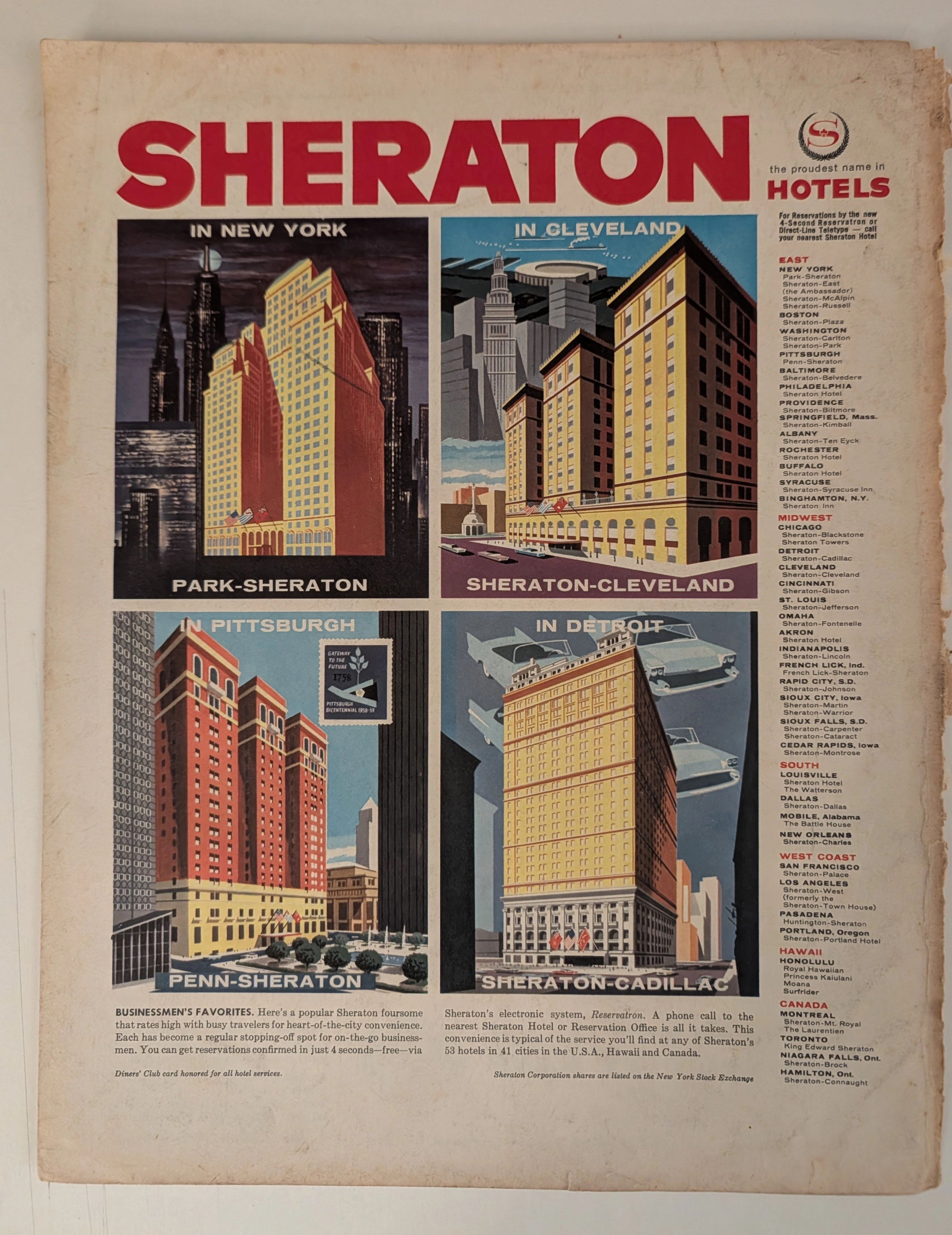
The artifact under exhaustive, uncompromising museum-grade analysis is a remarkably preserved Historical Relic originating from the absolute zenith of the post-war American economic boom. This Primary Art Document is a sweeping, monumental full-page advertisement for the Sheraton Hotels empire, forensically dated to circa 1958–1959 via the explicitly illustrated Pittsburgh Bicentennial (1758-1958) stamp embedded within the artwork. This document is not merely a travel advertisement; it is a profound "Sociological Blueprint of the American Corporate Ascendancy." Visually anchored by four hyper-stylized, architectural illustrations of Sheraton's flagship properties—New York, Cleveland, Pittsburgh, and Detroit—the piece captures the era's unbridled optimism. Each panel is a masterpiece of mid-century commercial illustration, particularly the Detroit panel featuring ethereal, floating tail-fin automobiles symbolizing the Motor City's dominance. Furthermore, this artifact documents critical milestones in global business history. It proudly advertises the acceptance of the Diners' Club card, marking the revolutionary dawn of the modern credit card era. It also boasts of Sheraton's "Reservatron" electronic system—one of the earliest commercial applications of computing in the hospitality industry—and proudly declares its listing on the New York Stock Exchange. Rescued from the binding of a forgotten, heavy-stock periodical, this pre-2000s analog artifact is an unforgeable testament to the Japanese aesthetic of wabi-sabi. Printed on inherently acidic wood-pulp paper, it exhibits a beautifully violent, jagged right margin and a deep, warm amber oxidation across its surface. This majestic, unstoppable chemical degradation transforms a mass-produced corporate propaganda piece into an irreplaceable, ready-to-frame Primary Art Document of mid-century architectural and economic history.