THE TIME TRAVELER'S DOSSIER:THE SMILE IN THE TRENCHES AND THE HOME FRONT BRAINWASHING
The History
The Crucible of 1943, Psychological Architecture, and the State's Instrument ]
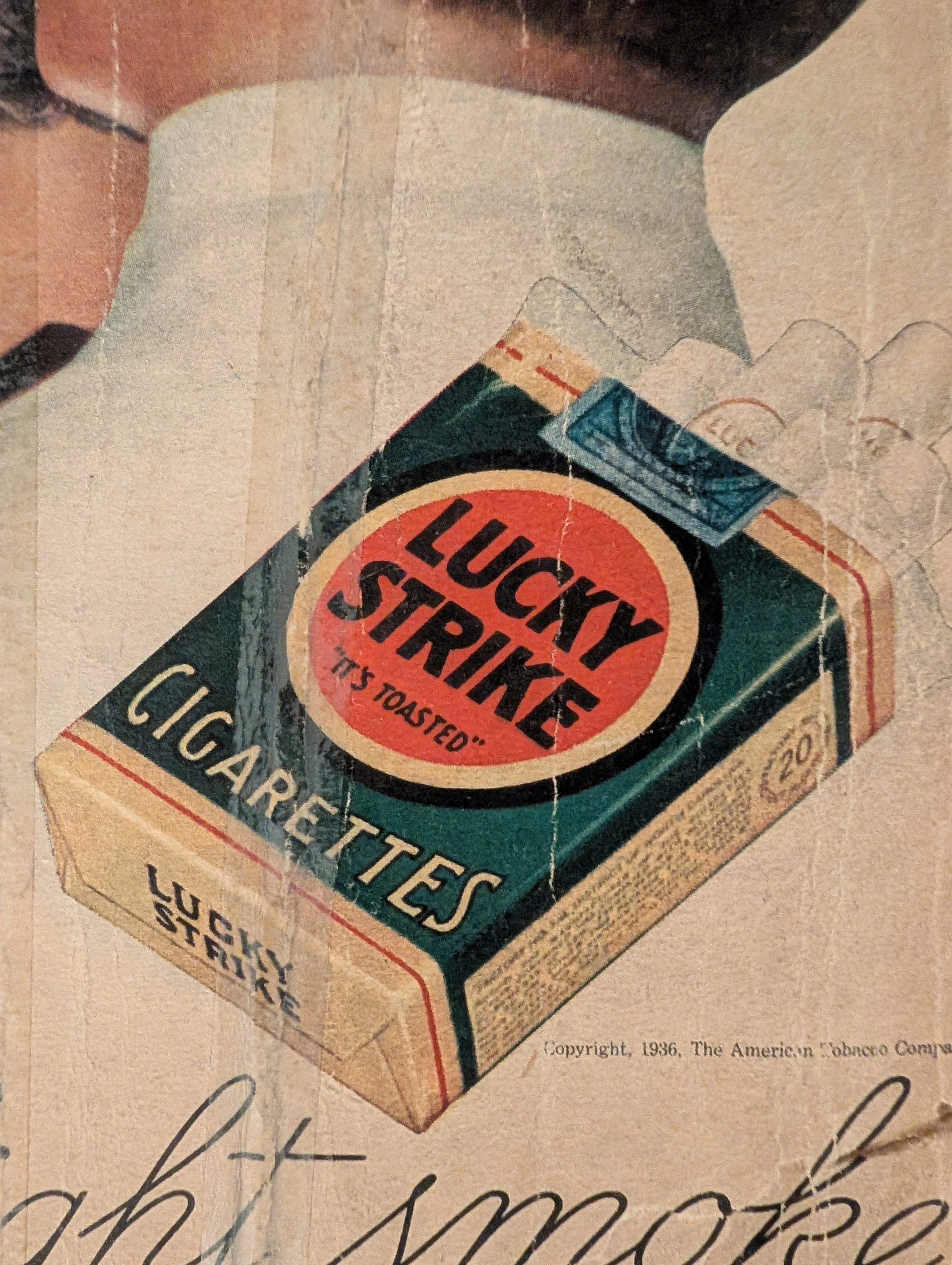
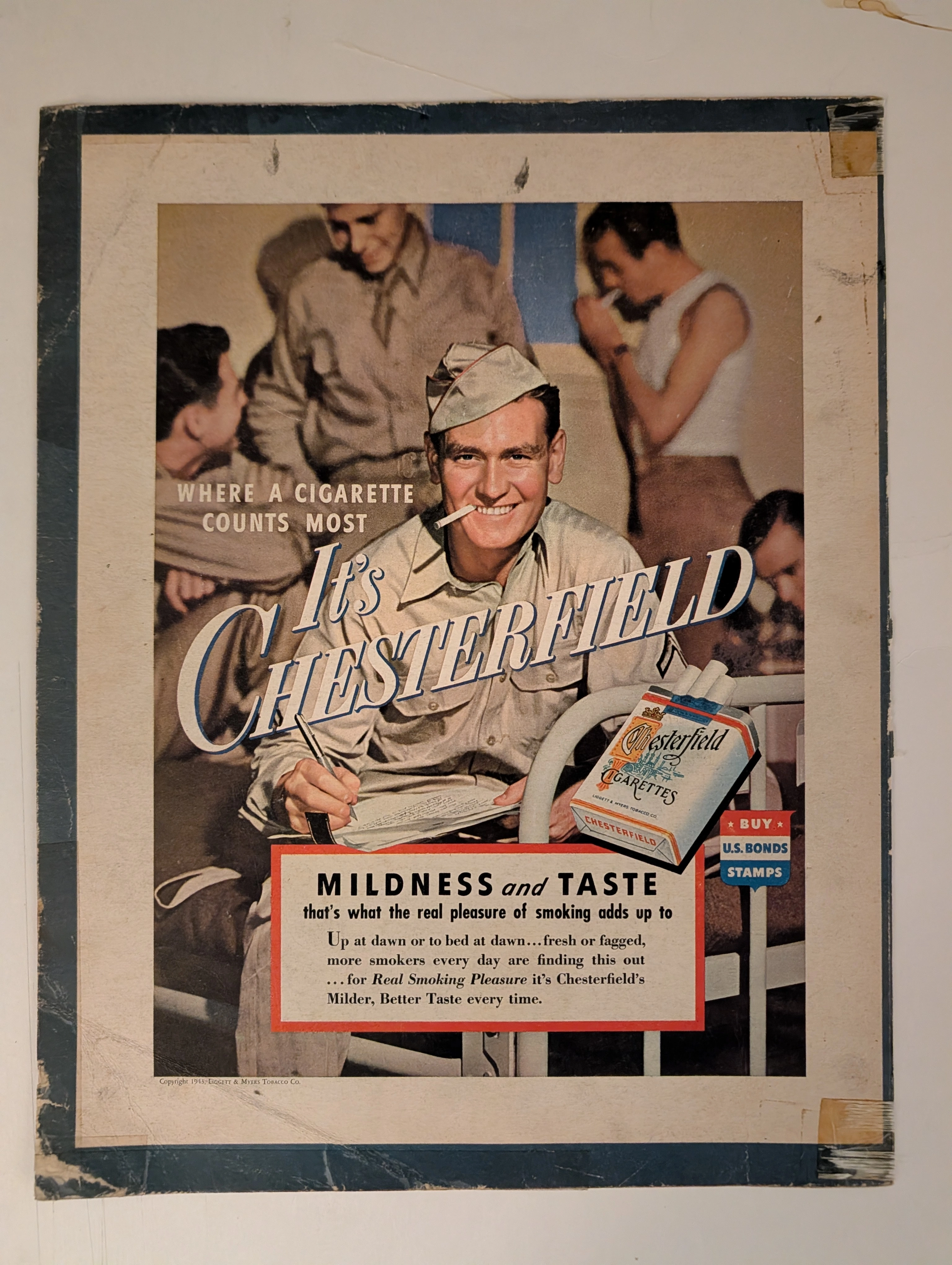
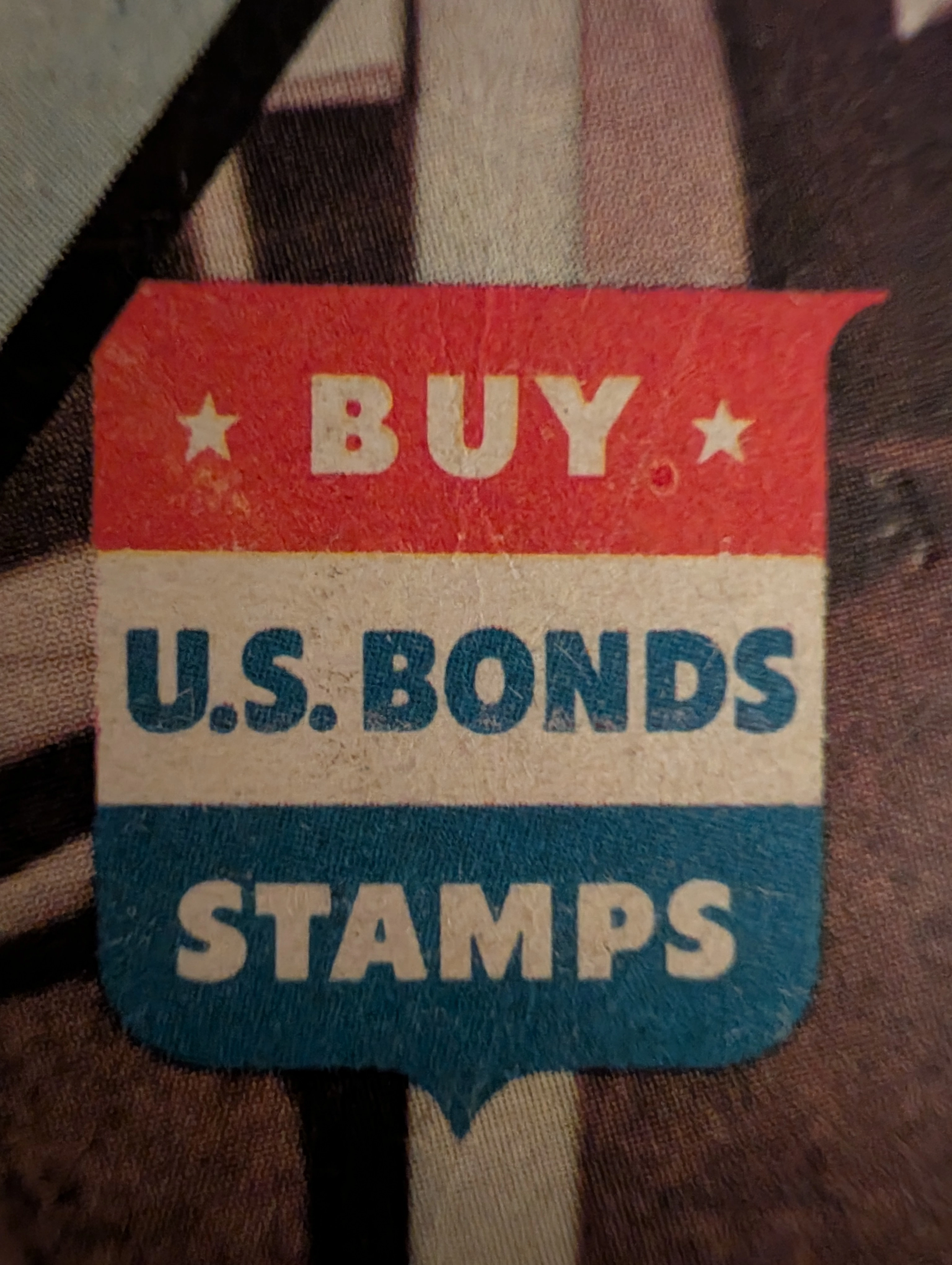
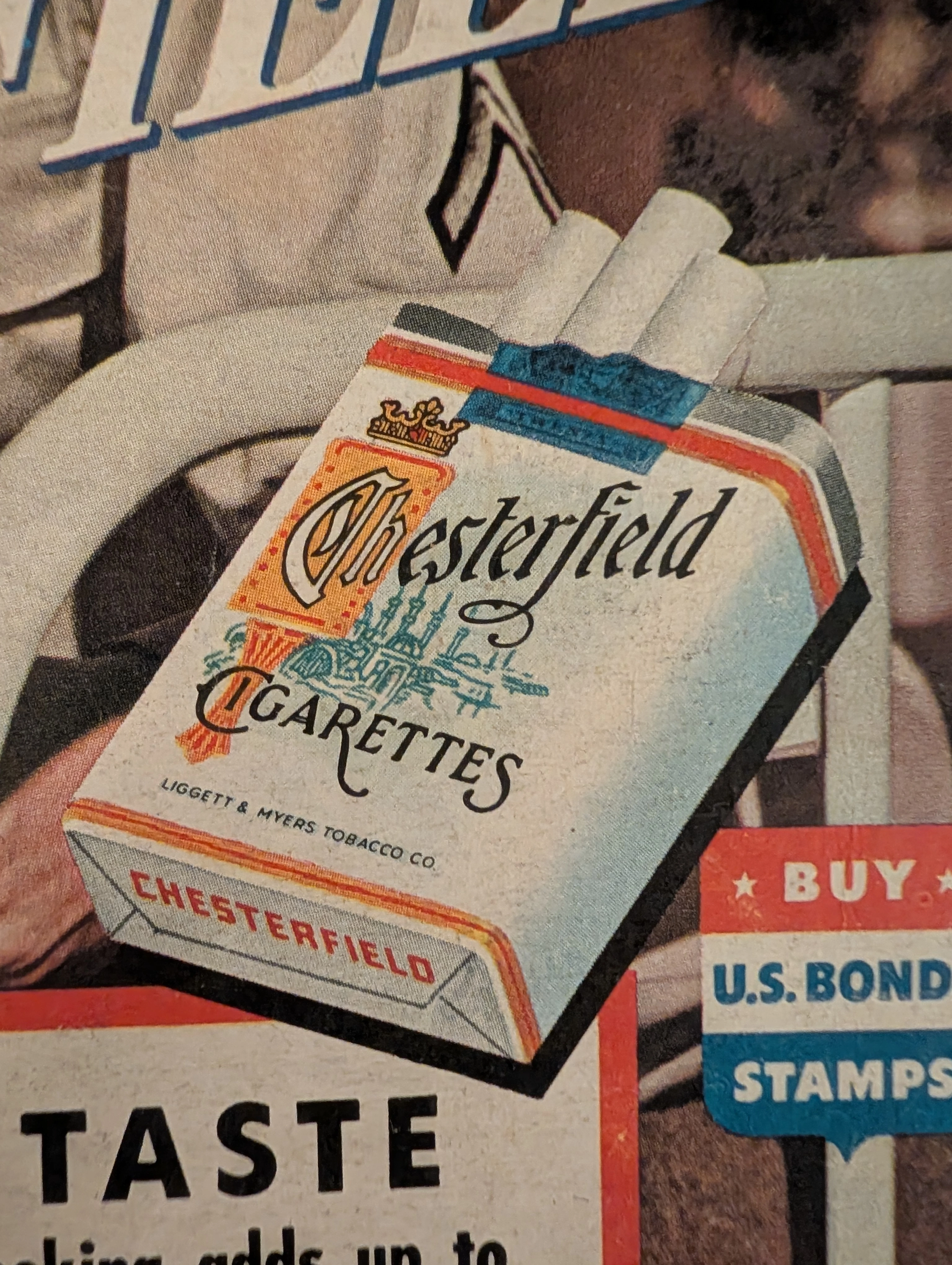
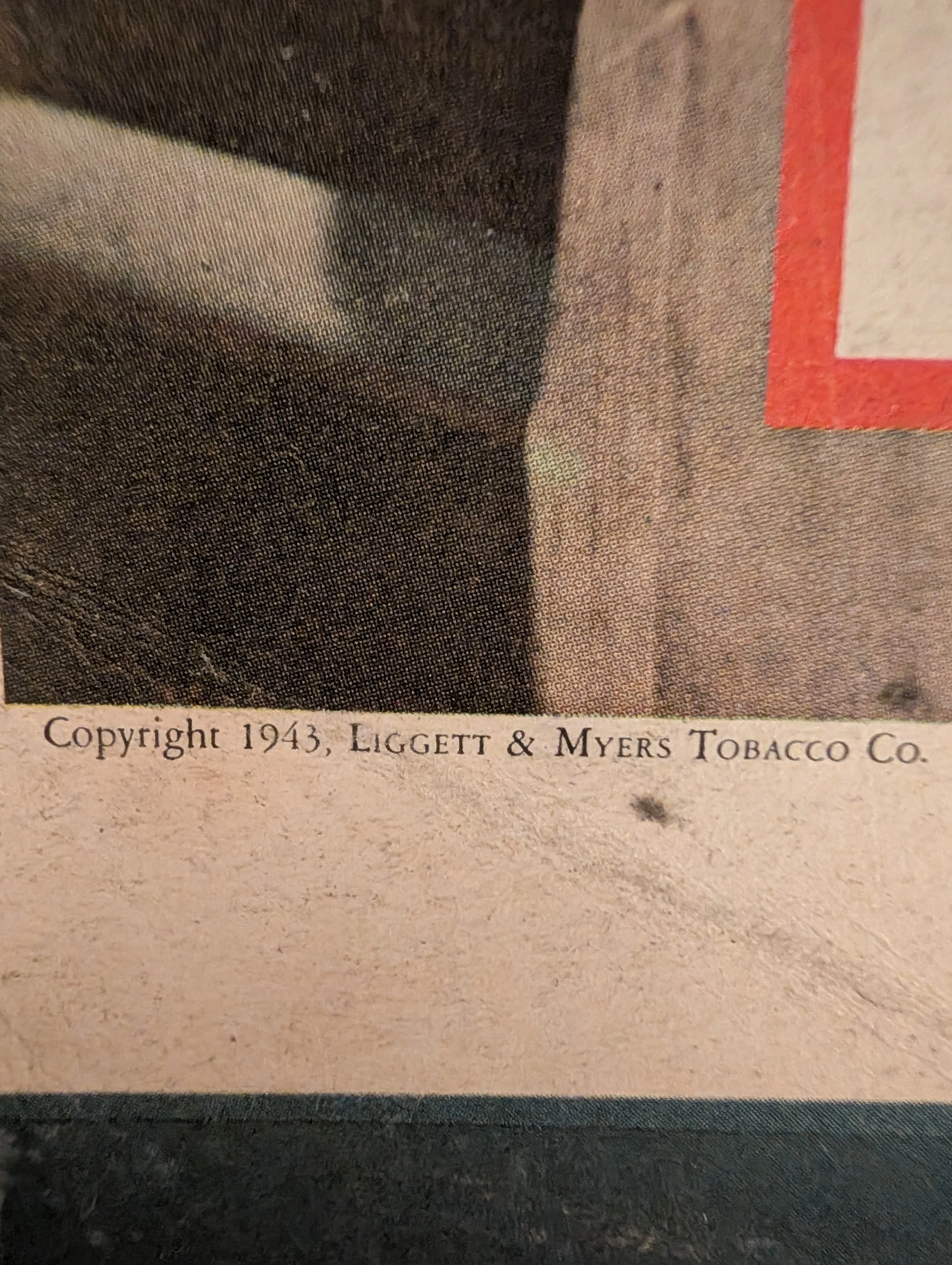
As the Chief Curator of The Record, I welcome you to the absolute, suffocating zenith of the Second World War. This Primary Art Document is forensically and undeniably dated to 1943 by the explicit legal text: "Copyright 1943, LIGGETT & MYERS TOBACCO CO.". The year 1943 was the terrifying climax of WWII. Madison Avenue ad executives brilliantly weaponized the anxiety of the Home Front. The Visual Architecture forcefully presents an idealized, smiling American G.I., sitting on his military cot, a Chesterfield cigarette hanging casually from his lips as he writes a letter home. The commanding headline, "WHERE A CIGARETTE COUNTS MOST," sent a direct, pacifying message to anxious families: Your boy is fine, and his ultimate solace in the horror of war is a Chesterfield. The true chilling gravity of this artifact is its role as "State-Sponsored Propaganda." Imposed upon the commercial art is a bold, patriotic shield bearing a strict government mandate: "BUY U.S. BONDS STAMPS". Smoking Chesterfield was inextricably linked to being a loyal, patriotic American.
The Paper
The Aesthetics of Decay (Wabi-Sabi) & The Fossils of Cellophane Tape
This artifact is the absolute epitome of a "Battered War Veteran." Magazines printed during WWII utilized exceptionally cheap, highly acidic wood-pulp paper due to strict Wartime Rationing. The left margin exhibits severe, jagged tears. But the true forensic miracles are the ancient, calcified residues of cellophane tape gripping the corners. Decades ago, a desperate owner attempted to repair this disintegrating page. That tape has turned into a hardened fossil, leaving deep chemical burns. Ambient oxygen has burned the once-white paper into a deep, toasted amber. This majestic death perfectly embodies the Japanese aesthetic of wabi-sabi.
The Rarity
Class S — A Miraculous Survivor of the Government Incinerators ]
Finding a 1943 primary document articulating both military history and explicit War Bond propaganda is an archival miracle. During the war, the U.S. government launched massive "Paper Drives," pulping millions of magazines for artillery packaging. The fact that this advertisement survived for over eight decades unequivocally commands the absolute highest Rarity Class S designation.
Exhibition Halls
The Archive Continues
Continue the Exploration
Kodak · Technology
The Time Traveller's Dossier: The Illumination of Memory – The Kodak Instamatic 104 and the Flashcube Revolution
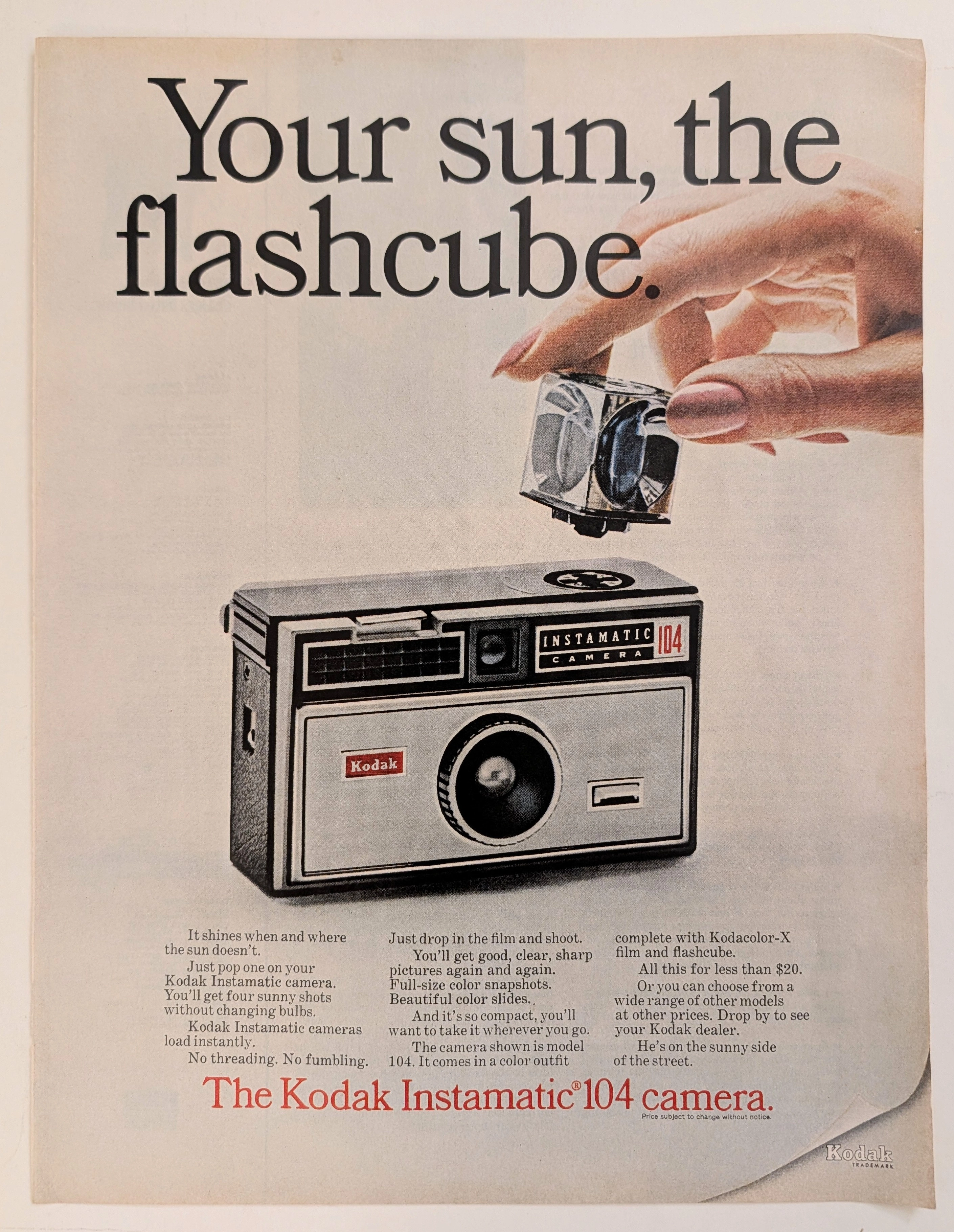
The evolution of the American domestic experience during the mid-twentieth century was inextricably linked to the ability of the average citizen to document it. The historical artifact elegantly and securely positioned upon the analytical table of The Record Institute today is a striking, full-page print advertisement for the Kodak Instamatic 104 camera, dating to the mid-1960s. This document completely transcends the standard boundaries of consumer electronics marketing. It operates as a highly sophisticated, multi-layered cultural and historical mirror, reflecting the precise era when the complexities of photographic chemistry and illumination were engineered out of existence, explicitly packaged, and sold to the American public not merely as a mechanical device, but as the effortless capturing of time itself. This world-class, comprehensive dossier conducts a meticulous, unyielding, and exceptionally deep examination of the artifact, operating under the absolute most rigorous parameters of historical, sociological, and material science evaluation. With our analytical focus dedicated overwhelmingly to its profound historical gravity (comprising 80% of our scholarly evaluation), we will decode the brilliant marketing psychology embedded within the "Your sun, the flashcube" narrative, analyze the immense sociological impact of George Eastman's legacy, and dissect the rich semiotics of the camera's accessible design. Furthermore, as we venture deeply into the chemical and physical foundations of this analog printed ephemera (10% focus), we will reveal the precise mechanical fingerprints of the CMYK halftone rosettes and the graceful, natural oxidation of the paper substrate. Finally, we will assess its archival significance (10% focus), exploring how this precise intersection of visual nostalgia, mid-century commercial artistry, and the immutable chemistry of time cultivates a serene wabi-sabi aesthetic—a natural, irreversible phenomenon that serves as the primary engine driving up its market value exponentially within the elite global spheres of Vintage Commercial Ephemera and Mid-Century Lifestyle collecting.
The Time Traveller's Dossier: How a 1959 Beer Ad Turned Alcohol into 'Health Food' – Barley and Malt Institute Advertisement
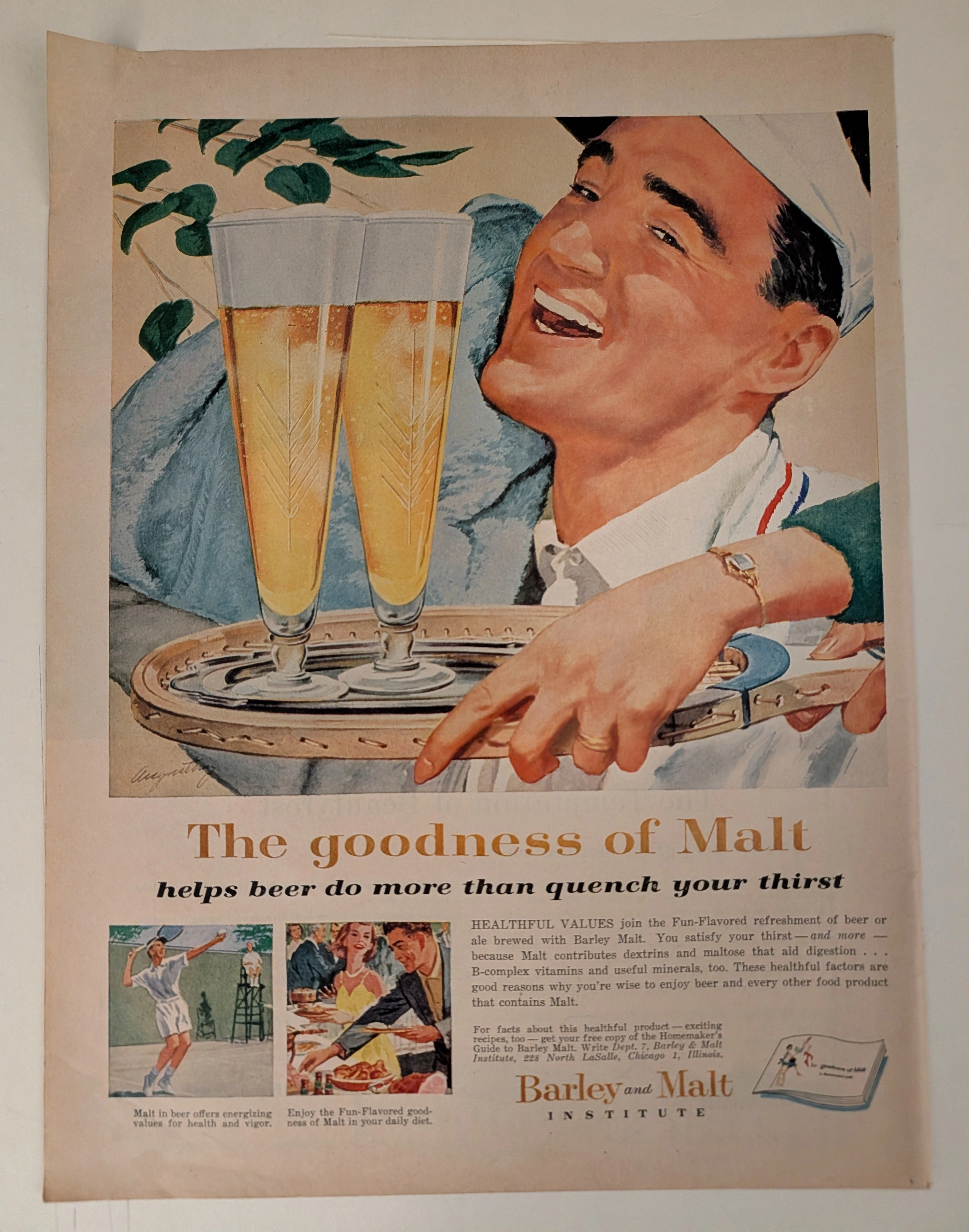
History is not written; it is printed. Before digital algorithms dictated human behavior, societal engineering was executed through the calculated geometry of the four-color offset press. The artifact before us is not merely an advertisement; it is a weaponized blueprint of middle-class aspiration. This museum-grade archival dossier presents an academic deconstruction of a 1959 print advertisement commissioned by the Barley and Malt Institute of Chicago. Operating on a profound binary structure, it documents a calculated paradigm shift within the American alcohol industry. It illustrates the precise historical fracture where beer was conceptually transitioned from a stigmatized working-class vice into a health-conscious staple of suburban domesticity. Through the lens of mid-century commercial artistry and precise visual forensics, this document serves as a masterclass in psychological marketing, establishing cultural tropes that unconditionally dominate modern pop culture and contemporary branding
Sky Way · Travel
The Time Traveller's Dossier: The Aesthetics of Gifting and Consumer Hypnosis – Skyway Luggage Advertisement (Circa 1950s)
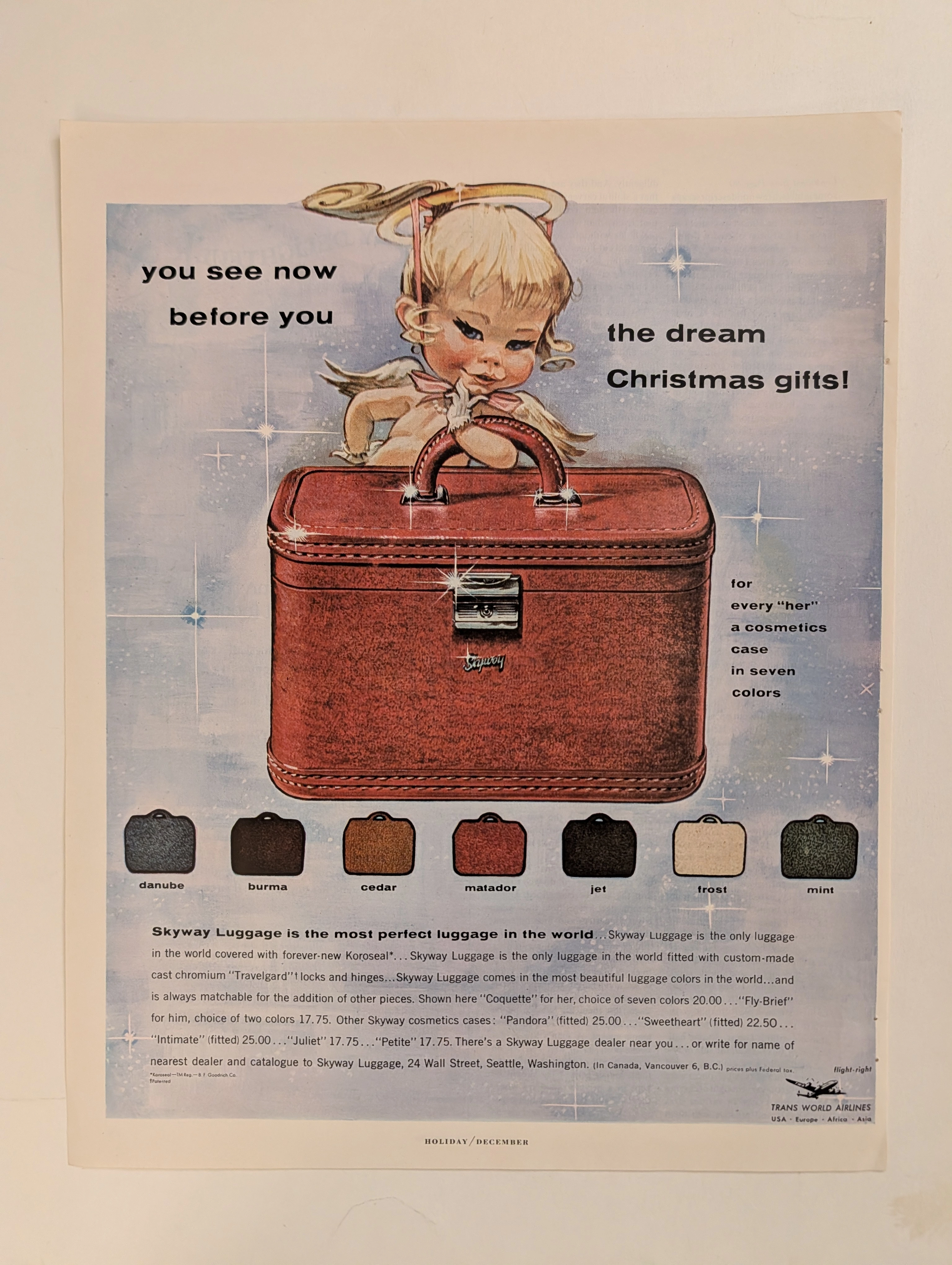
The history of commercial marketing is rarely driven by cold, rational logic; it is forged, molded, and dictated through the weaponization of emotion, manufactured desire, and the carefully engineered magic of the holiday season. Long before digital algorithms were deployed to predict and manipulate our purchasing behaviors, social engineering and consumer psychology were executed with devastating precision through the tip of a master illustrator’s brush on the pages of glossy magazines. The historical artifact standing before us is not merely a run-of-the-mill mid-century holiday campaign for a luggage brand. It is an absolute visual "Trojan Horse"—one of the most cunningly designed blueprints ever utilized to bypass the consumer's psychological defenses. It serves as an unwavering testament to an era when the stark, industrial rigidity of manufactured goods was brilliantly concealed beneath the irresistible wrapping paper of festive innocence. This museum-grade academic archival dossier presents an exhaustive, uncompromising deconstruction of a late-analog print advertisement from Skyway Luggage. Operating on a ruthlessly calculated, gender-segregated binary narrative structure, this campaign captures a critical paradigm shift: the exact historical moment when luggage transcended its utilitarian status as a mere "storage box" and was conceptually elevated into a highly coveted "dream Christmas gift." Through the highly specialized lens of mid-century commercial artistry and stringent visual forensics, this document serves as a masterclass in the psychological marketing of manufactured desire. It established the foundational archetype for the holiday retail economy—an archetype that unconditionally dictates the global lifestyle merchandising strategies of today.