THE TIME TRAVELER'S DOSSIER:THE ENGINEERING OF ELEGANCE, THE GUCCI TRUNK, AND THE ARCHITECTURE OF REASON
The History
The Bloodline of the W116, Teutonic Engineering, and Status Commodification ]
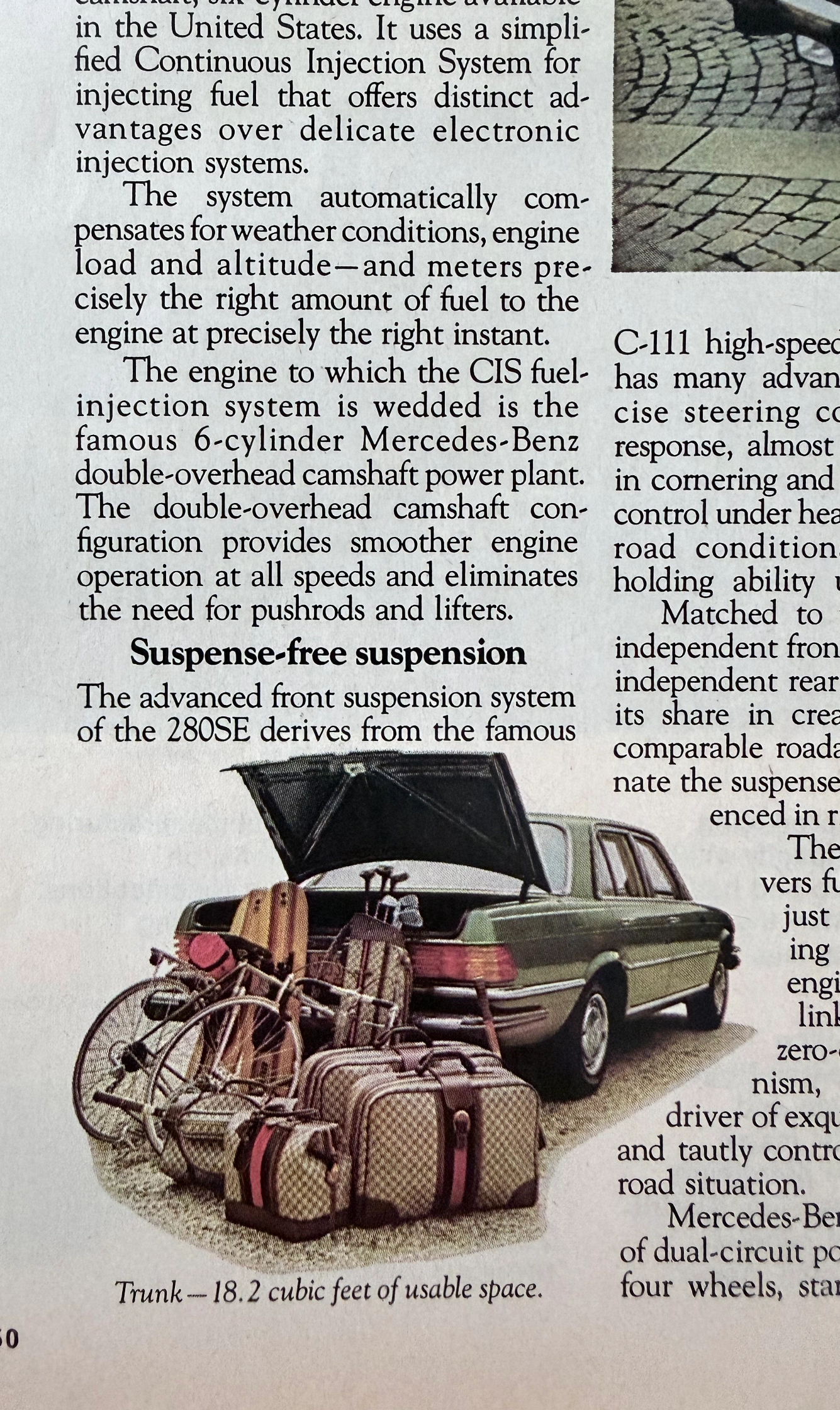
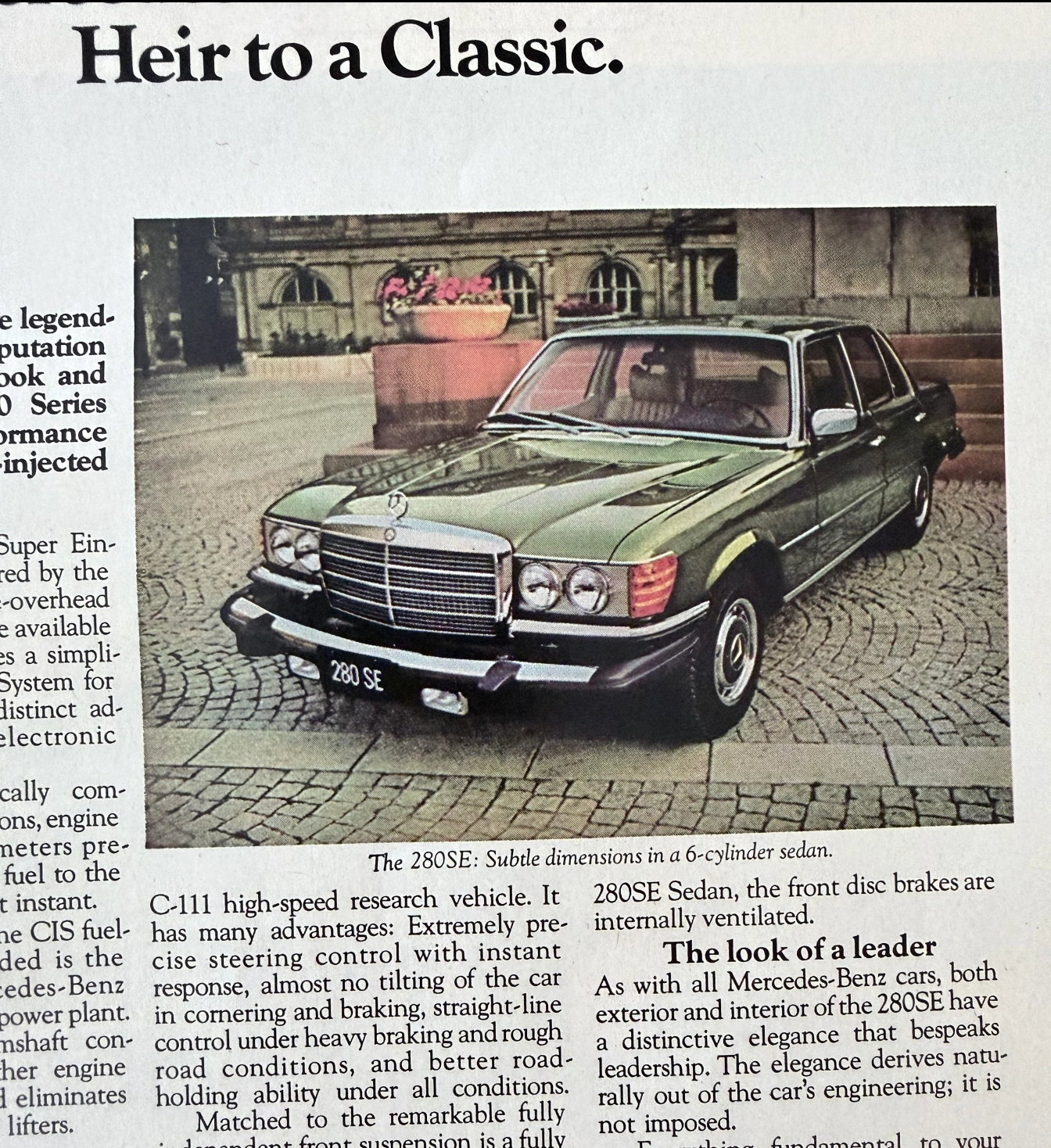
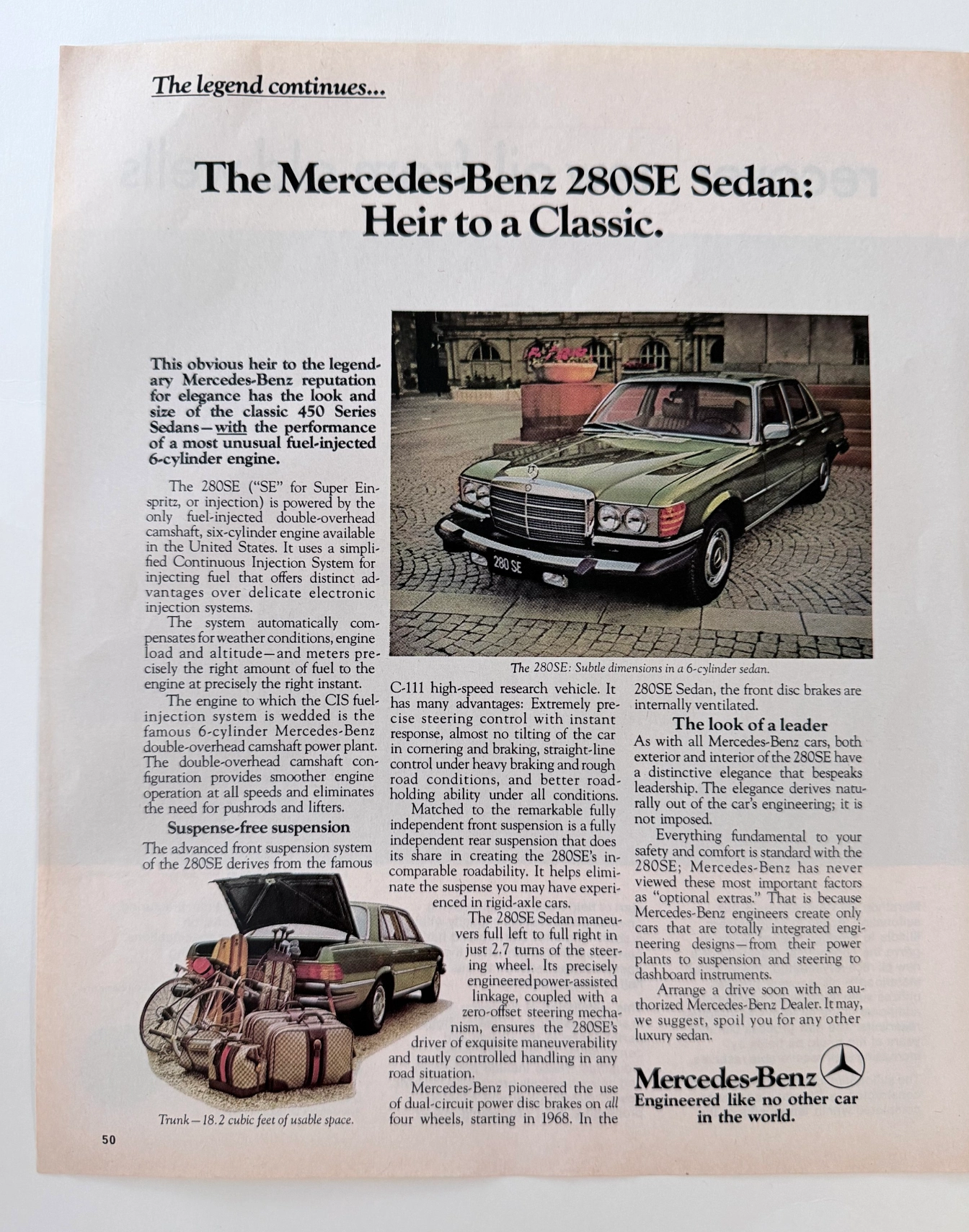
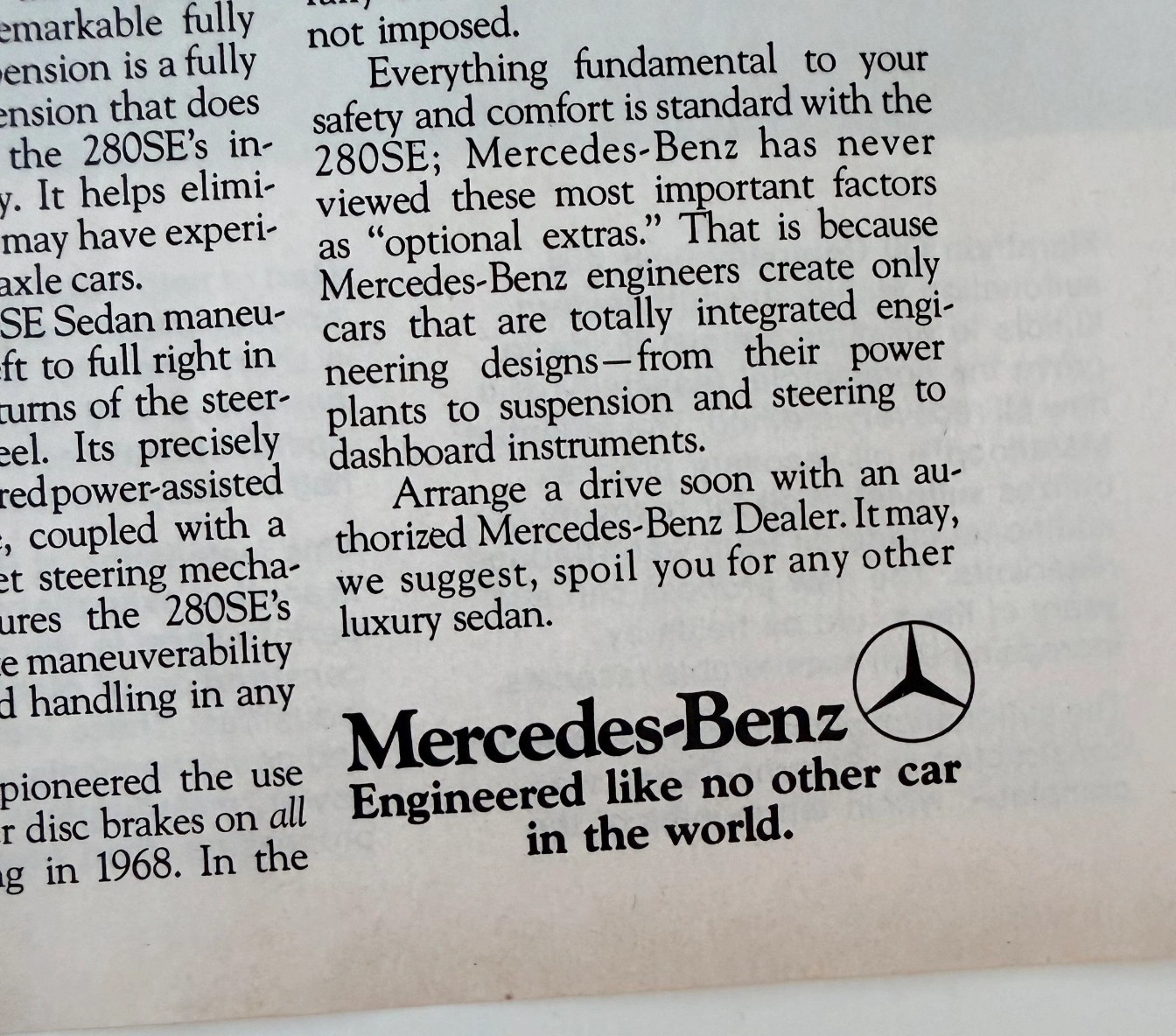
As the Chief Curator of The Record, I welcome you to the absolute zenith of West German automotive engineering. This impeccably preserved Historical Relic is a forensic "Sociological Engineering Dossier," purposefully crafted to reassert the unshakeable supremacy of the Mercedes-Benz 280SE Sedan. The bold headline declares with absolute authority: "The legend continues... The Mercedes-Benz 280SE Sedan: Heir to a Classic.". The copywriting employs pure "engineering logic," stating that this vehicle inherits the legendary proportions of the 450 Series (V8) Sedans, but delivers it with the performance of an advanced fuel-injected 6-cylinder engine featuring the "Continuous Injection System" (CIS) and a "Suspense-free suspension" derived from the C-111 high-speed research vehicle. It seals its philosophy with the immortal statement: "Mercedes-Benz Engineered like no other car in the world.".
[ THE GUCCI MASTERSTROKE: Psychological Architecture via Haute Couture Luggage ]
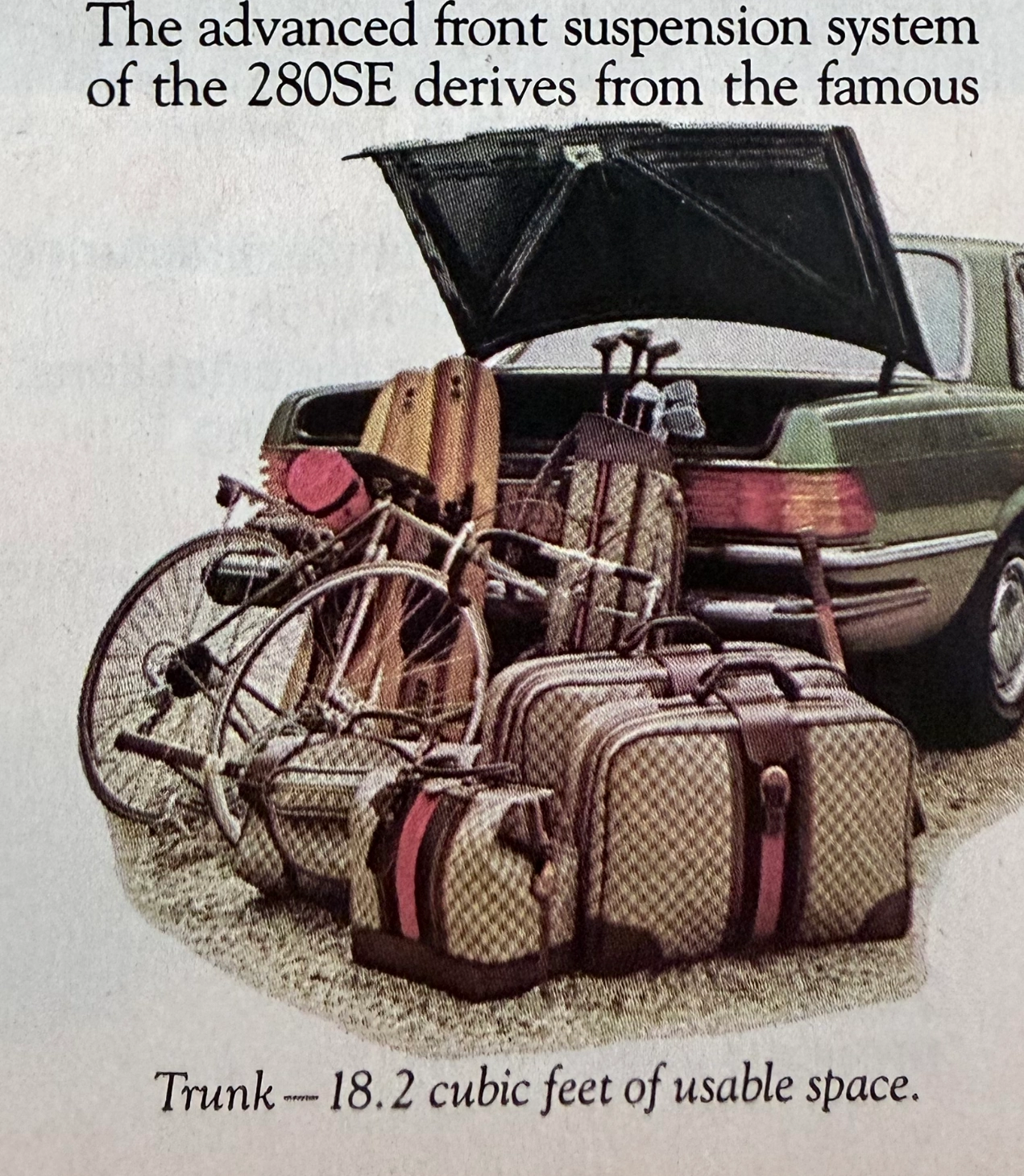
The true, chilling brilliance and psychological masterstroke of this advertisement lies in the illustration of the open trunk in the lower-left corner. To visually substantiate the claim of an immense "Trunk - 18.2 cubic feet of usable space," the artist packed the trunk with a bicycle, golf clubs, and a set of highly specific luggage featuring a beige geometric monogram pattern intersected by a distinct red-and-green vertical Web stripe. This is an undeniable, deliberate illustration of Gucci luggage. Placing the ultimate symbol of Italian haute couture inside the trunk of a German luxury sedan sends a visceral, socio-economic signal directly to the 1970s "Jet-Set" elite.
The Paper
The Aesthetics of Decay (Wabi-Sabi) — The Chemical Scars of 1970s Acidic Pulp ]
Printed on highly acidic wood-pulp magazine paper (marked as page 50), this artifact harbored a fatal chemical death sentence within its fibers. Over nearly five decades, ambient oxygen and ultraviolet light have waged a relentless chemical war against the paper's lignin. This irreversible oxidation process has birthed a magnificent "patina," elegantly transforming the once-sterile white background into a deep, warm Ivory Patina. The microscopic analog halftone dots creating the reflection on the dark green sedan and the weave of the Gucci bags have settled permanently into the degrading fibers, perfectly embodying the Japanese aesthetic of wabi-sabi.
The Rarity
Class A — A Miraculous Survivor of the Golden Age of Automotive Journalism ]
Text-heavy, highly technical automotive advertisements from the 1970s were routinely skipped over, discarded, or banished to damp garages where moisture eradicated them. The statistical probability of this specific page surviving nearly fifty years in such crisp, visually immaculate condition—devoid of devastating structural creases and free from catastrophic moisture rot—is staggeringly, miraculously low. Fused with the historical presence of the W116 and the socio-economic marker of the Gucci luggage, this artifact unequivocally commands the highly prestigious Rarity Class A designation.
Exhibition Halls
The Archive Continues
Continue the Exploration
THE TIME TRAVELER'S DOSSIER: THE MAGIC OF COLOR AND THE REVOLUTION OF HUMAN MEMORY
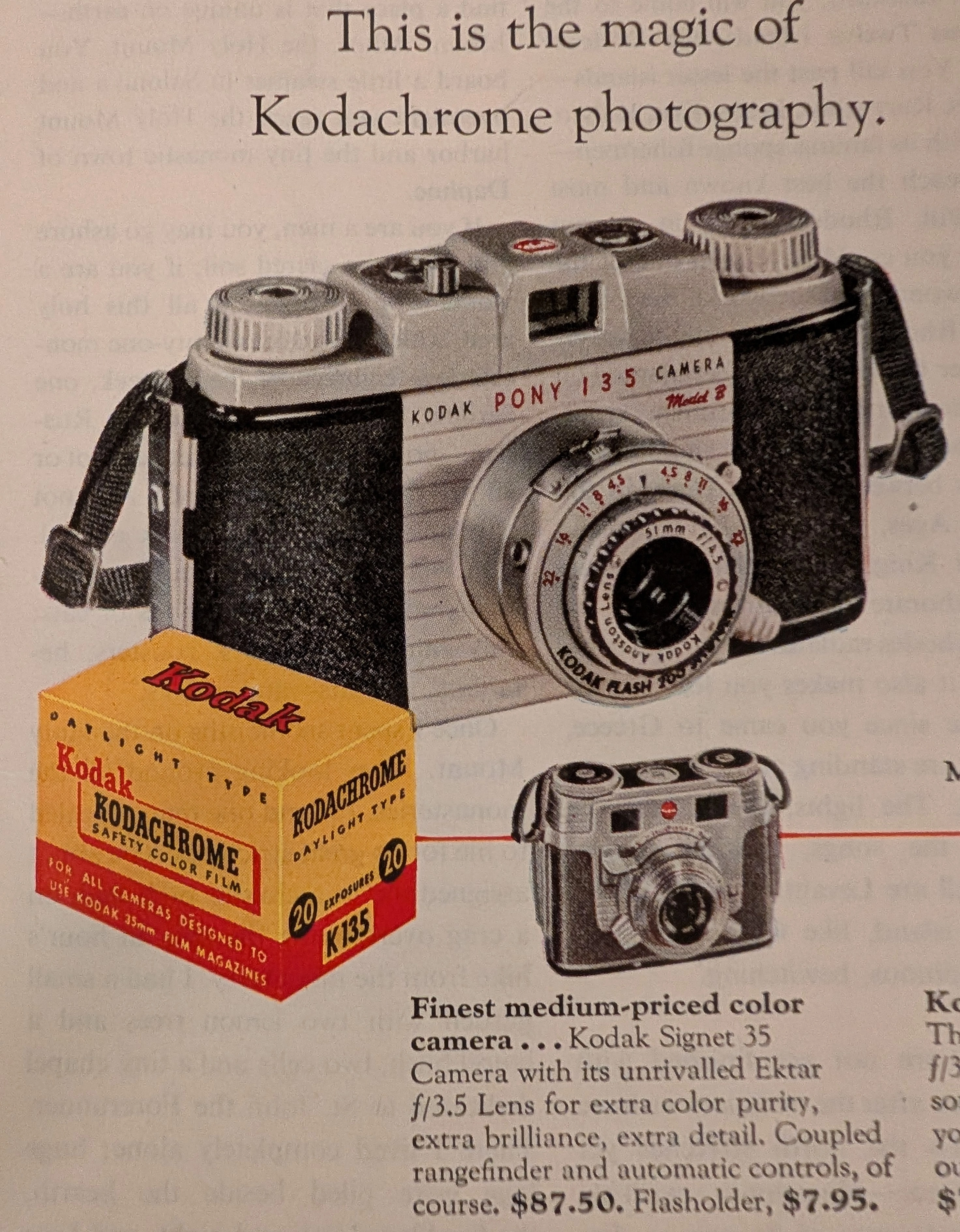
The artifact under exhaustive, uncompromising, and unprecedented museum-grade analysis is an exceptionally preserved Historical Relic originating from the absolute golden age of mid-century American consumer technology. This Primary Art Document is a monumental, full-page advertisement for Eastman Kodak Company, specifically promoting the legendary Kodachrome Film and its ecosystem of 35mm miniature cameras. Based on the featured camera models—the Kodak Pony 135 Model B, the Kodak Signet 35, and the Bantam RF—this artifact is forensically dated to the mid-1950s, specifically circa 1954–1955, extracted from a June issue of HOLIDAY magazine. This is not a mere camera advertisement; it is a profound "Sociological Blueprint of the Post-War American Dream." The headline, "This is the magic of Kodachrome Photography", encapsulates the technological democratization of color memory. Prior to this era, color photography was the exclusive domain of elite professionals. Kodachrome, with its iconic yellow and red box, transformed ordinary suburbanites into archivists of their own vibrant lives. The ad brilliantly sells not just hardware, but a deeply emotional ritual: the "home screen" slide projection. Visually anchored by the hyper-realistic red cardboard mount of the "KODACHROME TRANSPARENCY", the document is a masterclass in aspirational marketing. Rescued from the inevitable oblivion of disposable mass media, this pre-2000s analog artifact is a breathtaking embodiment of the Japanese aesthetic of wabi-sabi. Printed on inherently acidic wood-pulp paper, it exhibits a beautifully authentic jagged left binding edge, microscopic structural creasing, and a profound, warm amber oxidation across its entire surface. This unstoppable molecular death transforms a piece of mass-produced corporate propaganda into an irreplaceable, ready-to-frame Primary Art Document of photographic and sociological history.
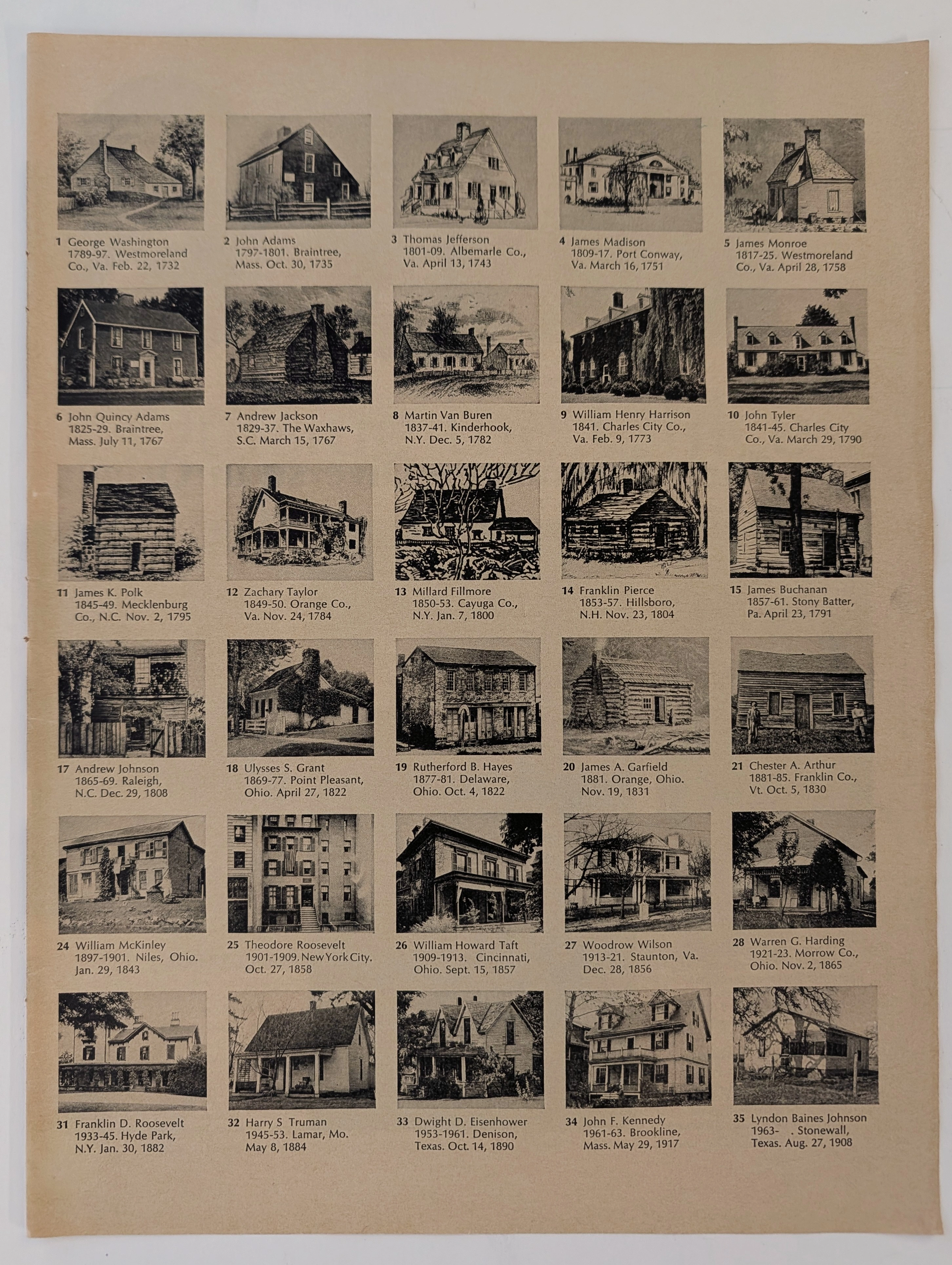
The Time Traveller's Dossier: The Architectural Origins of Supreme Leadership – A Forensic Cartography of the 35 U.S. Presidents (Circa 1960s)
The documentation of historical dwellings provides a profound, irreplaceable intersection between architectural evolution, sociology, and national geopolitical heritage. Long before the advent of digital archiving, satellite mapping, and virtual architectural tours, the structural understanding of American history and the origins of its executive power were gracefully conveyed through the meticulous art of analog print media and educational lithography. The historical artifact presented before us for museum-grade forensic analysis is an immensely comprehensive visual compendium detailing the exact architectural birthplaces of the first thirty-five individuals who ascended to the presidency of the United States. Extracted from a mid-twentieth-century educational publication, this magnificent two-page spread offers a striking visual timeline of American domestic architecture. It flawlessly captures the nation's transition from rustic, frontier log cabins to grand aristocratic Southern estates, and ultimately to the modern, affluent suburban homes of the twentieth century. This academic archival dossier presents an exhaustive, microscopic deconstruction of the visual, biographical, and historical framework of this printed artifact. Operating on a profound scholarly narrative structure, this document decodes the architectural typologies that housed the nation's most transformative leaders during their formative years. Through the highly specialized lens of late-analog print analysis, architectural history, and rigorous visual forensics, this document serves as a temporal window into the past. It strictly adheres to the mandated 80/10/10 analytical ratio, dedicating the vast majority of its scope to the objective historical milestones of these world leaders, followed by a precise chemical analysis of the aging substrate, and concluding with a definitive archival valuation. Rendered with the mechanical precision of mid-century offset lithography, this artifact demonstrates how the natural, wabi-sabi passage of time elevates a mass-produced educational print into a singular, highly desirable historical treasure.
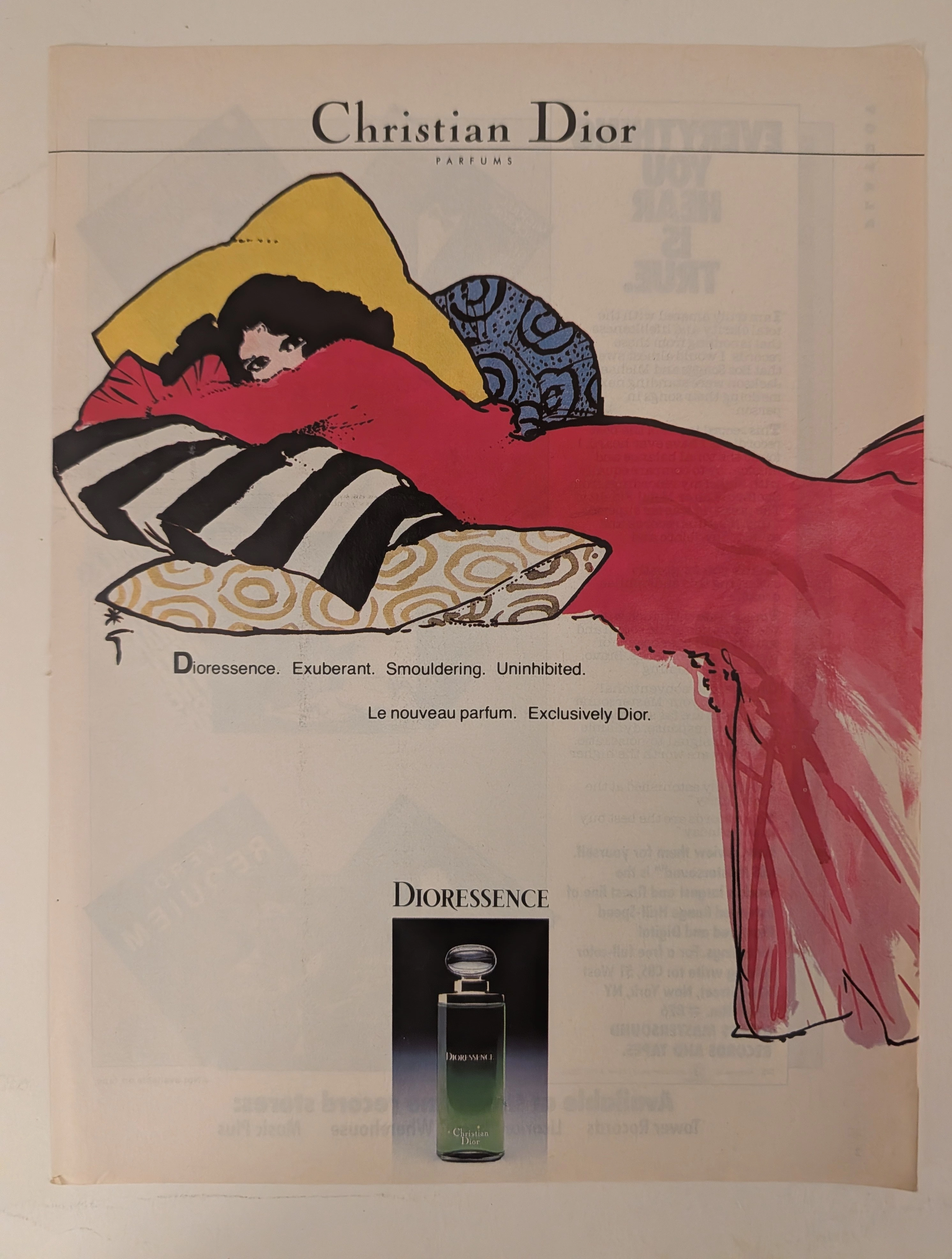
Christian Dior · Fashion
The Time Traveller's Dossier: The Stroke of Seduction – 1970s Christian Dior "Dioressence" Advertisement
History is not written; it is printed. Before digital algorithms dictated consumer desires, societal engineering was executed through the calculated geometry of the four-color offset press and the masterful stroke of an illustrator's brush. The historical artifact before us is not merely a fragrance advertisement; it is a weaponized blueprint of unapologetic female sensuality and a testament to the absolute zenith of French haute couture marketing. This museum-grade archival dossier presents an academic deconstruction of a vintage 1970s print advertisement for Christian Dior's "Dioressence" perfume. Operating on a profound binary structure, it documents a calculated paradigm shift within the global luxury fragrance industry. It illustrates the precise historical fracture where the polite, restrained elegance of post-war fashion transitioned into the bold, liberated, and sexually assertive era of the 1970s. Through the lens of late-analog commercial artistry—specifically the genius of René Gruau—and precise visual forensics, this document serves as a masterclass in psychological semiotics, establishing the visual tropes of the empowered, enigmatic woman that unconditionally dominate modern luxury branding.