THE TIME TRAVELER'S DOSSIER: THE MAGIC OF COLOR AND THE REVOLUTION OF HUMAN MEMORY — The Record Institute JournalTHE TIME TRAVELER'S DOSSIER: THE MAGIC OF COLOR AND THE REVOLUTION OF HUMAN MEMORY — The Record Institute JournalTHE TIME TRAVELER'S DOSSIER: THE MAGIC OF COLOR AND THE REVOLUTION OF HUMAN MEMORY — The Record Institute JournalTHE TIME TRAVELER'S DOSSIER: THE MAGIC OF COLOR AND THE REVOLUTION OF HUMAN MEMORY — The Record Institute Journal
1 / 4

✦ 4 Photos — Click any image to view in high resolution

March 8, 2026

THE TIME TRAVELER'S DOSSIER: THE MAGIC OF COLOR AND THE REVOLUTION OF HUMAN MEMORY

Archive Views: 46

The History

(THE HISTORY: The Golden Age of Kodachrome, 1950s Consumerism, and the "Slide Night" Ritual)

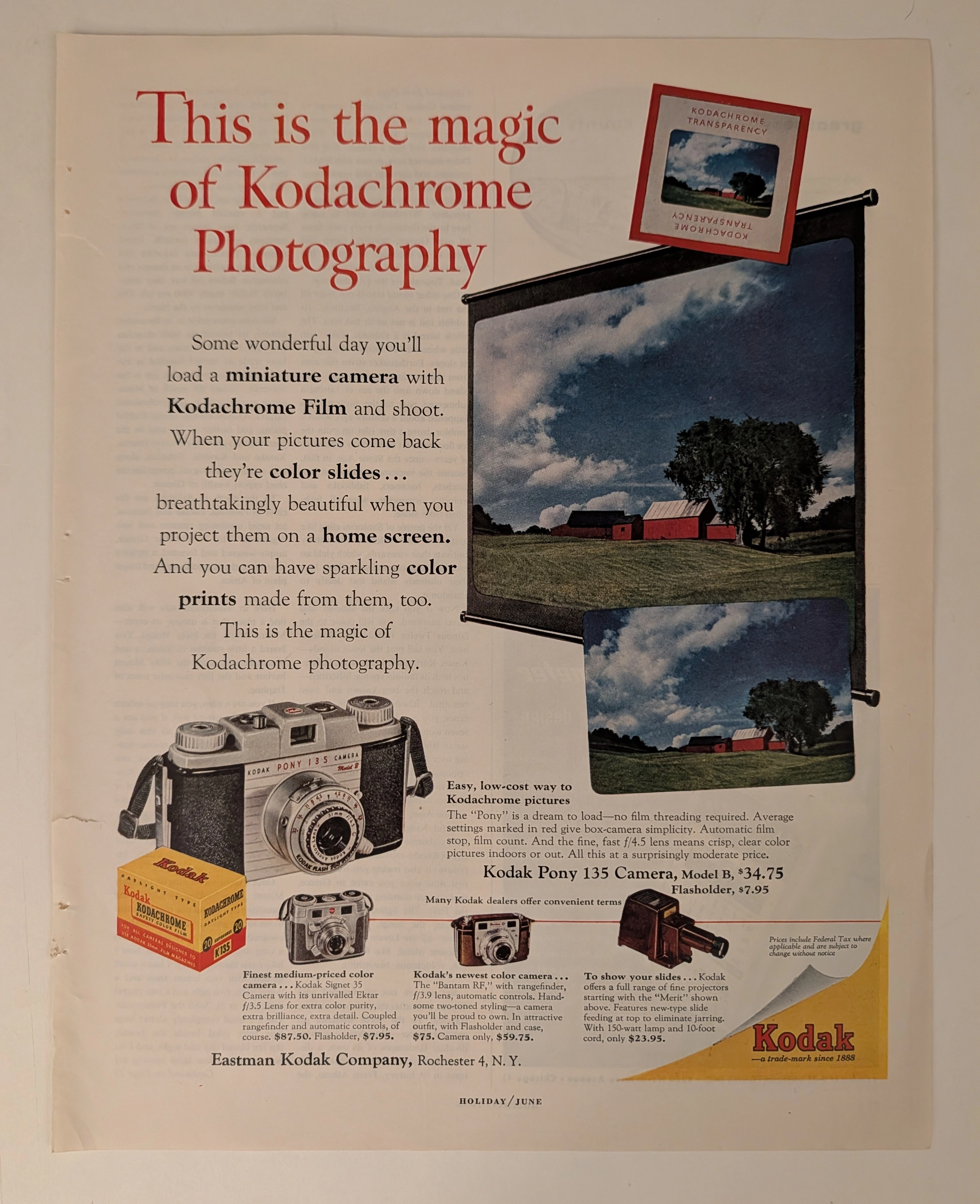
As the Chief Curator of The Record, the uncompromising guardian of analog history, I welcome you to the absolute, breathtaking epicenter of mid-century American technological supremacy. The heavily scarred, magical Historical Relic that lies before you is not a mere, soulless vintage camera advertisement. It is a forensic "Sociological Architecture of Memory," meticulously engineered in the mid-1950s (circa 1954-1955) to completely revolutionize how humanity documented, viewed, and remembered its own past. This Primary Art Document is the formidable work of the Eastman Kodak Company, the absolute global sovereign of the photographic empire.

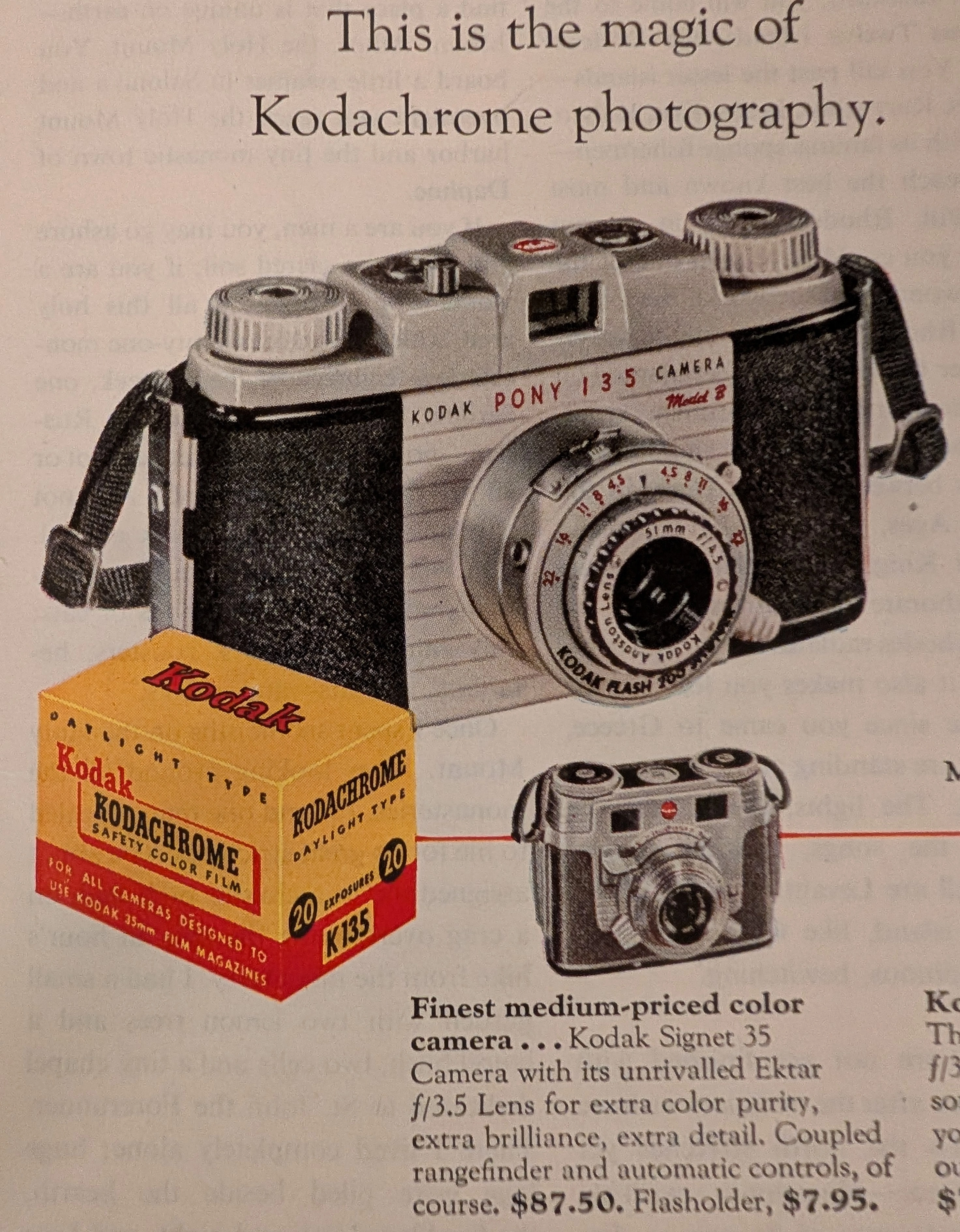
The staggering, immense historical gravity of this artifact explodes from its bold, confident typography: "This is the magic of Kodachrome Photography". Prior to the post-WWII boom of the 1950s, color photography was an expensive, incredibly complex medium reserved strictly for high-end professionals, commercial advertising, or Hollywood. The average American family documented their lives exclusively in black and white. Kodak annihilated this paradigm by heavily pushing "Kodachrome"—the legendary 35mm color reversal film (perfectly symbolized by the iconic, hyper-recognizable yellow and red K135 box)—into the hands of the booming, prosperous middle class.

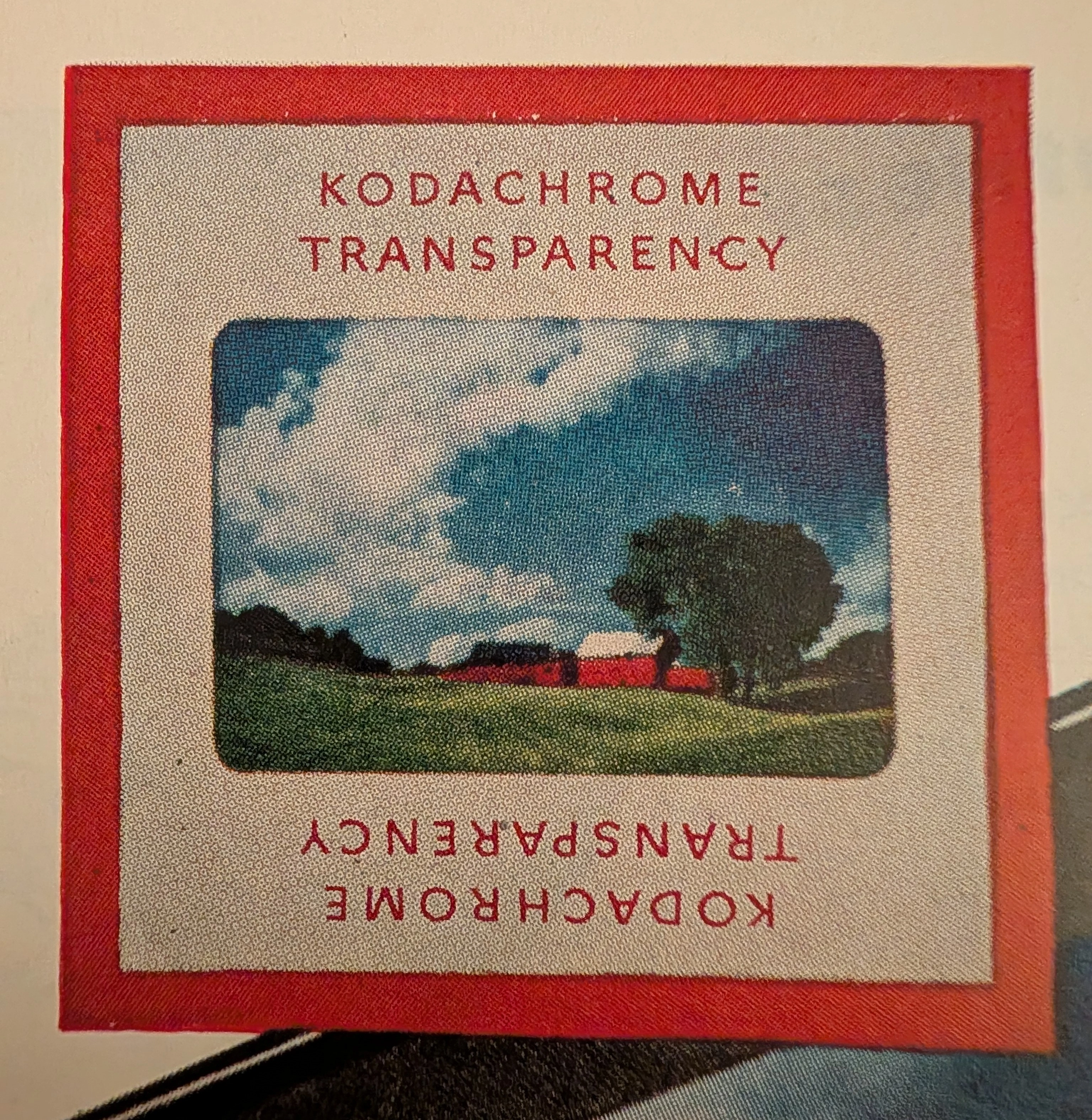
This is not just advertising; it is profound "Social Engineering." Kodak wasn't just selling a roll of film or a camera; they were aggressively manufacturing and selling a completely new cultural ritual: the "Slide Night." The ad masterfully paints this picture: "When your pictures come back they're color slides... breathtakingly beautiful when you project them on a home screen". Kodak dictated that the suburban living room should be transformed into a private cinema. The visceral image of the glowing projection screen displaying a vivid red barn against a rich blue sky, paired with the sacred red cardboard slide mount explicitly stamped "KODACHROME TRANSPARENCY", became the ultimate pop-culture symbols of 20th-century family archiving.

Technologically, this document serves as an industrial catalog of liberation. It introduces the Kodak Pony 135 Camera, Model B, priced at a highly accessible $34.75. This specific camera was the primary weapon that democratized the 35mm format for amateurs. For the discerning enthusiast, the ad also features the Signet 35 ($87.50) with its revered Ektar lens. This tiered pricing strategy is a textbook example of mid-century capitalist brilliance, designed to ensure every American could participate in the "magic" of color.

(THE PAPER: The Aesthetics of Decay (Wabi-Sabi) — The Violent Liberation from the 1950s )
At The Record, our ultimate, uncompromising reverence is reserved for the inevitable, tragic, and spectacular beauty of analog destruction. This artifact is the absolute epitome of a "Beautiful Survivor." Extracted from a June issue of HOLIDAY magazine (as verified by the microscopic "HOLIDAY/JUNE" text at the very bottom edge), this page was printed on incredibly cheap, highly acidic wood-pulp paper. It was explicitly designed by its publisher to be read, discarded, and forgotten.

Direct your curatorial, analytical gaze to the physical body of this artifact. The left margin exhibits a violent, jagged, and severely frayed edge tear. This is not a flaw; it is the forensic, physical evidence of its dramatic rescue—surgically and forcefully liberated from the glued and stitched binding of a decaying magazine destined for the incinerator. Over the course of nearly 70 years, ambient oxygen and ultraviolet light have waged a relentless, unstoppable chemical war against the paper's inherent lignin. This irreversible oxidation process has birthed a magnificent "patina," burning the once-sterile white paper into a deep, warm, toasted amber and creamy ivory.

The miraculous paradox of this piece is that while the paper structurally degrades, the authentic analog halftone dots of the cyan skies, the crimson barn, and the yellow film box have settled permanently into the brittle fibers. These are the unforgeable "Scars of Time." This paper is quietly, literally burning itself alive at a molecular level. No modern digital reprint, no high-resolution scan can ever replicate the fragile, tactile soul, nor the distinct olfactory signature of aging 1950s pulp. Its slow, majestic, and irreversible death is precisely what transfigures it into an immortal piece of Primary Art, perfectly embodying the profound Japanese aesthetic of wabi-sabi.

( THE RARITY: Class A — A Highly Coveted Holy Grail of Photographic Ephemera )
To understand the immense valuation of this artifact, you must comprehend the religious reverence that surrounds the word "Kodachrome" in the global photographic community. Kodachrome film was officially and permanently discontinued in 2009, instantly elevating all vintage materials associated with it from mere nostalgia to highly sought-after "Historical Treasures."
Finding intact, mass-market ephemera from the mid-1950s that retains such vibrant, bleeding color fidelity without devastating moisture rot or mold is an archival miracle. The fact that this specific advertisement—featuring the iconic vintage logo "Kodak - a trade-mark since 1888" and the legendary yellow/red film box—survived nearly seven decades, proudly wearing the violent physical scars of its endurance, is astounding. When you fuse this extreme physical scarcity with the monumental history of the color photography revolution, this artifact unequivocally commands the highly prestigious Rarity Class A designation. It has evolved far, far beyond a disposable piece of vintage advertising. It is a highly coveted Historical Relic, demanding to be framed and fiercely protected by an alpha curator who truly understands the heavy, beautiful weight of analog history that can never be reproduced.

▶ Watch Video

Share This Archive

The Archive Continues

Continue the Exploration
The Time Traveller’s Dossier: 1978 Camel Lights Vintage Advertisement — The Golden Illusion of Diminished Harm

Camel · Tobacco

The Time Traveller’s Dossier: 1978 Camel Lights Vintage Advertisement — The Golden Illusion of Diminished Harm

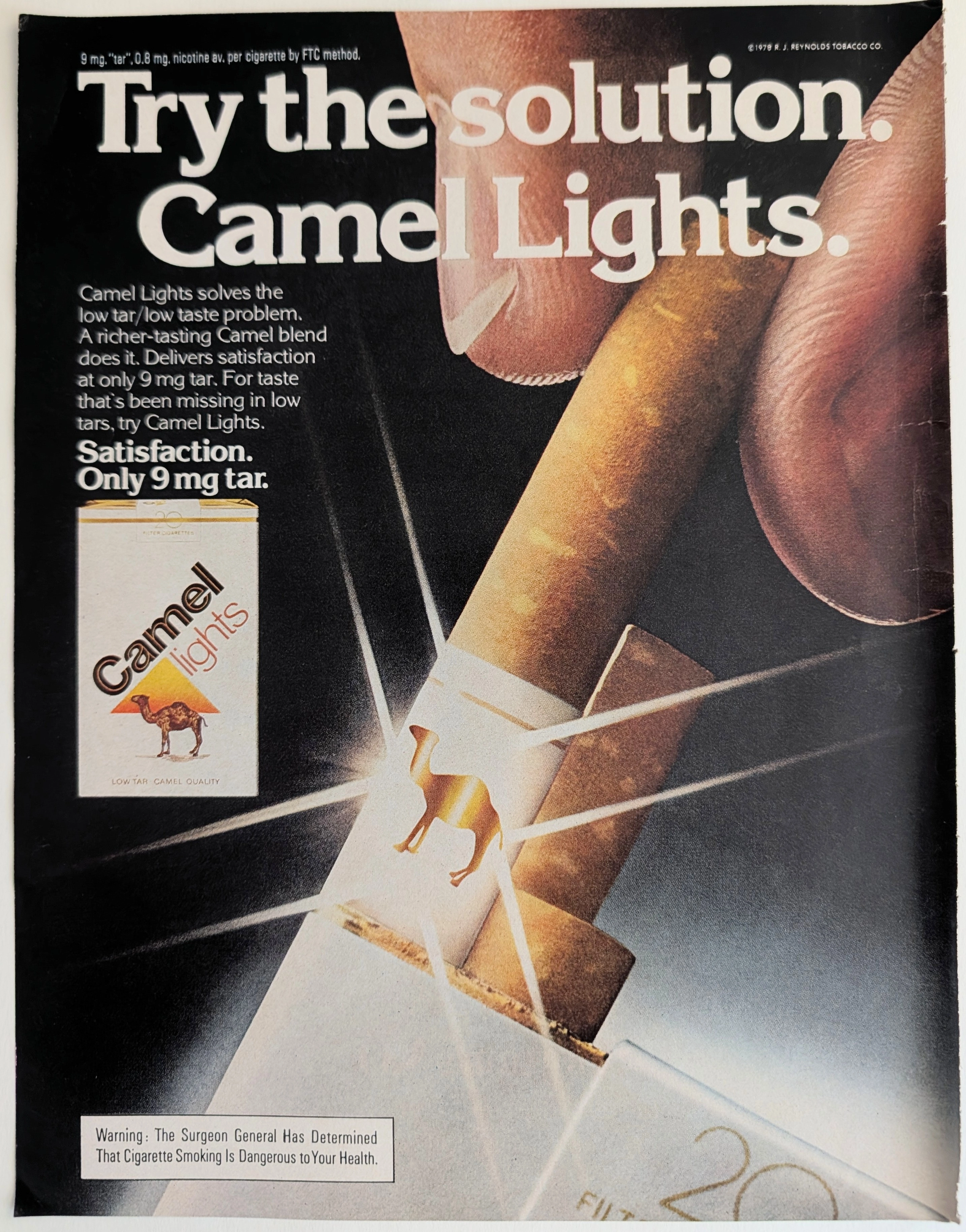
This archival dossier provides a comprehensive examination of the 1978 Camel Lights vintage advertisement, a defining artifact from an era when the global tobacco industry fiercely pivoted toward "low tar" alternatives in response to escalating public health mandates. As medical consensus shifted consumer habits in the late twentieth century, R.J. Reynolds introduced Camel Lights as "the solution" to the purported low tar and low taste dilemma. This document stands as a masterful exemplar of classic print ads, leveraging high-contrast macro photography and rugged, masculine aesthetics to retain fierce brand loyalty while navigating an increasingly regulated landscape. For archivists, cultural historians, and collectors of vintage ads and old advertisements, this artifact offers profound insight into the psychological marketing tactics of the 1970s. The visual centerpiece—a glowing golden camel illuminated by a struck match—demonstrates exceptional commercial print execution and art direction, cementing its status as a vital cultural document within the broader taxonomy of commercial advertising history.
The Time Traveller's Dossier: The Sub-Zero Socialite – The Whirlpool Automatic Icemaker Exhibition by Mort Drucker

Whirlpool · Technology

The Time Traveller's Dossier: The Sub-Zero Socialite – The Whirlpool Automatic Icemaker Exhibition by Mort Drucker

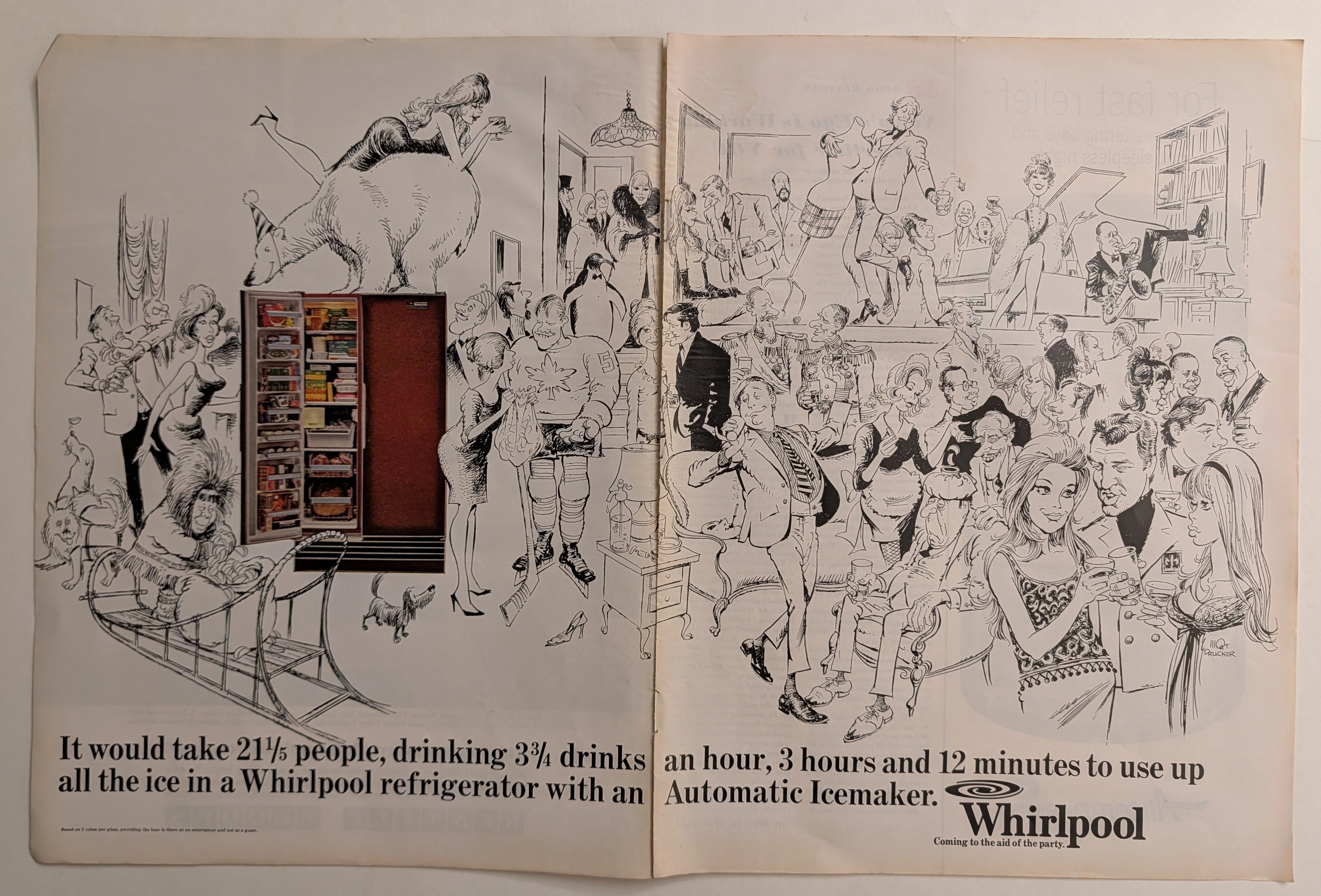
The evolution of the domestic appliance from a purely utilitarian instrument of labor into a central pillar of social entertainment and psychological comfort is one of the most fascinating sociological phenomena of mid-twentieth-century America. The historical artifact elegantly and securely positioned upon the analytical table of The Record Institute today is a majestic, large-format, two-page print advertisement for the Whirlpool Refrigerator with an Automatic Icemaker, originating from the cultural zenith of the 1960s. This document completely transcends the traditional boundaries of household goods marketing. It operates as a profound, sophisticated declaration of how technological innovation liberated the American middle class, transforming the private kitchen into a nexus of boundless hospitality, leisure, and social status. This world-class, comprehensive dossier will conduct a meticulous, unyielding, and deep examination of the artifact, operating under the absolute most rigorous parameters of historical, sociological, and material science evaluation. We will decode the brilliant, chaotic, and highly kinetic party scene birthed from the pen of legendary illustrator Mort Drucker, and analyze the dramatic visual juxtaposition of this monochromatic chaos against the highly structured, full-color reality of the Whirlpool refrigerator. Furthermore, as we venture into the chemical and physical foundations of this analog printed ephemera, we will reveal the mechanical fingerprints of the CMYK halftone rosettes and the graceful, natural oxidation of the paper substrate. This precise intersection of visual nostalgia, pop-art mastery, and the chemistry of time cultivates a serene wabi-sabi aesthetic—a natural, irreversible phenomenon that serves as the primary engine driving up its market value exponentially within the elite global spheres of Vintage Appliance Ephemera and Commercial Art collecting.
The Time Traveller's Dossier : Willys Jeep - The Engine of Global Conflict

The Time Traveller's Dossier : Willys Jeep - The Engine of Global Conflict

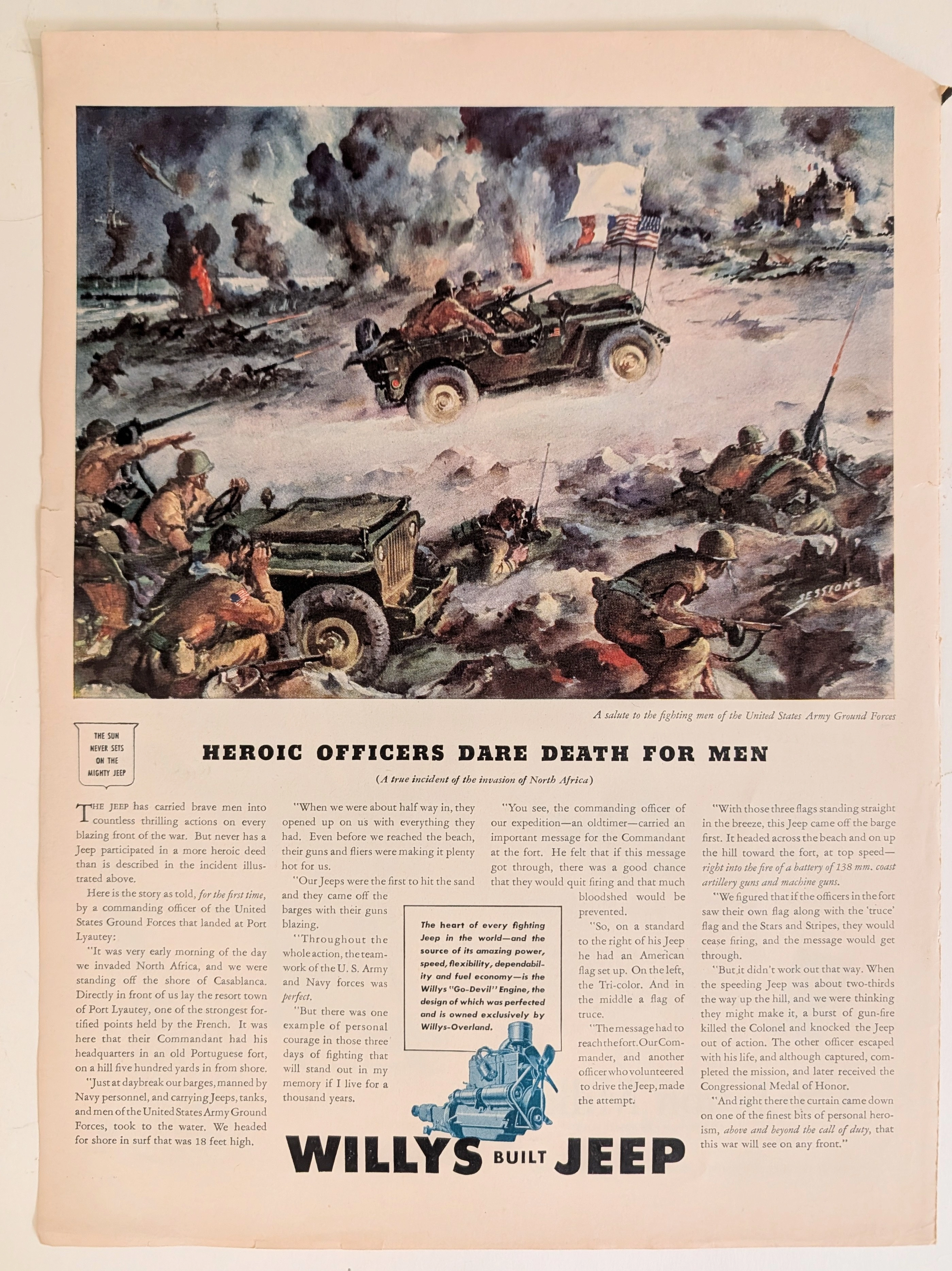
We measure history by the borders we draw. But borders are defined by our capacity to traverse them. Before 1940, mobility was dictated by infrastructure. Armies required roads. Supply lines required railways. The terrain was the ultimate arbiter of military strategy. Then came the quarter-ton utility vehicle. A paradigm shift wrought in steel and canvas. This artifact is not merely an advertisement. It is a documented claim of ownership over a geopolitical pivot point. It is Willys-Overland declaring that their machinery was the vector of liberation. The problem was a world swallowed by tyranny and impassable geography. The solution was a four-cylinder engine wrapped in an olive-drab box.
Published by

The Record Institute

Taxonomy Match

Related Articles

THE TIME TRAVELER'S DOSSIER: THE ARCHITECT OF CAPITALISM AND THE AESTHETICS OF RUIN — related article
Read Article

THE TIME TRAVELER'S DOSSIER: THE ARCHITECT OF CAPITALISM AND THE AESTHETICS OF RUIN

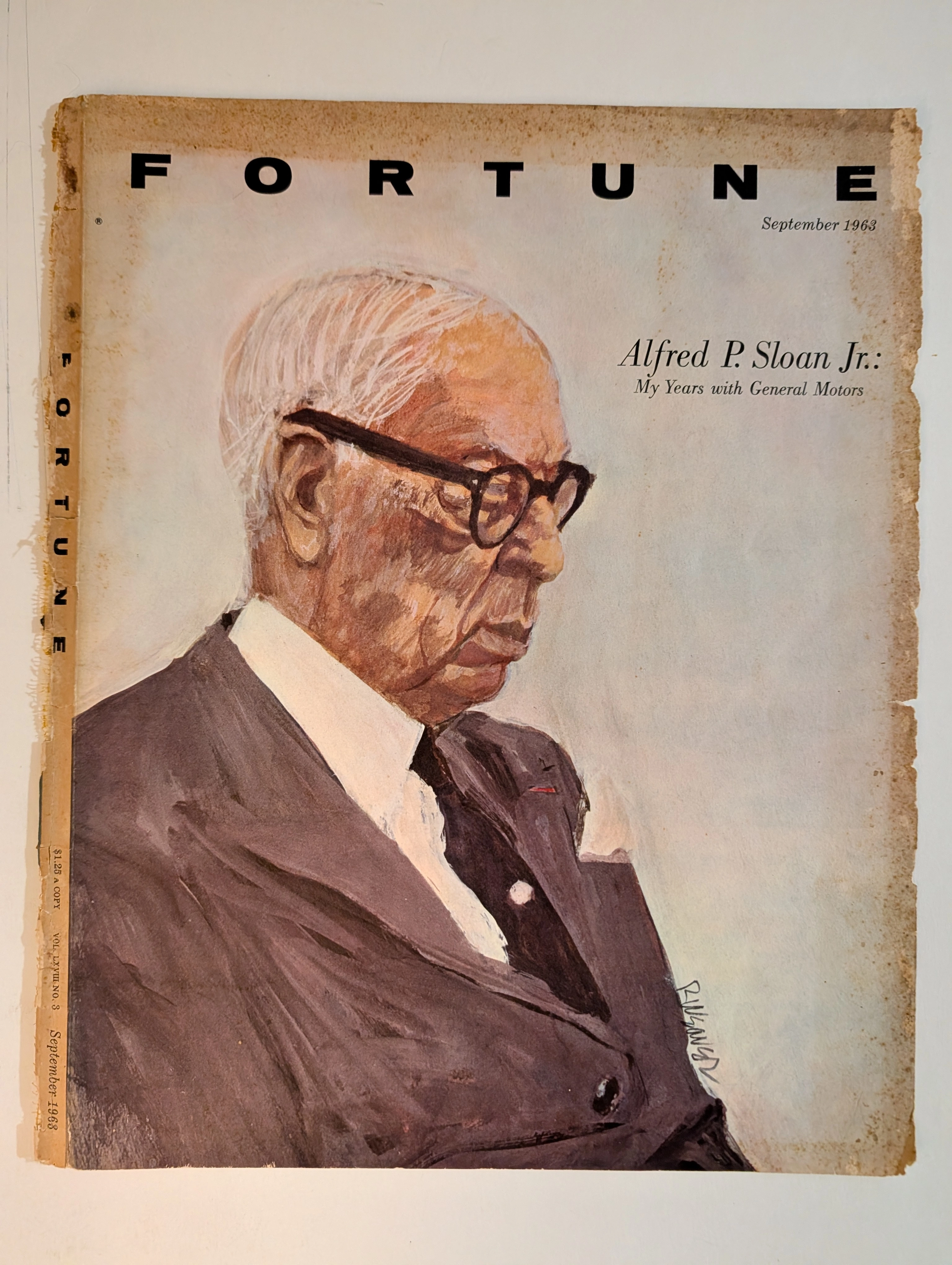
The artifact under rigorous, museum-grade analysis is a profoundly significant Historical Relic originating from the absolute zenith of American corporate ascendancy. This Primary Art Document is the front cover of FORTUNE magazine, explicitly dated September 1963. It features a majestic, expressive painted portrait of Alfred P. Sloan Jr., the legendary architect of the General Motors empire. ​Masterfully rendered by the acclaimed American illustrator Robert Weaver, whose signature is prominently visible, this artifact visually anchors the magazine's serialization of Sloan's definitive business memoir, My Years with General Motors. This text remains a foundational scripture of modern corporate management and decentralized organizational structure. ​Rescued from the ravages of time and preserved as a standalone Archival Artifact, the premium, heavy-stock analog paper of Fortune is undergoing a breathtaking process of chemical degradation. It exhibits severe edge fraying, jagged paper loss, and deep biological oxidation along its borders. This glorious decay transforms a mass-produced business periodical into an irreplaceable, ready-to-frame Primary Art Document—a testament to the fragile mortality of even the greatest capitalist empires.

THE TIME TRAVELER'S DOSSIER: ARROGANCE AND INNOVATION IN THE ABYSS OF THE DEPRESSION — related article
Read Article

THE TIME TRAVELER'S DOSSIER: ARROGANCE AND INNOVATION IN THE ABYSS OF THE DEPRESSION

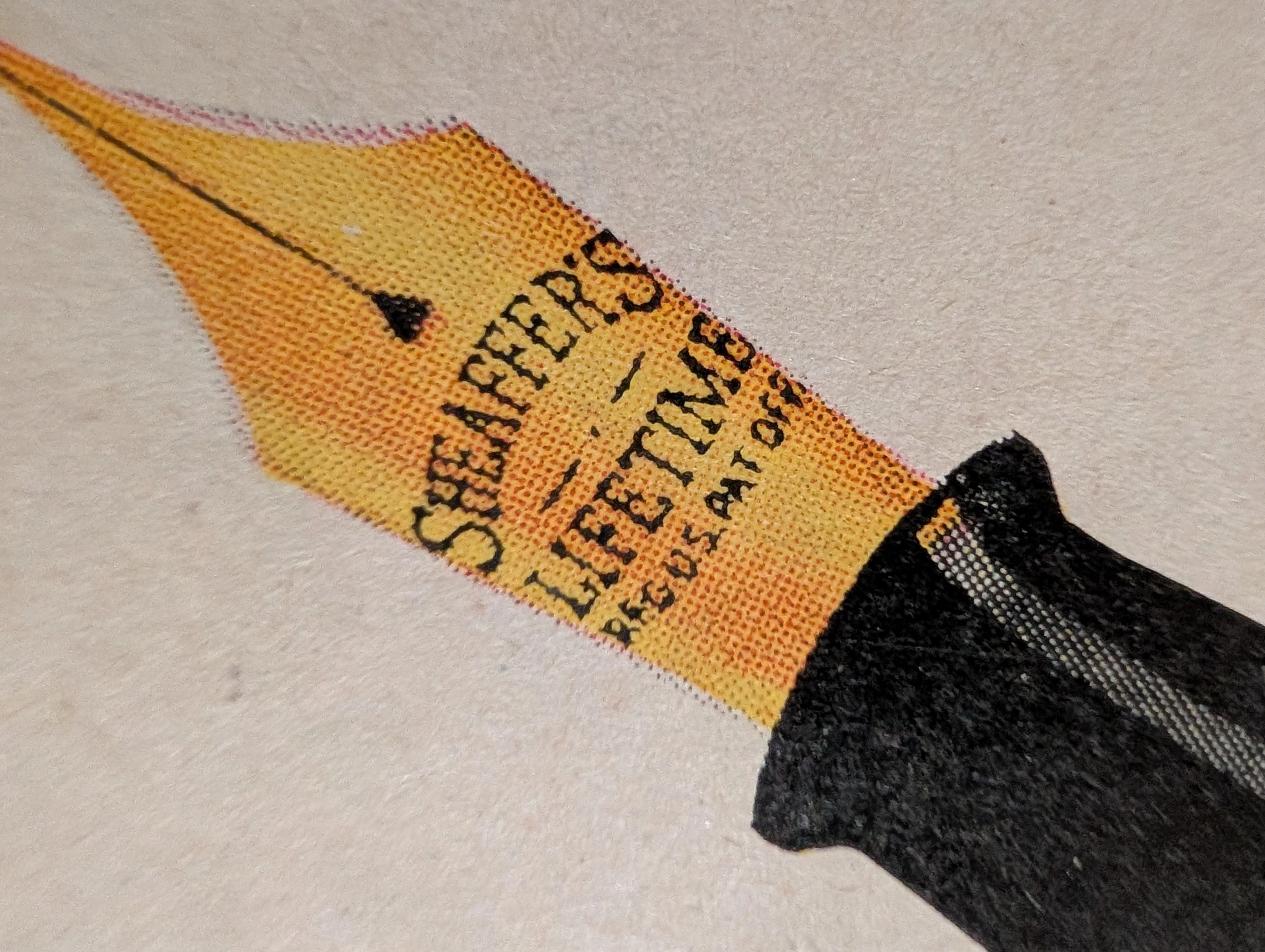
The artifact under rigorous, museum-grade analysis is an exceptionally preserved Historical Relic originating from the darkest economic abyss of the 20th century: the American Great Depression. Sourced from a 1931 issue of The Saturday Evening Post, this Primary Art Document features a sweeping, full-page advertisement for the Sheaffer's "Balance" Lifetime Pen. This piece is a profound sociological and industrial marker. In 1931, as the global economy collapsed, W.A. Sheaffer defiantly marketed a revolutionary, streamlined luxury writing instrument priced at an astronomical $15. The ad explicitly highlights the "White Dot" lifetime guarantee and the 14-karat solid gold "Autograph" band engraved with the owner's signature ("John Adams"). It is a masterclass in aspirational marketing during an era of mass destitution. Physically, this nearly century-old wood-pulp document is a breathtaking testament to the Japanese aesthetic of wabi-sabi. It exhibits severe, dramatic edge trauma, profound edge loss, deep amber oxidation, and prominent moisture staining along the left margin. This extreme analog decay transforms the mass-produced commercial print into an irreplaceable, highly coveted Primary Art Document that physically embodies the scars of its 90-year journey through history.

THE TIME TRAVELER'S DOSSIER: THE FLAVOR OF AUTHENTICITY AND THE PROPHET OF CAPITALISM — related article
Read Article

THE TIME TRAVELER'S DOSSIER: THE FLAVOR OF AUTHENTICITY AND THE PROPHET OF CAPITALISM

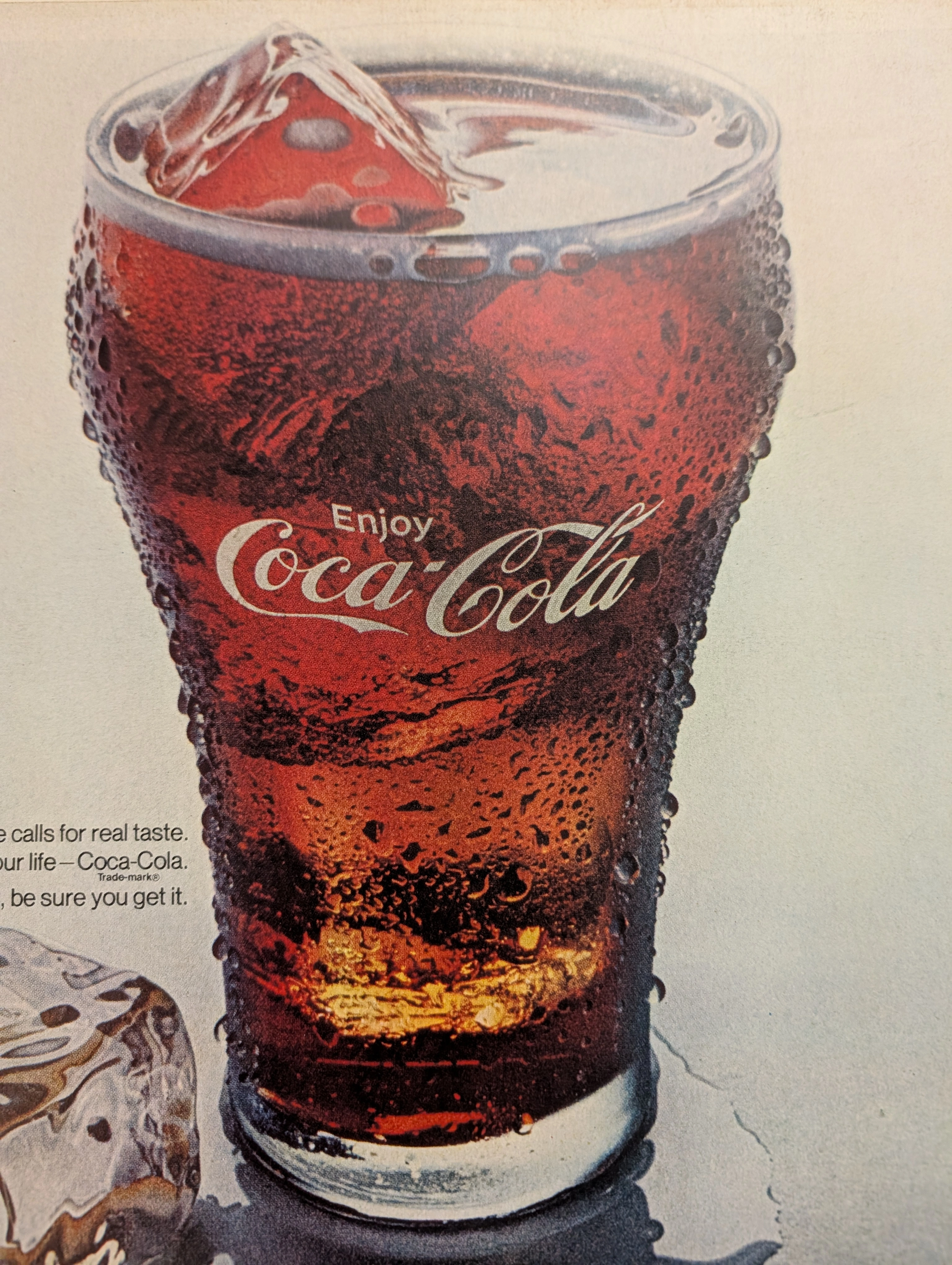
The artifact under uncompromising, museum-grade analysis is a flawlessly preserved Historical Relic originating from the cultural epicenter of 1970. This Primary Art Document is a monumental, full-page advertisement for Coca-Cola, officially copyrighted in 1970. It serves as the definitive visual anchor for one of the most legendary and heavily studied marketing campaigns in human history: "It's the real thing." ​This is not a mere beverage promotion; it is a profound sociological masterstroke. Emerging at the dawn of the 1970s—an era defined by counter-culture, political disillusionment, and a search for genuine meaning—Coca-Cola aggressively positioned its product as the ultimate, unassailable anchor of authenticity. The commanding copywriting, "Real life calls for real taste... When you ask for it, be sure you get it", is a psychological directive urging consumers to reject artificiality. Visually, the artifact is a triumph of mid-century hyper-realism. The towering glass, weeping with visceral, tactile condensation, and the monolithic block typography elevate a 15-cent soda to the status of an absolute cultural leviathan. ​Rescued from the inevitable oblivion of disposable mass media and preserved as a standalone Archival Artifact, the inherently acidic analog paper is undergoing a majestic chemical degradation. It exhibits a beautiful, warm patina, with natural biological oxidation softening the iconic red "Enjoy Coca-Cola" emblem. This unstoppable molecular death transforms a piece of mass-produced corporate propaganda into an irreplaceable, ready-to-frame Primary Art Document of American pop-art history.

THE TIME TRAVELER'S DOSSIER: THE STRATOSPHERIC MANSION AND THE AESTHETICS OF DECAY — related article
Read Article

THE TIME TRAVELER'S DOSSIER: THE STRATOSPHERIC MANSION AND THE AESTHETICS OF DECAY

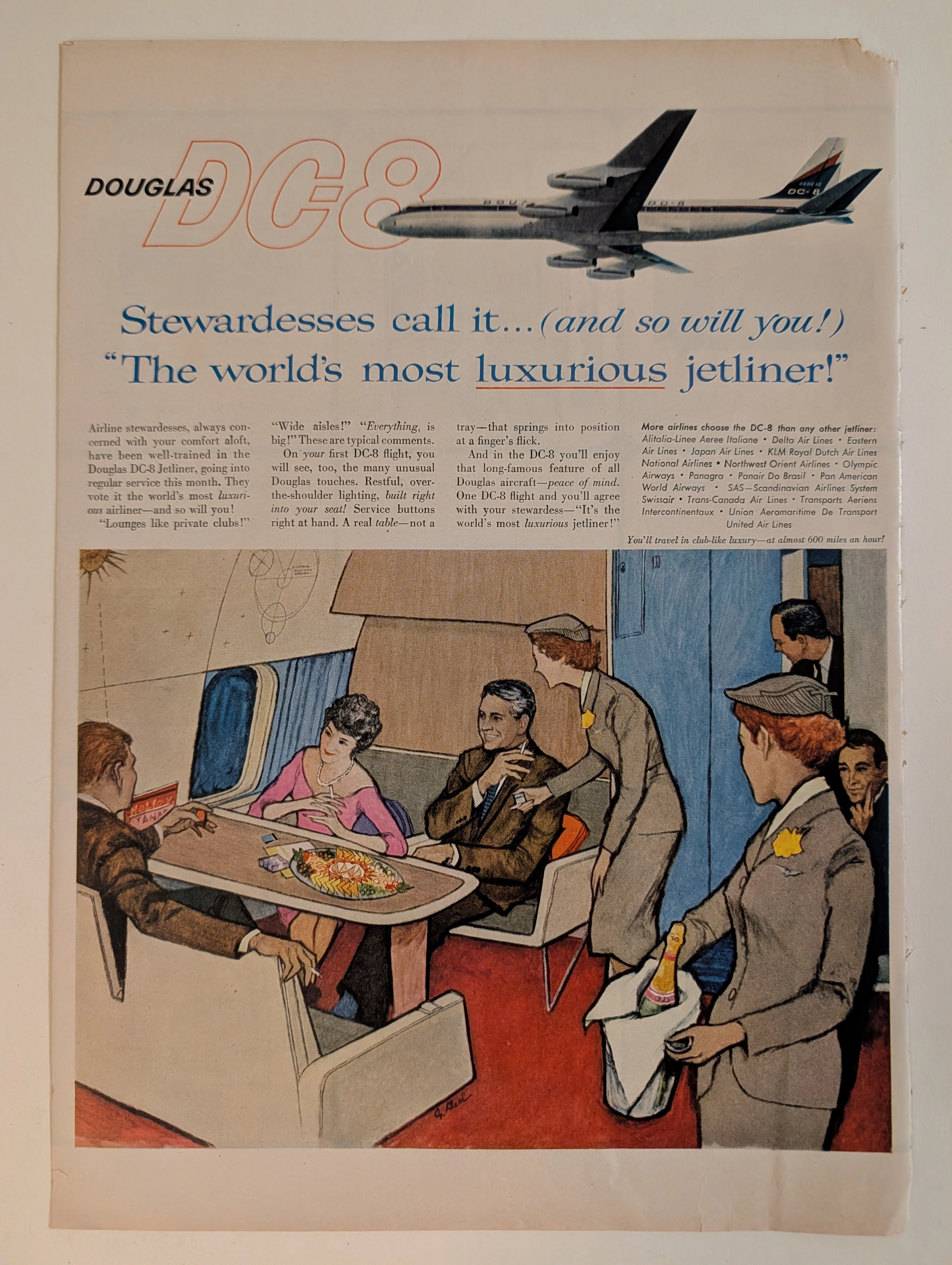
The artifact under exhaustive, museum-grade analysis is a flawlessly preserved Historical Relic originating from the absolute dawn of the commercial Jet Age (circa late 1950s to early 1960s). This Primary Art Document is a magnificent full-page advertisement for the Douglas DC-8, the aerospace leviathan engineered to rival the Boeing 707 and conquer the global skies. ​Visually anchored by an elegant, sweeping illustration of the aircraft's exterior and a highly detailed, evocative rendering of its opulent passenger lounge, the piece represents the zenith of mid-century aspirational marketing. Signed by an elusive mid-century commercial artist, the illustration captures the "Palomar Lounge"—a private club in the stratosphere where the elite played cards, smoked, and drank champagne beneath a Space-Age celestial diagram. By utilizing the ultimate authority of the era—the airline stewardess—to validate its luxury ("Stewardesses call it... The world's most luxurious jetliner!"), Douglas masterfully sold the illusion of exclusive, aristocratic segregation at 600 miles per hour. ​Rescued from the binding of a forgotten periodical, this pre-2000s analog artifact is an unforgeable testament to the aesthetic of wabi-sabi. Printed on inherently acidic wood-pulp paper, it exhibits a beautifully frayed right margin and a deep, warm ivory oxidation. This majestic chemical degradation transforms a mass-produced corporate propaganda piece into an irreplaceable, ready-to-frame Primary Art Document of aerospace history.

THE TIME TRAVELER'S DOSSIER: THE GOLDEN LIE AND THE PROPAGANDA OF 1936 — related article
Read Article

THE TIME TRAVELER'S DOSSIER: THE GOLDEN LIE AND THE PROPAGANDA OF 1936

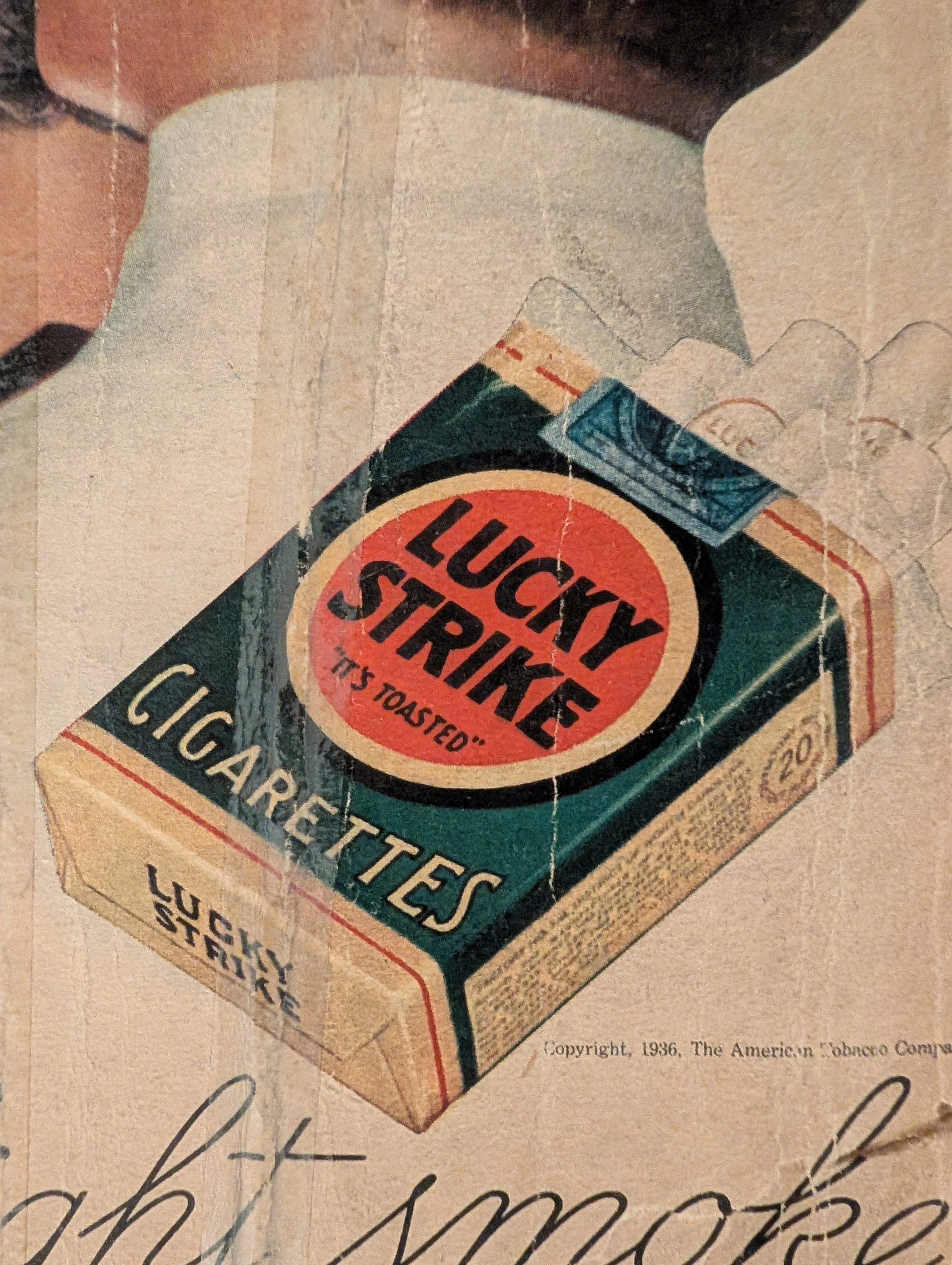
The artifact under exhaustive, uncompromising, and unprecedented museum-grade analysis is an exceptionally rare, battle-scarred Historical Relic originating from the absolute zenith of the American tobacco empire. This Primary Art Document is a monumental, full-page advertisement for Lucky Strike Cigarettes, forensically and definitively dated to 1936 by the explicit copyright text: "Copyright, 1936, The American Tobacco Company". This is not merely a vintage tobacco ad; it is a profound "Sociological Blueprint of Corporate Propaganda" from the interwar period. Emerging in the heart of the Great Depression, this artifact captures the audacious peak of 1930s psychological marketing. The commanding headline, "Smoke to Your Throat's Content", represents the era's surreal, medically ironic strategy where tobacco conglomerates aggressively marketed deadly carcinogens as "smooth" and "non-irritating" to the throat. Furthermore, the legendary slogan "It's Toasted" serves as a masterclass in advertising spin, transforming a standard manufacturing process into an exclusive health benefit. Visually, the ad brilliantly normalizes and glamorizes female smoking—a direct continuation of the industry's sociological engineering to double their consumer base. Rescued from the inevitable oblivion of disposable mass media, this pre-2000s analog artifact is a breathtaking embodiment of the Japanese aesthetic of wabi-sabi. Printed on highly acidic wood-pulp paper, it exhibits severe, violent edge trauma, deep structural creasing, ancient tape residue, and a profound, burning amber oxidation across its entire surface. This unstoppable molecular death transforms a piece of mass-produced corporate propaganda into an irreplaceable, ready-to-frame Primary Art Document of American marketing history.

THE TIME TRAVELER'S DOSSIER: BLOOD CAPITALISM AND THE WEAPONIZATION OF WHISKEY — related article
Read Article

THE TIME TRAVELER'S DOSSIER: BLOOD CAPITALISM AND THE WEAPONIZATION OF WHISKEY

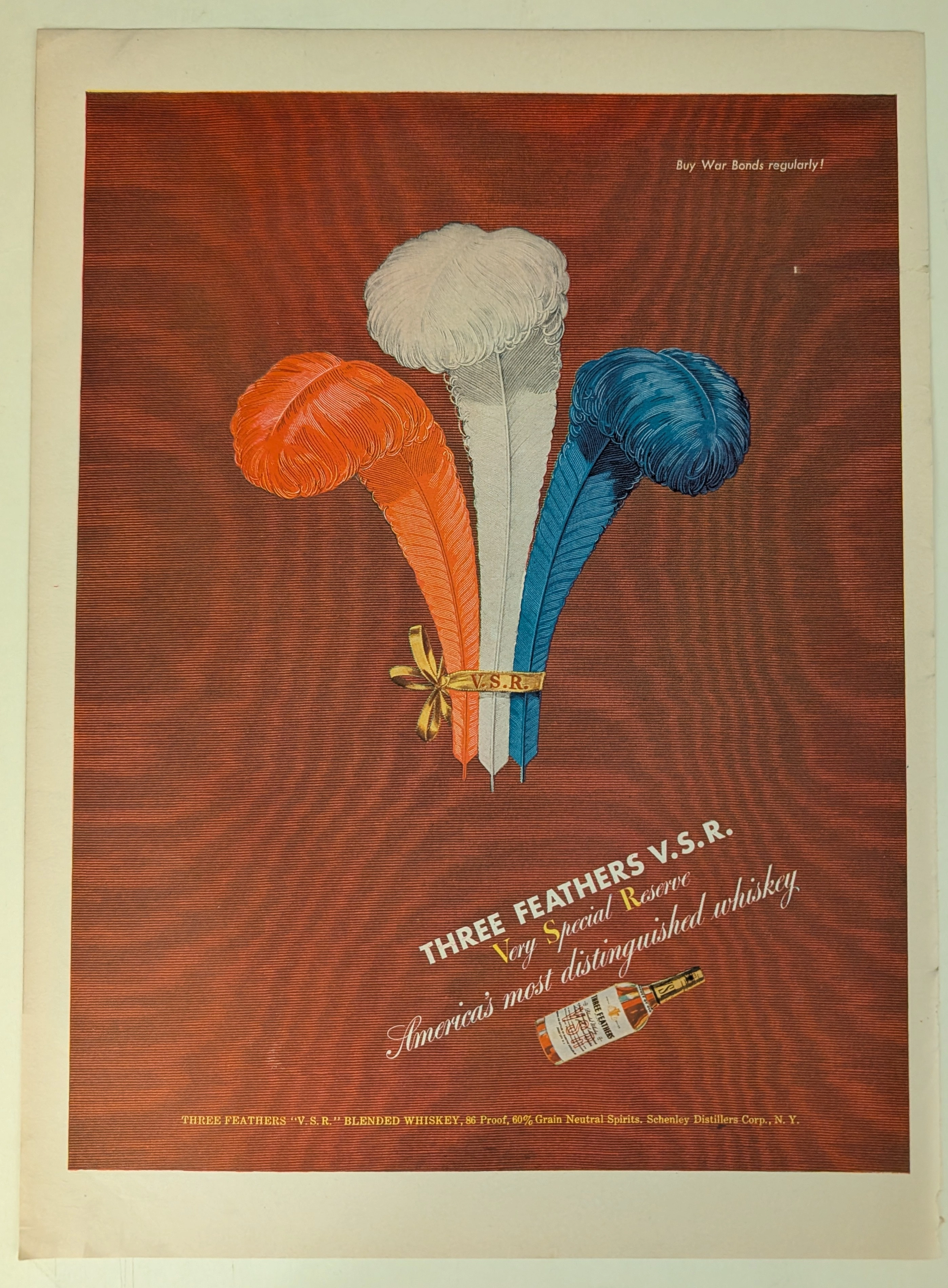
This impeccably preserved Historical Relic is a Primary Art Document from the brutal crucible of World War II, featuring a sweeping advertisement for THREE FEATHERS V.S.R. Blended Whiskey. It chronicles the ultimate mid-century psychological strategy of "Patriotic Capitalism." The artifact is forensically and definitively dated to the WWII era by the explicit, government-aligned directive in the upper right corner: "Buy War Bonds regularly!". Visually, the brand masterfully hijacked American nationalism by rendering its iconic three feathers in a vibrant Red, White, and Blue patriotic color scheme. Surviving the aggressive scrap paper drives of the 1940s, the acidic analog paper exhibits a profound integration of the deep crimson ink into its degrading fibers, perfectly encapsulating the analog aesthetic of wabi-sabi. This slow chemical death elevates this rescued wartime artifact to an irreplaceable Primary Art Document of Rarity Class A.